Gift, donation, or debt repayment: which phrases in card-to-card transfers can cause problems


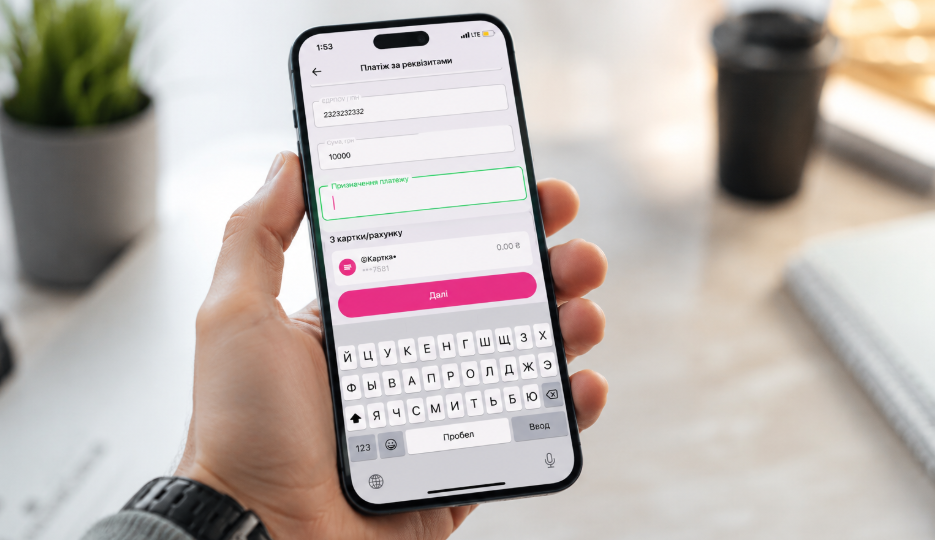










Card transfers have long become part of daily life: Ukrainians send money to relatives, repay part of shared expenses, help parents, children, or friends. At the same time, even a simple transfer can raise questions from the bank or tax authorities if its purpose looks like payment for goods, services, or regular income. The main rule is to write truthfully, specifically, and in such a way that the wording makes it clear: this is a household, family, or personal transaction, not hidden entrepreneurial activity.
Why the payment purpose is important
Banks analyze card transactions not only by the words in the payment purpose. The amount, frequency of transfers, client behavior, source of funds, regularity of receipts, and other signs also matter.
However, the text in the "payment purpose" field can also be one of the factors for inspection, experts note. If an individual regularly receives transfers with wording like "for goods," "for services," "for consultation," or "salary," the bank may interpret this as a sign of entrepreneurial activity without proper registration.
Therefore, the payment purpose must correspond to the actual content of the transaction. It is not worth inventing wording just to "bypass" the check: in case of a request from the bank or tax service, you will have to explain the origin of the funds and provide documents.
How to write the payment purpose for transfers to relatives
Transfers between close relatives usually have a household or family nature. To avoid unnecessary questions, it is worth indicating who exactly is transferring the funds and for what purpose in the payment purpose.
Examples:
- "Help from father for education"
- "Financial support from husband"
- "Help to daughter for rent"
- "Money to parents for utility payments"
- "Help to grandmother for medicine"
- "Financial support to son for education"
Such wording shows that the transfer is not payment for goods or services.
Compensation of shared expenses: what is better to specify
Ukrainians often split expenses for dinner, fuel, tickets, trips, groceries, or utilities. In such cases, it is better not to write just "compensation" but to specify exactly what the money is being returned for.
Examples:
- "Compensation of expenses for shared dinner"
- "Refund for movie tickets"
- "Share for food order 04.06.2026"
- "Fuel compensation for joint trip to Lviv"
- "Reimbursement of grocery expenses for the week"
- "Share in kindergarten payment for June"
It is advisable to keep receipts, electronic invoices, or screenshots of orders if it concerns larger amounts.
Debt repayment: when questions may arise
The phrase "debt repayment" itself is not prohibited. But if there are many such payments, the bank may ask why funds regularly come to the account as loan repayments.
It is safer to detail the payment and have confirmation: a receipt, loan agreement, or other document.
Examples:
- "Loan repayment by receipt dated 01.05.2026"
- "Partial loan repayment by agreement"
- "Return of lent funds"
At the same time, it is not worth abusing identical wording. A large number of regular "debt repayments" may look like unregistered lending activity to financial monitoring.
Sale of personal items: how to describe the payment
If a person sells their own used item, it is worth clearly stating that this is personal property, not goods within a business.
Examples:
- "Refund for used iPhone 12, personal use"
- "Settlement for personal Samsung TV"
- "Refund for used laptop"
- "Settlement for personal Toyota Camry 2018"
- "Compensation for personal wardrobe items"
Wording like "used," "personal," "for own use" helps distinguish a one-time sale from regular trading.
Transfers for services to individuals: main risk
The most questions may arise from payments to individuals with the purpose:
- "for services"
- "for consultation"
- "for repair"
- "for goods"
- "for order"
Such wording indicates income receipt. If a person systematically sells goods or provides services, such activity must be properly registered, including through a sole proprietor (FOP) or other legal form.
If it is a one-time household help, it is worth writing specifically:
- "Fuel compensation for transportation"
- "Compensation for help with moving"
- "Reimbursement of transport expenses"
Transfers between own accounts
Transfers between own cards or accounts are not income. But for clarity, it is better to indicate that funds are transferred between accounts of the same person.
Examples:
- "Transfer of own funds between personal accounts"
- "Replenishment of own card"
- "Consolidation of personal funds"
- "Transfer between own cards"
If an FOP transfers funds from a business account to a personal one, the wording must correspond to accounting and reporting.
Rent and utility payments
For payments for housing, utilities, internet, or electricity, it is better to indicate the period and the nature of the payment.
Examples:
- "Rent payment for June 2026"
- "Utility payment for May"
- "Internet payment for June"
- "Electricity expense compensation"
If the landlord is an FOP, it is important that the payment purpose corresponds to the contract and type of activity. Poor wording like "compensation for utilities" can create tax risks if the payment is not actually reflected as FOP income.
Gift, donation, charity: why it’s not so simple
The phrase "gift" does not always automatically mean no taxes. For money transfers, it is important who exactly gives the funds and to whom.
If the money comes from close relatives, that is one situation. But if a "gift" or "donation" comes from third parties, especially regularly, the tax authorities may consider it income.
It is also worth being cautious with wording:
- "donation"
- "charity"
- "non-repayable assistance"
Such payments are not always exempt from taxation. They can be safe only if there is a proper status or grounds: for example, for a charitable organization, registered volunteer, or a person who has legal grounds to receive such assistance tax-free.
Why it’s better not to mention cryptocurrency
Transfers with a purpose mentioning cryptocurrency, exchange, purchase, or sale of virtual assets may attract increased attention from the bank. Such operations often require additional explanation of the origin of funds.
If the bank cannot establish the economic meaning of the operation, the account or payment may be temporarily suspended for verification.
"Advance," "prepayment," and "deposit": what’s the difference
In everyday life, these words are often used as synonyms. But legally, they have different meanings.
An advance or prepayment is usually refundable if the deal does not take place. A deposit has a different legal nature: in certain cases, it may not be returned to the party that refused the contract.
Therefore, before writing "deposit," it is worth making sure that this corresponds to the parties' agreement.
Which phrases are better to avoid
Individuals without entrepreneurial status should avoid payment purposes like:
- "payment for goods"
- "payment for services"
- "for consultation"
- "salary"
- "for repair"
- "for order"
- "commercial payment"
Such words may indicate income receipt. If the payment is indeed for goods or services, it must be conducted according to tax rules.
It is also not advisable to leave the payment purpose empty if the system allows filling it. An empty field is not always a problem but leaves more room for different interpretations of the operation.
What to do if the payment purpose was indicated incorrectly
If an unsuccessful or inaccurate phrase was mistakenly indicated in the payment purpose, it is worth:
- contacting the bank and clarifying if the purpose can be corrected;
- keeping documents that confirm the real content of the transfer;
- preparing explanations about the origin of funds if necessary;
- if the payment was received by mistake — returning it with the appropriate purpose.
Main rule for card-to-card transfers
There is no single "blacklist" of words for all banks. Financial institutions evaluate not only the payment text but the entire operation: amount, frequency, account history, client behavior, and the consistency of transfers with the client's financial profile.
To reduce risks, the payment purpose must be:
- truthful;
- specific;
- without ambiguous wording;
- without signs of hidden commercial activity;
- supported by documents if it concerns a significant amount.
The safest approach is to write not a "pretty" payment purpose, but one that accurately explains the real content of the transfer.
Subscribe to our Telegram channel t.me/sudua and to Google News SUD.UA, as well as to our VIBER and WhatsApp pages, and on Facebook and Instagram to stay updated on the most important events.