Ukrainians can even face criminal liability for forwarding messages in messengers


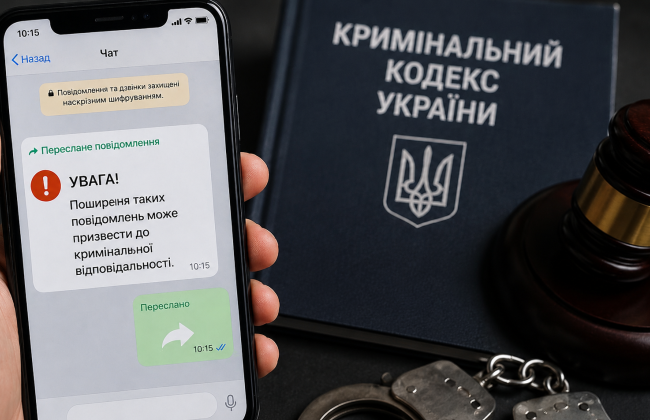










Every day, millions of users exchange personal messages through messengers and social networks. At the same time, situations often arise when one of the participants in the correspondence forwards the received message to a third party, publishes a screenshot of the conversation, or uses the content of the messages in conflicts, court disputes, or public discussions.
Does a person have the right to dispose of the received message at their own discretion? Is private correspondence an object of legal protection? The answers to these questions follow from constitutional guarantees, civil law norms, and established judicial practice.
The secrecy of correspondence as a constitutional guarantee
The right to the secrecy of correspondence is enshrined in Article 31 of the Constitution of Ukraine, according to which everyone is guaranteed the secrecy of correspondence, telephone conversations, telegraph, and other correspondence. Restrictions on this right are allowed only in cases provided by law and only by court decision.
The modern understanding of correspondence includes not only traditional letters but also emails, messages in messengers, chats, and social networks.
It is also necessary to consider the provisions of Article 32 of the Constitution of Ukraine, which guarantees the right to privacy in personal and family life and prohibits the dissemination of confidential information about a person without their consent. Therefore, forwarding private correspondence can be considered not only as a matter of correspondence secrecy but also as an intrusion into private life.
What civil law says
Particular importance is attached to Article 306 of the Civil Code of Ukraine.
According to it, letters, telegrams, phone messages, and other types of correspondence are the property of the addressee. However, this does not mean that the addressee can unconditionally disseminate their content.
Part three of Article 306 of the Civil Code of Ukraine provides that correspondence may be published only with the consent of the person who sent it and the addressee. If the correspondence concerns the personal life of another person, the consent of that person is also required.
At the same time, correspondence concerning an individual may be attached to a court case only if it contains evidence relevant to the resolution of the case. The information contained in such correspondence is not subject to disclosure.
Thus, the law distinguishes the right of ownership of the material carrier or received information and the right to the inviolability of private communication.
Additionally, Articles 301 and 302 of the Civil Code of Ukraine guarantee a person's right to privacy and control over the dissemination of information about themselves.
Additional guarantees for the protection of private information are contained in the Law of Ukraine "On Information." According to Articles 11 and 21 of this Law, the collection, storage, use, and dissemination of confidential information about an individual without their consent are not allowed, except in cases provided by law.
Can criminal liability arise
In certain cases, the dissemination of someone else's correspondence may go beyond a civil dispute.
Article 163 of the Criminal Code of Ukraine provides for liability for violating the secrecy of correspondence, telephone conversations, telegraph, or other correspondence transmitted by communication means or via computer.
At the same time, for qualification under this article, the mere fact of forwarding a message is usually insufficient. Law enforcement agencies and courts usually assess the method of obtaining information, the presence of illegal access to it, the intent of the person, and other circumstances. Therefore, not every forwarding of a message automatically constitutes a criminal offense.
The Supreme Court's approach
The Supreme Court in its practice proceeds from the fact that correspondence is protected by the right to the secrecy of correspondence, and its use in court proceedings is allowed only in cases provided by law.
In case No. 752/9895/20, the Supreme Court considered a dispute regarding the transfer of correspondence and other information received during familiarization with the materials of a criminal proceeding to third parties.
The plaintiff claimed that his electronic correspondence, messages in Skype, Viber, and WhatsApp, as well as other confidential data, were transferred abroad without his consent.
The Supreme Court confirmed that the right to the secrecy of correspondence and the protection of confidential information are protected by Articles 31 and 32 of the Constitution of Ukraine, Article 306 of the Civil Code of Ukraine, and the Law of Ukraine "On Information." At the same time, the Court upheld the appellate court's decision to dismiss the claim, as it established that the disputed information was transferred based on the investigator's permission for use in court proceedings in Ukraine and abroad, and the plaintiff did not prove illegal dissemination of confidential information or its distribution outside such proceedings.
Thus, the Supreme Court effectively confirmed that the transfer of correspondence to third parties can be assessed through the prism of the right to the secrecy of correspondence, but the legal assessment depends on the grounds for obtaining the information, the purpose of its use, and the presence of exceptions provided by law.
A separate direction of judicial practice concerns the use of correspondence as evidence in court.
As noted by the "Judicial and Legal Newspaper", the Supreme Court allows the use of electronic correspondence and messages in messengers as evidence provided they are relevant and admissible. At the same time, submitting correspondence to the court does not automatically grant the right to further disseminate or disclose it to third parties.
ECtHR practice
The European Court of Human Rights consistently considers correspondence as part of the right to respect for private and family life and correspondence guaranteed by Article 8 of the Convention for the Protection of Human Rights and Fundamental Freedoms.
In the case of Copland v. United Kingdom, the Court confirmed that telephone calls, emails, and other forms of communication are covered by the concept of "correspondence" within the meaning of Article 8 of the Convention.
In the case of Barbulescu v. Romania, the ECtHR emphasized that even in the workplace, a person retains a certain level of expectation of privacy regarding their messages.
The Court's approach boils down to the fact that any interference with the privacy of communication must be lawful, proportionate, and justified by a legitimate aim.
Problematic aspects of law enforcement
The most practical questions arise in cases when:
- one of the participants in the correspondence voluntarily transfers messages to third parties;
- screenshots of correspondence are published on social networks;
- correspondence is used to defend one's rights in court;
- messages contain socially important information or relate to exposing unlawful behavior.
In such situations, courts are forced to seek a balance between the right to privacy and freedom of expression guaranteed by Article 10 of the Convention.
Thus, the mere fact of receiving a message does not give a person unlimited rights to dispose of its content. The Constitution of Ukraine, the Civil Code of Ukraine, and ECtHR practice protect the privacy of correspondence as part of a person's private life.
At the same time, each situation requires individual analysis, taking into account the purpose of disseminating information, the consent of the participants in the correspondence, and the balance between competing rights and interests.
Read also — disclosure of personal data will result in a fine of up to 34 thousand hryvnias.
Subscribe to our Telegram channel t.me/sudua and to Google News SUD.UA, as well as to our VIBER and WhatsApp pages on Facebook and Instagram to stay informed about the most important events.