The Grand Chamber explained why the state should be held responsible for the actions of the “Berkut” during Maidan












The issue of compensation for damage caused by illegal actions of state representatives is of particular importance for judicial practice. The correct identification of the proper defendant affects not only the effectiveness of protecting victims but also the actual enforcement of court decisions.
“Judicial and Legal Newspaper” previously reported on the decision of the Grand Chamber of the Supreme Court in case No. 754/1519/22, which resolved the issue of the proper subject liable for compensation for damage caused by an official of a state authority during the performance of official duties, as well as the possibility of the state’s participation as a civil defendant in a criminal proceeding. The full text of the ruling has now been published in the Unified State Register of Court Decisions, allowing a detailed analysis of the formulated legal conclusions.
Before this ruling, different approaches existed in practice regarding who should bear responsibility for damage caused by an official during the performance of official duties and whether joint recovery of funds from the state authority and the direct perpetrator of the crime is permissible.
Circumstances of the case
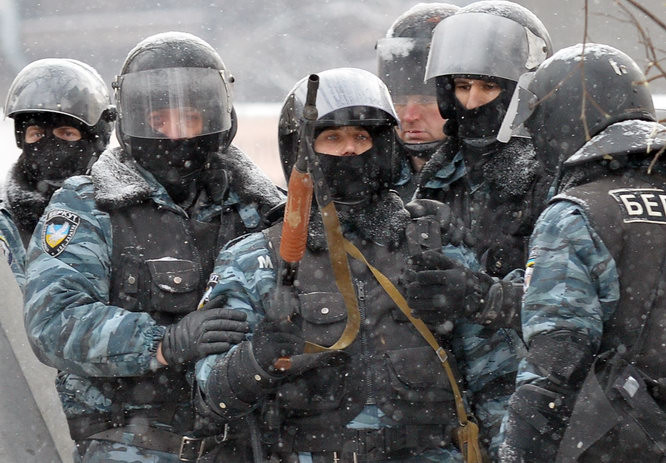
The courts established that on the night of December 10 to 11, 2013, the deputy commander of the special police regiment “Berkut” – the chief of staff at the Main Department of the Ministry of Internal Affairs of Ukraine in the Autonomous Republic of Crimea, while executing a clearly criminal order, gave subordinates instructions to forcibly push back and detain participants of a peaceful protest on Independence Square and Khreshchatyk Street in Kyiv.
In compliance with this order, employees of the Crimean “Berkut” unit used physical force and special means against protesters, striking them with hands, feet, and rubber batons. As a result, some protesters suffered bodily injuries of varying severity, others experienced physical pain, and several individuals were unlawfully detained.
Among the victims was a participant of Euromaidan who suffered physical pain due to law enforcement actions, was unlawfully detained, and endured moral suffering.
Furthermore, the courts found that after the occupation of Crimea, the former head of the Crimean “Berkut” voluntarily switched to the side of the Russian Federation, joined the law enforcement agencies established by the occupying authorities, and continued service in Russian security structures on the occupied peninsula.
The Desniansky District Court of Kyiv found him guilty of exceeding authority and official powers, unlawful obstruction of meetings, rallies, marches, and demonstrations during the events of the Revolution of Dignity on Independence Square in December 2013, as well as of state treason.
At the same time, the court satisfied the victim’s civil claim and awarded 200,000 UAH in moral damages jointly from the accused and the Ministry of Internal Affairs of Ukraine.
The Ministry of Internal Affairs of Ukraine appealed this decision regarding the civil claim, insisting that the proper defendant should be the state, not the Ministry of Internal Affairs, and that joint recovery is unlawful.
Position of the Grand Chamber of the Supreme Court
The Grand Chamber indicated that Articles 1173 and 1174 of the Civil Code of Ukraine establish a special liability regime for damage caused by state authorities and their officials.
The court noted that according to the provisions of part one of Article 1174 of the Civil Code of Ukraine, damage caused to a physical or legal person by illegal decisions, actions, or inaction of an official or employee of a state authority, the authority of the Autonomous Republic of Crimea, or a local self-government body in the exercise of their powers is compensated by the state, the Autonomous Republic of Crimea, or the local self-government body regardless of the fault of that person.
The Grand Chamber emphasized that the analysis of the content of Article 1174 of the Civil Code of Ukraine shows that the norm distinguishes the subject who directly caused the damage (official or employee) and the subject who has the obligation to compensate such damage (the state of Ukraine, the Autonomous Republic of Crimea, or the local self-government body).
The court stressed that the legal norm set out in Article 1174 of the Civil Code of Ukraine is a special norm to be applied in cases of damage caused to a physical or legal person by illegal decisions, actions, or inaction of an official or employee of a state authority, the authority of the Autonomous Republic of Crimea, or a local self-government body in the exercise of their powers and unconditionally imposes the obligation to compensate such damage on the state, the Autonomous Republic of Crimea, or the local self-government body regardless of the fault of such official or employee.
The Grand Chamber noted that within a claim proceeding for compensation for damage caused by illegal decisions, actions, or inaction of an official or employee of a state authority, the authority of the Autonomous Republic of Crimea, or a local self-government body, responsibility cannot also be imposed on the official or employee who directly caused the damage by their decisions, actions, or inaction in the exercise of their powers.
The court also drew attention to the absence of legal grounds for simultaneously imposing joint (solidary or partial) liability on public law entities defined in Article 1174 of the Civil Code of Ukraine as participants liable under the special tort rules, and on officials and employees who directly committed illegal actions, inaction, or made illegal decisions.
Separately, the Grand Chamber pointed out that a systematic analysis of the legal norms enshrined in part three of Article 127 of the Criminal Procedure Code of Ukraine and Article 1174 of the Civil Code of Ukraine, part five of Article 128 of the Criminal Procedure Code of Ukraine, and part two of Article 48 of the Civil Procedure Code of Ukraine, in their interrelation, indicates that in criminal proceedings, the state may act as a civil defendant in case of an obligation to compensate for damage caused by an official or employee of a state authority.
The court emphasized that the state, being the subject of liability in a tort obligation provided for by Article 1174 of the Civil Code of Ukraine arising from the commission by an official or employee of a state authority of a criminal offense in the exercise of their powers, upon the victim’s filing of a civil claim in criminal proceedings, acquires the procedural status of a civil defendant.
Summarizing the legal position, the court stated that simultaneously imposing joint (solidary or partial) liability both on the official or employee who directly committed the criminal offense and caused damage to the victim in the exercise of their powers and on the state as a civil defendant, which participates in criminal proceedings through the relevant state authority whose official caused the damage, contradicts the provisions of Articles 1174 and 1190 of the Civil Code of Ukraine.
Thus, the Grand Chamber of the Supreme Court partially satisfied the cassation appeal of the Ministry of Internal Affairs of Ukraine and amended the court decisions regarding the civil claim.
The court ordered to recover 200,000 UAH in moral damages from the state at the expense of the State Budget of Ukraine and dismissed the claim against the former deputy commander of the Crimean “Berkut.”
The court formulated an important legal conclusion that if an official commits a crime and causes harm to a person while performing their official duties, the state must compensate for this harm. At the same time, the victim may claim compensation directly within the criminal proceedings, and responsibility cannot be imposed simultaneously on both the state and the official.
Subscribe to our Telegram channel t.me/sudua and to Google News SUD.UA, as well as to our VIBER and WhatsApp pages on Facebook and Instagram to stay informed about the most important events.