The Territorial Recruitment and Social Support Center fined a man with schizophrenia 17,000 UAH for failure to register for military service after moving: what the court decided


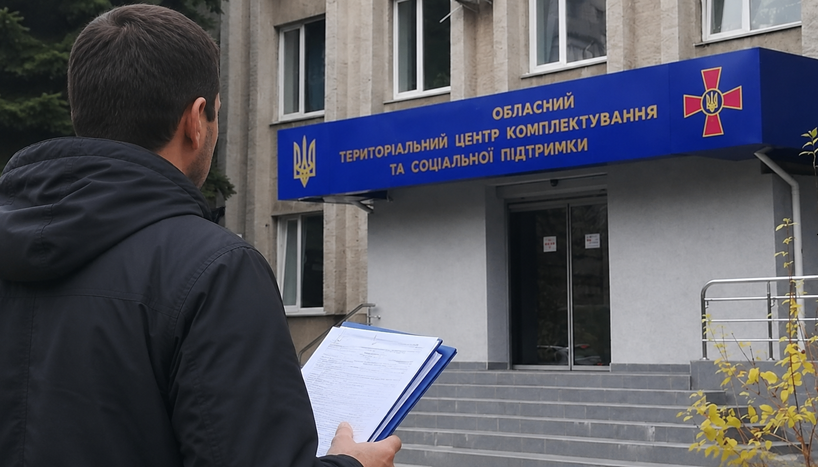










The Shevchenkivskyi District Court of Kharkiv considered an administrative case on a citizen's claim against the district Territorial Recruitment and Social Support Center regarding the recognition as unlawful and cancellation of the decision on bringing him to administrative responsibility under part 3 of article 210 of the Code of Ukraine on Administrative Offenses. The plaintiff appealed the decision that imposed a fine of 17,000 UAH on him for late arrival to the Territorial Recruitment and Social Support Center to register for military service after changing his place of residence as an internally displaced person.
Essence of the case
The plaintiff asked the court to recognize as unlawful and cancel decision No. 620 dated March 5, 2026, on bringing him to administrative responsibility, and to close the proceedings due to the absence of an administrative offense.
In support of the claim, it was stated that at the time the protocol was drawn up, he was not liable for military service, is a person with a group II disability due to a mental illness (schizophrenia), was removed from military registration in 2006 due to health reasons according to the Ministry of Defense of Ukraine order No. 342 dated June 9, 2006, and is an internally displaced person. The plaintiff explained that he was unaware of the requirement for persons removed from military registration to report to the Territorial Recruitment and Social Support Center after changing their place of residence. He also noted that his only source of income is a disability pension of 3,323 UAH, so paying a fine of 17,000 UAH is impossible for him.
The defendant opposed the claim. The representative of the Territorial Recruitment and Social Support Center stated that citizens removed from military registration under the Ministry of Defense order No. 342 are subject to referral to a military-medical commission to determine fitness for military service according to the current Ministry of Defense order No. 402 dated August 14, 2008. According to the defendant, the status of a person removed from military registration in peacetime is not equivalent to exclusion from military registration and does not exempt from military duty during a special period.
Furthermore, the defendant noted that according to the "Oberig" registry, the plaintiff had the status of liable for military service, was registered for military service, and after receiving a certificate of an internally displaced person, was obliged within seven days to report to the Territorial Recruitment and Social Support Center at the new place of residence for military registration. It was also emphasized that group II disability only provides grounds for deferment from conscription under article 23 of the Law of Ukraine "On Mobilization Preparation and Mobilization" but does not exempt from the obligation to be registered for military service. The defendant's representative indicated that the procedure for bringing to administrative responsibility was followed, the protocol was drawn up by an authorized person, the rights provided by article 268 of the Code of Ukraine on Administrative Offenses were explained to the plaintiff, and the fine was imposed at the minimum amount established by law.
In response to the reply, the plaintiff's representative stated that the person has a permanent group II disability due to a psychiatric illness, is almost incapacitated, requires constant supervision by a psychiatrist, was removed from military registration for health reasons, and is not subject to conscription.
The plaintiff's side also indicated that during the consideration of the administrative offense case, the requirements of articles 268, 278, and 279 of the Code of Ukraine on Administrative Offenses were significantly violated. In particular, the person was not provided the right to defense, procedural rights were not explained, the opportunity to use legal assistance of a lawyer was not given, all circumstances of the case were not investigated, the fact of violation of military registration rules was not properly established, and guilt was not confirmed by proper evidence. Moreover, the protocol on the administrative offense was drawn up and the case was considered on the same day, which, according to the plaintiff, effectively deprived him of the opportunity to exercise his guaranteed rights to defense.
The plaintiff's representative also drew the court's attention to the fact that from the content of the protocol and decision it is impossible to determine whether the person who drew up the protocol was duly authorized to perform such procedural actions.
Position and conclusions of the court
During the consideration of case No. 638/4635/26, the court established that by the decision of the acting head of the district Territorial Recruitment and Social Support Center dated March 5, 2026, the plaintiff was brought to administrative responsibility under part 3 of article 210 of the Code of Ukraine on Administrative Offenses with a fine of 17,000 UAH. The basis for responsibility was the late arrival to the Territorial Recruitment and Social Support Center for military registration after changing the place of residence, which, according to the defendant, is a violation of the Law of Ukraine "On Military Duty and Military Service" and the Rules of military registration of conscripts, liable persons, and reservists.
The court noted that according to part two of article 77 of the Code of Administrative Procedure of Ukraine, the burden of proving the legality of the decision lies with the authority. Such an authority cannot rely on evidence not included in the basis of the challenged decision unless it proves the impossibility of obtaining them before the decision was made.
The court stated that in administrative offense cases the presumption of innocence applies. Accordingly, all doubts about the existence of the offense or the guilt of the person must be interpreted in favor of the person, and failure to prove guilt is equated with proven innocence.
Referring to points 1 and 3 of part two of article 2 of the Code of Administrative Procedure of Ukraine, the court emphasized that when reviewing decisions of authorities, the administrative court must establish whether they were made on the basis, within the powers, and in the manner defined by the Constitution and laws of Ukraine, and whether they are justified considering all relevant circumstances.
After examining the case materials, the court concluded that the challenged decision does not meet these requirements.
The court established that the plaintiff is a person with group II disability due to a psychiatric illness, confirmed by a pension certificate and a certificate to the medical-social expert commission's examination act.
At the same time, the court noted that article 271 of the Code of Ukraine on Administrative Offenses provides the right to legal assistance during administrative offense proceedings. However, the Code does not regulate mandatory participation of a defender when a person, due to mental or physical condition, cannot fully exercise the right to defense independently.
The court believes that this gap should be filled by analogy applying provisions of the Criminal Procedure Code of Ukraine, the Constitution of Ukraine, the Convention for the Protection of Human Rights and Fundamental Freedoms, and the practice of the European Court of Human Rights.
The court noted that according to point 5 of part one of article 129 of the Constitution of Ukraine, ensuring the right to defense is one of the fundamental principles of justice.
The court also referred to article 9 of the Constitution of Ukraine, the Law of Ukraine "On Execution of Decisions and Application of the Practice of the European Court of Human Rights," and the ECHR decisions in the cases "Shvydka v. Ukraine" and "Nadtochiy v. Ukraine," which recognized that administrative offense proceedings may have a criminal-law character within the meaning of the Convention.
Separately, the court cited the ECHR legal position in the case "Engel and Others v. the Netherlands," according to which the criminal nature of proceedings is determined considering the classification of the offense under national law, the nature of the offense, and the severity of possible punishment.
Considering these provisions, the court concluded that in cases where a person due to mental illness cannot fully exercise procedural rights, the provisions of point 3 of part two of article 52 of the Criminal Procedure Code of Ukraine regarding mandatory participation of a defender apply.
The court established that at the time of the administrative offense case consideration, the defendant was fully aware of the plaintiff's mental illness and disability, as he was removed from military registration on these grounds back in 2006.
Nevertheless, during the case consideration, the defendant did not ensure the participation of a defender, and the case materials contain no evidence of urgent circumstances justifying consideration without a lawyer.
Under these circumstances, the court concluded that the defendant considered the administrative offense case in violation of the constitutionally guaranteed right to defense.
The court emphasized that violation of the right to defense is an independent and sufficient ground for recognizing the decision on administrative responsibility as unlawful regardless of other arguments of the parties.
Considering the above, the court satisfied the administrative claim, canceled the Territorial Recruitment and Social Support Center's decision on bringing the plaintiff to administrative responsibility under part 3 of article 210 of the Code of Ukraine on Administrative Offenses, and closed the proceedings in the administrative offense case.
Subscribe to our Telegram channel t.me/sudua and to Google News SUD.UA, as well as to our VIBER and WhatsApp, our page on Facebook and on Instagram to stay informed about the most important events.