Can a driver be fined for a crack on the windshield: judicial practice


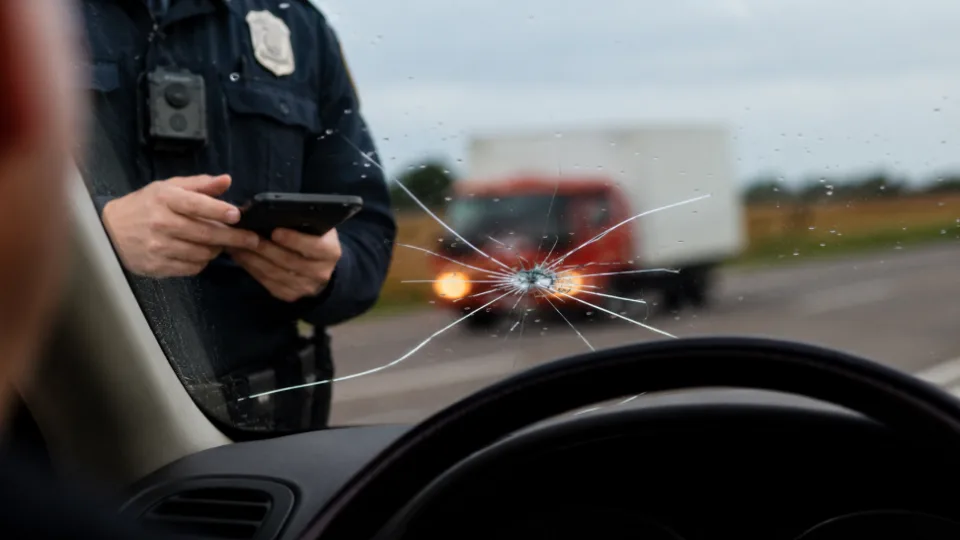










The appearance of a crack on the windshield is a common situation for Ukrainian drivers, especially given the poor condition of roads, stone impacts, or consequences of Russian shelling. At the same time, after a vehicle is stopped by the police, the question often arises: is such damage grounds for a fine. A recent decision by the Samarivka City District Court of the Dnipropetrovsk region shows that the mere presence of a crack on the windshield does not automatically mean administrative liability. The court thoroughly analyzed the requirements of the Traffic Rules, DSTU 3649:2010, and the police's obligation to prove the presence of an offense.
When a crack on the windshield is not an unconditional ground for a fine
In Ukraine, the technical condition of vehicles is regulated by the Traffic Rules and national standards, in particular DSTU 3649:2010 "Wheeled Vehicles."
Clause 6.8.5 of DSTU provides that cracks or chips are not allowed on the windshield in the area of the wiper operation. At the same time, the list of technical faults that prohibit the operation of a vehicle is defined specifically by section 31 of the Traffic Rules.
Therefore, when holding a driver liable, it is not enough to simply establish the fact of a crack. The police must prove that all the grounds provided by law for applying part one of article 121 of the Code of Ukraine on Administrative Offenses (CUAO) exist, and confirm this with proper and admissible evidence. This conclusion was reached by the Samarivka City District Court of the Dnipropetrovsk region in a case challenging a patrol police ruling.
Judicial practice: why the court canceled the fine for a crack on the windshield
The Samarivka City District Court of the Dnipropetrovsk region canceled the patrol police's ruling holding the driver administratively liable under part 1 of article 121 CUAO and closed the proceedings. In addition, the court ordered the Patrol Police Department to pay the plaintiff court fees.
Case circumstances
In May 2026, patrol officers stopped a Daewoo Matiz in Kyiv and issued the driver a fine of 340 UAH. The ruling stated that the driver operated the vehicle with a crack on the windshield, allegedly violating DSTU 3649:2010 and clause 31.4.7.e of the Traffic Rules.
The driver disagreed with this decision and appealed to the court. He explained that the police provided no evidence of the violation, did not conduct proper video recording, and that the crack appeared after a missile strike on Kyiv two days before the vehicle was stopped. He also pointed out procedural violations in the case review and ruling issuance.
During the case review, the court examined video recordings provided by the plaintiff. They indeed showed the presence of a crack on the vehicle's windshield. However, these recordings did not confirm that the crack was located specifically in the wiper operation zone, where according to DSTU 3649:2010 such damage is prohibited.
Why the court found the police ruling unlawful
The court emphasized that according to article 77 of the Code of Administrative Procedure, the burden of proving the legality of its decision lies with the authority. Although in cases under part 1 of article 121 CUAO a police officer has the right to issue a ruling without drawing up a protocol, this does not exempt the police from the obligation to properly confirm the fact of the offense.
The court found that the defendant did not provide photo or video evidence confirming the crack's location specifically in the wiper operation zone. There was also no evidence of measurements or other methods to establish the damage location. Moreover, the mere fact of a crack does not confirm the presence of an administrative offense without proving all necessary circumstances.
The court also noted an inconsistency in the ruling itself. Although the driver was accused of operating a vehicle with a cracked windshield, the police officer referred to clause 31.4.7.e of the Traffic Rules, which regulates a completely different violation — the absence of a bumper or rear protective device provided by the vehicle's design. The case materials did not confirm such a defect.
Additionally, the Patrol Police Department explained the absence of bodycam recordings by the expiration of the 30-day storage period. However, the court noted that the lawsuit was filed just a few days after the ruling was issued, and the defendant was timely notified of the court dispute and had enough time to take measures to preserve the relevant evidence.
What legal position the court formulated
The court stated that DSTU 3649:2010 indeed requires the absence of cracks in the wiper operation zone. However, in this case, the police did not prove that the damage was located in that zone, nor did they provide proper evidence of a technical fault that, according to the law, prohibits vehicle operation.
The court also emphasized that according to article 62 of the Constitution of Ukraine, the accusation cannot be based on assumptions, and all doubts regarding the proof of a person's guilt are interpreted in their favor. Since the Patrol Police Department did not fulfill its legal obligation to prove the legality of its ruling, the court concluded that there were no grounds to hold the driver administratively liable.
What the court decided
The Samarivka City District Court of the Dnipropetrovsk region fully satisfied the claim. The court canceled the fine of 340 UAH under part 1 of article 121 CUAO, closed the administrative offense case, and ordered the Patrol Police Department to pay the plaintiff 665.65 UAH in court fees.
Subscribe to our Telegram channel t.me/sudua and on Google News SUD.UA, as well as on our VIBER and WhatsApp, Facebook page and Instagram to stay updated on the most important events.