If the law allows carrying weapons in public places, can they be banned in parks — the US court decides


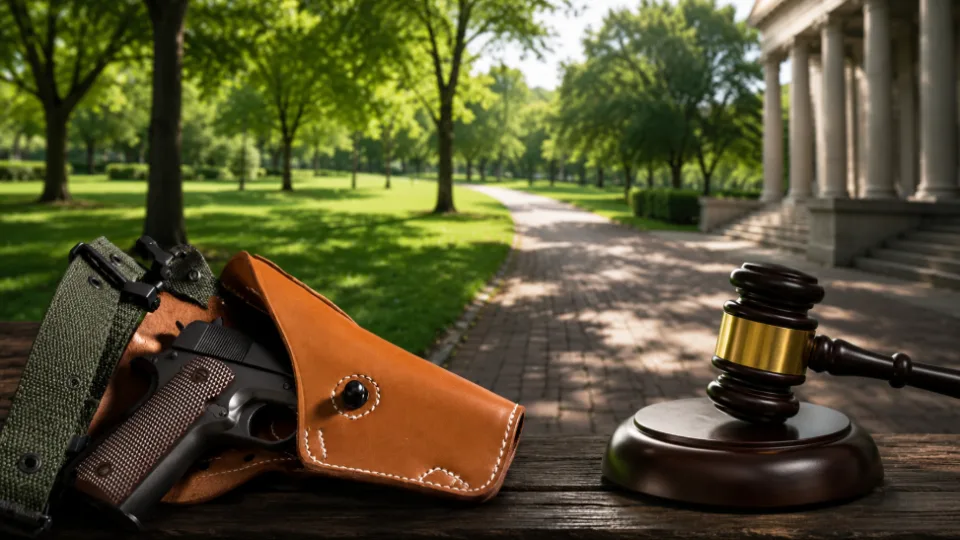










In Nebraska, a court is considering a case that may determine whether local governments have the right to independently ban carrying concealed firearms in city parks and on pedestrian routes, despite the state’s current law on so-called "constitutional carry." The plaintiffs argue that such restrictions contradict state law, while the city of Lincoln insists it has the right to set rules for the use of property under its jurisdiction.
The Nebraska court considers a dispute over the ban on concealed weapons in city parks
A hearing was held in the Lancaster County District Court in Nebraska on a lawsuit filed by four gun owners against the city of Lincoln.
The main issue in the dispute is whether the city government’s right to regulate the use of its property extends to city parks and pedestrian routes, and whether the city can ban carrying concealed firearms there.
City representatives stated that they have such authority. In contrast, the plaintiffs believe that after the 2023 adoption of the "constitutional carry" law, local authorities can no longer impose such restrictions.
What the "constitutional carry" law is about
In 2023, the Nebraska Legislature passed Legislative Bill 77, which allowed adult citizens to carry concealed firearms without obtaining a special permit.
The bill was initiated by then-Senator Tom Brewer, who advocates expanding gun owners' rights. The document was supported by 33 deputies, with 14 voting against it.
After the law came into effect, the mayors of the two largest cities in the state — Lincoln and Omaha — introduced bans on carrying weapons in city parks, municipal buildings, and on pedestrian routes.
Why gun owners challenge the ban
The lawsuit was filed by four gun owners, according to Courthouse News.
A representative of the plaintiffs stated in court that the true owners of city parks, sidewalks, and streets are the public, not the local government.
According to him, because of this, the city government cannot exercise the same rights as a private property owner and independently ban carrying weapons.
At the same time, the city representative noted that lawmakers, when adopting the concealed carry law, did not intend to deprive cities of the ability to manage their own property.
What is already known about the case
Earlier, the Nebraska Firearms Owners Association filed lawsuits against Lincoln and Omaha, claiming that local rules contradict state law.
In February 2024, Judge Andrew Jacobsen dismissed the case regarding Lincoln because the plaintiffs did not prove that they had already suffered or would inevitably suffer harm due to the relevant order. However, the court did not assess the legality of the ban itself.
Later, the Nebraska Supreme Court concluded that the four gun owners have the right to bring such a lawsuit. After that, the case was returned to Judge Jacobsen for substantive consideration. Meanwhile, the Firearms Owners Association is no longer a plaintiff.
Separately, in a similar case regarding the city of Omaha, another judge previously issued a temporary injunction that currently blocks the enforcement of the relevant local restrictions.
Why the plaintiffs believe their rights are violated
None of the four plaintiffs have been detained or held accountable for violating city policy.
At the same time, they stated that they stopped regularly visiting city parks and pedestrian routes, fearing possible criminal prosecution.
Three plaintiffs told the court that they carry firearms constantly, and the fourth said they do so in most cases.
What arguments the Lincoln authorities present
In court documents, the city pointed out that during the discussion of Legislative Bill 77, its author himself stated that property owners, including cities, can set rules regarding carrying weapons on their territory. As an example, he cited the Pinnacle Bank Arena sports and concert complex in Lincoln.
In contrast, the plaintiffs' representative emphasized that there is a fundamental difference between buildings and open public spaces — parks, sidewalks, and pedestrian routes.
Referring to the practice of the US Supreme Court and the Nebraska Supreme Court, he stated that such areas are held in so-called "public trust," so the rules for them differ from those applicable to ordinary private property.
A separate dispute concerns details for weapons
The hearing also discussed the ban on the use of so-called multiburst trigger activators — devices that allow two or more shots with one pull of the trigger.
The city believes it has the right to regulate the use of certain weapon components.
The plaintiffs argue that if such devices are a necessary part of certain firearm models, their ban effectively means a ban on the firearms themselves.
After the hearing, Judge Andrew Jacobsen suggested that the parties submit drafts of possible court decisions.
The court has not yet announced when the final decision in the case will be made.
Subscribe to our Telegram channel t.me/sudua and to Google News SUD.UA, as well as to our VIBER and WhatsApp pages, and follow us on Facebook and Instagram to stay updated on the most important events.