Stolychnyi Market Director Appeals to Business Ombudsman over Business Climate in Kyiv












This text is an open appeal to Ukraine’s Business Ombudsman, Ms Anka Feldhusen, former German Ambassador to Ukraine from 2019 to 2023, as quoted by Censor.NET.
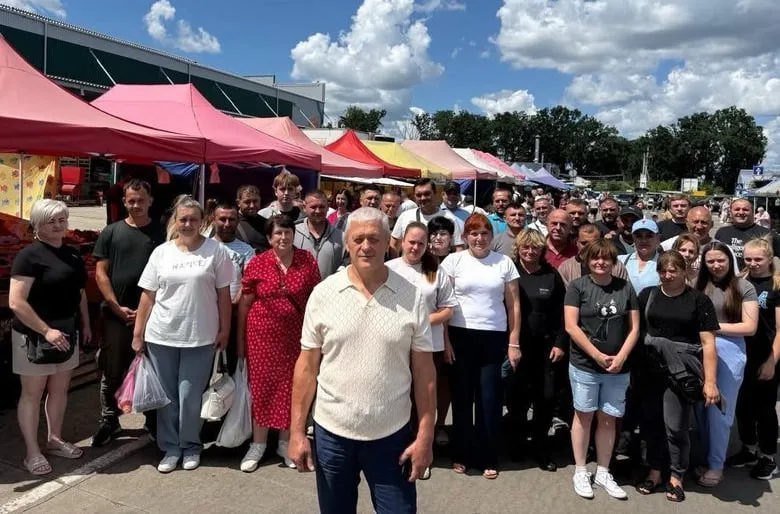
“I am the director of "Stolychnyi" Market — one of the largest wholesale agricultural markets in the country, through which thousands of farmers and entrepreneurs provide food to Kyiv and the Kyiv region every day. For many small farmers and their families, who do not have the opportunity to sell their products through large supermarket chains, the market is the main — and often the only — source of livelihood.
I want only one thing: for the market to be able to operate. Instead, for several years it has been operating under a state-imposed seizure. As part of criminal proceedings that do not concern either the market’s day-to-day operations or most of its land, the state placed the entire land plot under seizure — all 157 hectares that the enterprise has leased since 2012. This is despite the fact that the investigation’s claims concern only 18 hectares of that land.
The market is merely a lessee of state-owned land. Yet the consequences of this total seizure are being felt across the entire enterprise: banks refuse to provide loans, the construction of new pavilions has been halted, and debts have accumulated. This is not an investigative measure; in essence, it amounts to state sanctions against a business that is hiding nothing and is asking for only one thing: to be allowed to work.
When the enterprise began to lawfully challenge the seizure, the pressure did not ease; it intensified. Its latest manifestation is the prosecutor’s request to increase the bail set for me almost fourfold, to UAH 20 million — more than 60 years’ worth of my official income. The land seizure and this bail are links in the same chain. Increasingly, I see in this case not a search for a balance between the interests of the investigation and human rights, but the opposite: whenever the situation allows for two interpretations, the prosecution chooses the one that results in new restrictions, risks, or pressure on the enterprise. This no longer looks like a coincidence.
That is why I am making this appeal publicly. I am not asking the Business Ombudsman to determine guilt or interfere with the work of the court. Rather, this situation requires an assessment from the perspective of the very principle for which the institution of the Business Ombudsman was created: the state must not use its powers in a way that turns them into an instrument of disproportionate pressure on business.”
"Impartiality" of the SAP
This is not about the substance of the suspicion, but about the manner in which the proceedings are being conducted. And this is a matter that goes far beyond a single criminal case.
Every criminal case contains circumstances that may be interpreted in different ways. That is why the law imposes a special duty on the prosecutor. Part two of Article 9 of the Criminal Procedure Code requires the prosecutor to investigate both incriminating and exculpatory circumstances. The Law of Ukraine “On the Prosecutor’s Office” identifies fairness, impartiality, and objectivity as fundamental principles of prosecutorial activity. Similar standards are enshrined in international instruments, including the UN Guidelines on the Role of Prosecutors.
This is neither a formality nor a mere aspiration. It is an established standard against which the specific episodes of this case should be assessed. Those episodes are set out below.
More than just a market
The "Stolychnyi" Market is often perceived as merely another asset around which a criminal case has arisen. In reality, there are real people behind it: thousands of farmers, carriers, workers, and entrepreneurs depend on its operation.
The importance of such infrastructure became especially acute in the first months of the full-scale war. When logistics around Kyiv had been practically destroyed, it was large wholesale markets that helped determine whether the capital would have food supplies. After the de-occupation of Kyiv region in April 2022, Stolychnyi resumed operations and continued supplying products to Kyiv and the Kyiv region. In 2023, the market joined the World Union of Wholesale Markets, and events in support of the Armed Forces of Ukraine are regularly held on its premises.
I mention this not to grant the enterprise any special status or privilege before the law. The point is simply that procedural decisions concerning such infrastructure should be made with particular care, as their consequences affect a much wider circle of people than the direct participants in the proceedings. For thousands of Ukrainian farmers and workers, the market is a place where they sell their harvest and earn income during the war. Therefore, any decisions that effectively paralyse its development harm not only the suspect, but also the people who depend on this infrastructure.
An arrest that prevents nothing
Let us return to this seizure — the root of the entire matter. To recall, the investigation’s claims concern 18 hectares, yet the entire leased plot of 157 hectares was placed under seizure. This raises the central question: why was the seizure imposed on the entire land plot?
By its nature, seizure of property is applied to prevent its concealment, alienation, or other unlawful disposal. However, a lessee cannot sell, re-register, or otherwise alienate state-owned land; they simply do not have such powers. This creates a paradoxical situation: a measure intended to prevent the alienation of property is applied to property whose alienation is impossible in principle. Instead, it blocks the only thing the lessee has both the right and the contractual obligation to do — develop the market infrastructure.
One might argue that the seizure was intended to prevent further changes in the legal status of the plot. But even if that were the case, such a risk would concern only the disputed 18 hectares and registration actions, whereas the entire plot and the enterprise’s economic activity — which has nothing to do with registration changes — have been blocked.
The consequences for the enterprise are quite tangible: contracts and permits for the construction of new pavilions have been secured, but because of the seizure, financing cannot be raised, and outstanding debts have reached around UAH 50 million. When claims concerning approximately one-ninth of the land result in the entire plot being blocked, this no longer looks like a targeted procedural measure, but rather a restriction on the enterprise’s activity as a whole.
When the right to defense is presented as a risk of a new crime
The situation with the appeal is also telling.
The enterprise exercised its right to appeal the seizure. This would appear to be entirely normal procedural conduct — after all, this is precisely why the right of defence exists. However, in the case materials, the appeal was characterised as “the realisation of the risk of committing another criminal offence.”
Even if this phrase is interpreted in the mildest possible way, it goes far beyond a single case. When the exercise of the right of defence begins to be treated as evidence of a person’s social danger, the line between procedural safeguards and punishment for exercising lawful rights is erased.
Another contradiction is even harder to explain. The prosecutor notes that the market did not appeal the seizure in a timely manner because the relevant ruling was sent to the landowner — the state — and not to the user, namely the market itself. In other words, it is acknowledged that the enterprise did not receive a copy of the court decision. At the same time, the enterprise is blamed for missing the deadline for appeal.
I find it difficult to understand how these two positions can coexist: one cannot miss the deadline for exercising a right of which one was effectively not notified.
It is also telling that the decision of the HACC Appeals Chamber on this issue was not unanimous. One judge expressed a dissenting opinion, finding that there were grounds to restore the deadline and that the complaint should be considered on the merits. Thus, even within the judicial panel, there was another legally reasoned view.
Bail that becomes a verdict
Another significant point is the timing of the increase in bail. As soon as the appeal against the seizure created prospects for its removal in court, the Specialized Anti-Corruption Prosecutor’s Office requested that the bail be increased almost fourfold — from UAH 5 million to almost UAH 20 million. Meanwhile, according to the Pension Fund, my official annual income for 2025 was approximately UAH 321,600, and my family’s property has been under seizure since last September. UAH 20 million is more than 60 years of my official income.
That is why the figure highlighted in the headline is not abstract for me. If bail is intended to secure my appearance in court, why is its amount set as though it were meant to become a punishment before any verdict has been delivered?
I understand the logic by which the amount of bail is linked to the size of the alleged damage. But my family’s property is already under seizure — meaning that proper procedural conduct is already being secured by other means. In Neumeister v. Austria, the European Court of Human Rights emphasised that the amount of bail must take into account the person’s financial situation and be sufficient only to secure their appearance, not to become a hidden form of punishment. Bail that is unaffordable by definition does not serve this purpose.
This raises another question. The ruling of the HACC investigating judge of April 15, 2026, did not confirm the risk of new offences. Throughout the entire period, I appeared in response to every summons and did not violate any procedural obligations. What new circumstances, then, justify the need to increase bail fourfold?
I cannot help but note the timing. On the day the defence announced its intention to ask the court to reduce the bail, a counter-motion to increase it was filed almost immediately. From a legal point of view, simultaneity proves nothing. But it naturally raises the question: was the request to increase bail the result of an independent assessment of new risks, or a reaction to the defence’s procedural step?
When all doubts are interpreted in only one way
Each of the episodes described can be explained separately. But when they form a sequence, a pattern emerges: the right of defence turns into an additional risk; the lack of notification does not prevent accusations of missing the appeal deadline; claims concerning 18 hectares lead to the seizure of the entire 157-hectare plot; and an unconfirmed risk of new offences does not prevent a demand to increase bail fourfold. Each time, doubt is interpreted in only one direction.
All of this looks like deliberate pressure, the consequence of which is the slow strangulation of an operating enterprise.
That is why I am addressing the Business Ombudsman — to draw attention to a trend that goes beyond a single court case. The institution now represented by Anka Feldhusen was created with the support of international partners precisely to prevent the state from arbitrarily destroying the business environment. For years, the Business Ombudsman’s systemic reports have documented the problem of law enforcement pressure on business. I do not claim that the Stolychnyi case is exceptional. On the contrary, I am concerned that it increasingly resembles yet another illustration of this systemic problem.
I am deliberately presenting this position publicly and am equally willing to have the prosecution’s full position published alongside it. I have nothing to hide. I ask only one thing: that the state act within the framework of the proceedings, without turning lawful measures into instruments of pressure, and that the market that feeds the capital and thousands of Ukrainian farming families be allowed to operate peacefully.”
Subscribe to our Telegram channel t.me/sudua and to Google News SUD.UA, and join us on VIBER, WhatsApp, Facebook and Instagram to stay informed about the important events.