Dog Photographer Loses Copyright Case Over AI-Generated Comic Version of Her Photo












A photographer specialising in underwater dog portraits lost a copyright lawsuit concerning an AI-generated, comic-style image derived from one of her photographs. The court ruled that such an image does not infringe her copyright, writes PetaPixel.
The Higher Regional Court of Germany determined that transforming another’s photograph into a comic-style image using AI does not automatically constitute copyright infringement. This decision has become a landmark ruling for the country.
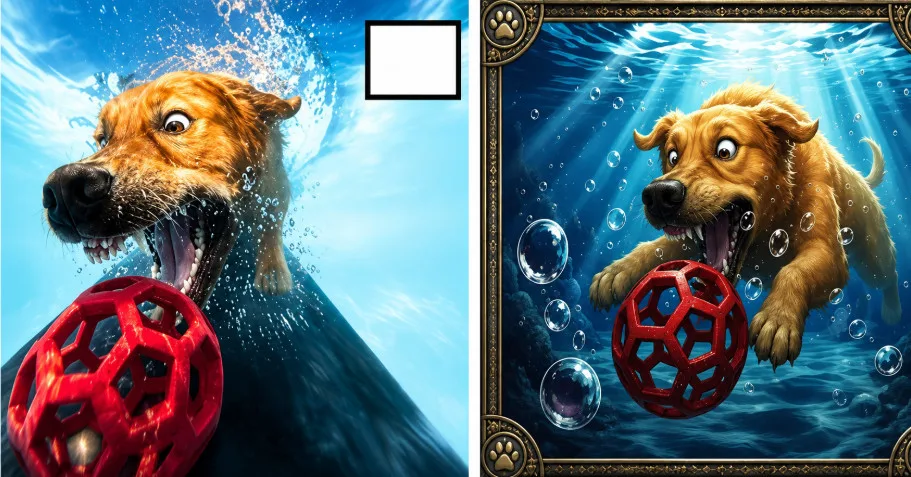
The case involved a photographer who sells underwater dog photographs. She filed a lawsuit against her former business partner, who used one of her original photos—of a dog diving for a red toy—as input for AI software, which then created a comic-style version. Subsequently, the former partner published the AI-generated image on his website.
The original photo depicted a dog underwater reaching for a red toy, characterised by tight framing, shallow depth of field, and a dynamic, realistic appearance. The AI-generated version retained the same motif but transformed it into a cartoonish image: the dog is shown in full, and its paws were deliberately enlarged to convey a more playful look.
The photographer sued her former partner over the publication of the AI-generated image, which was created based on her copyrighted photo. However, the German court dismissed the lawsuit, finding that the AI image did not copy protectable elements of the original photo, including framing, perspective, lighting, and sharpness. The subject and motif of the photo themselves are not protected by copyright.
The court determined that the AI-generated image altered the creative elements of the photo: it employed different framing, a different angle, and a flat, cartoonish rendition instead of the realistic style and shallow depth of field of the original. Since the AI version preserved only the unprotected subject but did not reproduce the creative elements of the photo, the court concluded that no copyright infringement had occurred.
"The scope of protection for a photographic work is usually limited to the choice of composition, perspective, lighting, as well as sharpness or blur achieved through the proper combination of aperture and shutter speed," the court noted. "The subject of the image and its motif are generally not subject to legal protection."
This case followed another high-profile German court decision involving stock photographer Robert Kneschke, who sued the company LAION after discovering a "huge number" of his photos in one of its image databases. This dataset was used by major tech companies to train AI image generators. The court ruled that since LAION provides this dataset for free, its use falls under an exception for non-commercial scientific research.
Subscribe to our Telegram channel t.me/sudua, follow SUD.UA on Google News , and join us on VIBER, WhatsApp, Facebook and on Instagram to stay informed about the important events.