Sentence for TikTok Lifehack: Man Printed Driver's License at Home and Received 5 Years Imprisonment












Digitalization and the accessibility of technology daily create the illusion of ease in bypassing legal procedures. Social networks constantly feature new lifehacks and harmful advice on how to circumvent the system using souvenir money, special stickers on car plates, or forged documents. Many consumers of "social media trends" perceive this information as a call to action and try to top up cards at ATMs with souvenir money or obtain a driver’s license within 2 days. However, judicial practice shows that law enforcement and judicial systems are becoming increasingly effective at detecting forgeries.
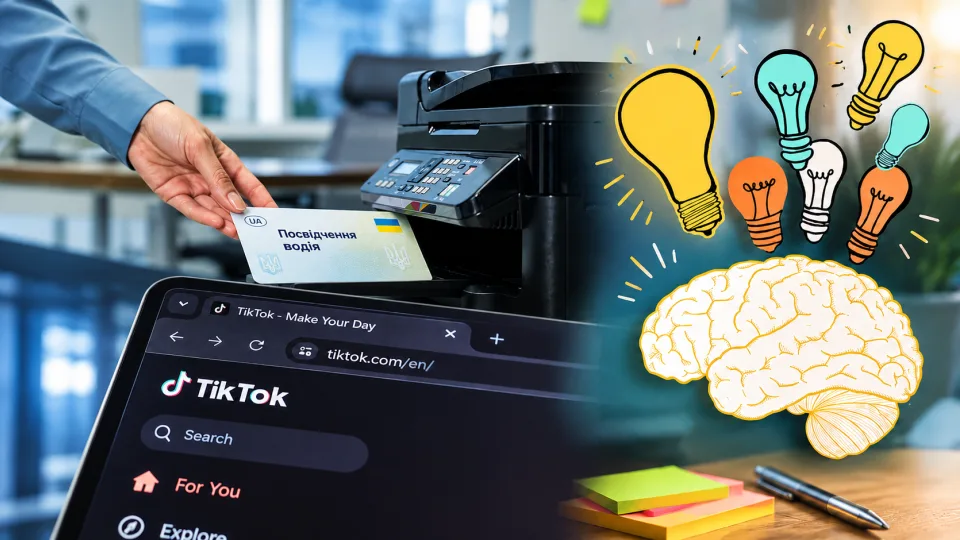
Analyzing the verdict in case No. 344/8338/26, we see that a resident of Ivano-Frankivsk went beyond simply quickly obtaining forged documents. The man produced a driver’s license at home using a printer and video tutorials from social networks. An interesting nuance of the case is that the accused was already under probation supervision, which led to a severe sentence.
The accused consciously chose to ignore the legally established procedure for obtaining the right to drive vehicles.
While in Kyiv, the man purchased a souvenir driver’s license blank in an underground passage. Inspired by a video on the "TikTok" network, he independently produced a forged "A1" category driver’s license in his name using a home computer and printer.
Soon after, while driving a scooter in Ivano-Frankivsk, he was involved in a traffic accident. Upon the patrol officers' request, he presented his creation as a valid document, attempting to avoid liability for driving without a license.
The expert conclusion in the case established that the blank did not correspond to official samples, and all images were applied using operational printing means, i.e., a home printer.
The man’s actions were qualified under two parts of Article 358 of the Criminal Code of Ukraine: namely, Part 1 of Article 358 CC — forgery of a license issued by a state institution for use; and Part 4 of Article 358 CC — use of a knowingly forged document.
The court did not accept the argument that the document was made as a "souvenir." Since the accused presented it to the police during a document check, his intent to use the forgery to obtain special rights was fully proven.
An important circumstance for the court was that the man had already been convicted in 2023 for theft (Part 4 of Article 185 CC) and received 5 years imprisonment with a 3-year probation period. Committing a new crime during probation indicates that the previous lenient punishment did not achieve correction.
When imposing the final punishment, the court applied Articles 70 and 71 of the Criminal Code of Ukraine. Thus, for the new crimes, i.e., forgery and use of a forged license, a punishment of 1 year restriction of liberty was determined.
Since the offense was committed during the probation period, the court added the remaining unserved punishment for the previous crime (theft). As a result, the court sentenced him to imprisonment for 5 years and 1 month.
Additionally, the accused was ordered to pay 5,348 UAH for the expert examination costs.
Similar Cases and Judicial Practice
Judicial practice shows that law enforcement regularly detect cases of manufacturing, purchasing, and using forged driver’s licenses in various regions of Ukraine.
According to official data from the Main Service Center of the Ministry of Internal Affairs, punishment for document forgery under Article 358 of the Criminal Code of Ukraine depends on the method of committing the offense, the role of the accused, and case circumstances.
In Lviv region, a man contacted an unidentified person, providing his personal data and photo to produce a forged category "B" driver’s license. The fake document was issued with false information and details of the territorial service center of the Ministry of Internal Affairs.
The court found him guilty of aiding in forgery of an official document and using a knowingly forged driver’s license.
The Yaremche City Court, in turn, established that a citizen, acting in collusion with an unidentified person, ordered a forged driver’s license via an internet messenger. He sent his personal data and photo and received the forged document at a postal operator’s office. The court found the man guilty under Parts 3 and 4 of Article 358 of the Criminal Code of Ukraine (repeat forgery or group actions) and sentenced him to a fine of 17,000 UAH with a probation period.
An important nuance in this category of cases is establishing the subjective side of the crime, namely the person’s awareness that the document is forged. The Supreme Court in ruling No. 295/5331/22 formed an important legal position: liability for using a forgery (Part 4 of Article 358 CC) arises only if direct intent is proven.
In case No. 295/5331/22, the accused was acquitted because he convinced the court that he sincerely believed the "additional payment" procedure for extra categories at the traffic police office was legal, and the laminated document he received was genuine.
The court emphasized that forgery includes both completely falsified blanks and official documents to which unauthorized changes have been made (for example, adding categories "A" and "B").
However, the situation completely changes when it comes to self-made forgeries. In case No. 344/8338/26, the Ivano-Frankivsk City Court faced a case that entirely excluded the possibility of referring to an honest mistake. The accused did not just order the document but personally produced it at home using a computer, printer, and TikTok video instructions.
Subscribe to our Telegram channel t.me/sudua and to Google News SUD.UA, as well as to our VIBER and WhatsApp pages, and follow us on Facebook and Instagram to stay informed about the most important events.