Co-owner of an apartment is obliged to pay for heating regardless of place of registration — court decision












The Kherson Court of Appeal upheld the decision of the Kherson City Court of Kherson Region in the case filed by JSC "Kherson Thermal Power Plant" for the recovery of debt for centralized heating services.
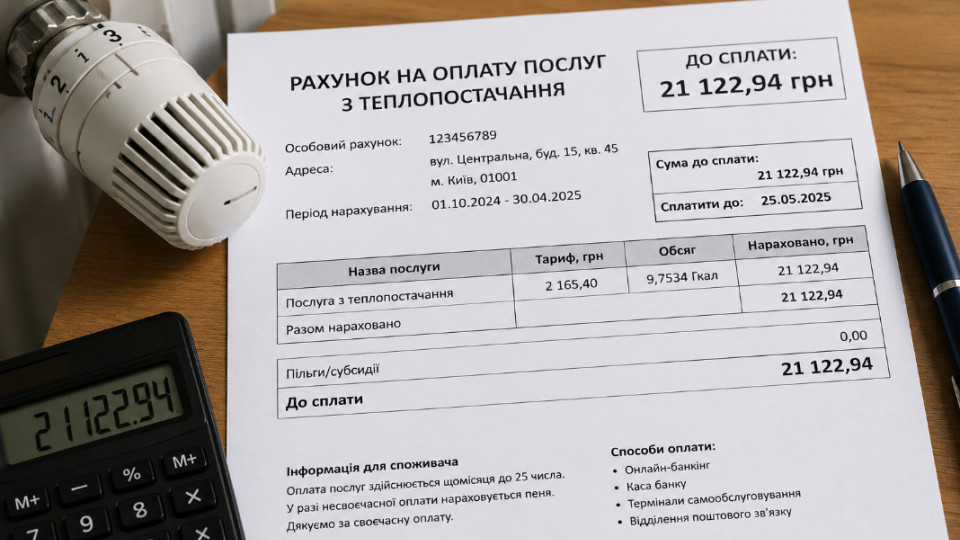
The plaintiff requested to recover from the defendants over 41 thousand UAH of debt for the period from January 1998 to November 2020. The court of first instance partially satisfied the claim, applying the consequences of the expiration of the limitation period, and recovered the debt only for the period from December 1, 2017 to November 30, 2020 — 21,122.94 UAH, proportionally from each co-owner of the apartment.
In the appeal, the representative of one of the defendants requested to cancel the decision and fully dismiss the claim. In particular, the complainant noted that the defendant had not lived in the disputed apartment since 2016, was deregistered at this address, and therefore did not actually consume the heating service.
The appellate court rejected these arguments. The court reasoned that the defendants are co-owners of the apartment under the right of private joint ownership, and therefore, as property owners, are obliged to participate in its maintenance and payment of relevant utility services. Having a different place of registration does not exempt a co-owner from the obligation to maintain their share in the real estate.
When resolving the dispute, the appellate court referred to the provisions of the Civil Code of Ukraine, in particular Part 1 of Article 509 of the Civil Code of Ukraine, according to which an obligation is a legal relationship in which the debtor is obliged to perform a certain action in favor of the creditor, including payment of money. The court also took into account the provisions of Part 1 of Articles 901 and 903 of the Civil Code of Ukraine regarding the contract for the provision of services and the customer's obligation to pay for the provided service.
Additionally, the appellate court applied the provisions of the Law of Ukraine "On Housing and Communal Services." In particular, the court noted that according to Part 1 of Article 12 of this Law, housing and communal services are provided exclusively on a contractual basis, and according to Part 1 of Article 9, the consumer makes payment for consumed housing and communal services monthly unless otherwise specified by the contract. The court also referred to paragraph 5 of Part 2 of Article 7 of the Law, which imposes on the individual consumer the obligation to pay for provided housing and communal services at established tariffs, and to Part 2 of Article 8 of the Law regarding the obligation of the communal service provider to prepare and conclude contracts with the consumer.
Separately, the appellate court emphasized that the heating service is one whose cost depends not on the number of persons actually living in the apartment, but on the area of the dwelling. Therefore, the mere fact that a co-owner does not live in the apartment is not grounds for exempting them from paying their respective share of the service cost.
This approach is consistent with the legal position of the Supreme Court set forth in the ruling dated April 15, 2021, in case No. 638/5001/17, which was also cited by the appellant's side. In that case, the Supreme Court stated that services whose cost depends not on the number of persons using them, but on the apartment area, including heating, must be paid by the co-owner according to their share in ownership rights.
The appellate court also agreed with the application by the court of first instance of Part 4 of Article 267 of the Civil Code of Ukraine regarding the consequences of the expiration of the limitation period. Since the plaintiff applied to the court on December 1, 2020, claims for debt recovery for the period from January 1998 to November 30, 2017 were filed beyond the three-year limitation period. Therefore, in this part, the claim was justifiably denied.
After reviewing the decision of the court of first instance within the arguments of the appeal, the appellate court in case No. 766/19436/20 concluded that it was made in compliance with substantive and procedural law. By the ruling of the Kherson Court of Appeal dated May 11, 2026, the decision of the Kherson City Court of Kherson Region dated February 2, 2026 was left unchanged.
Subscribe to our Telegram channel t.me/sudua and to Google News SUD.UA, as well as to our VIBER and WhatsApp, pages on Facebook and Instagram to stay informed about the most important events.