The Limit of Criticism of Judicial Decisions and Undermining the Legitimacy of the Court: Supreme Court Chairman Stanislav Kravchenko Participated in an International Conference in the EU


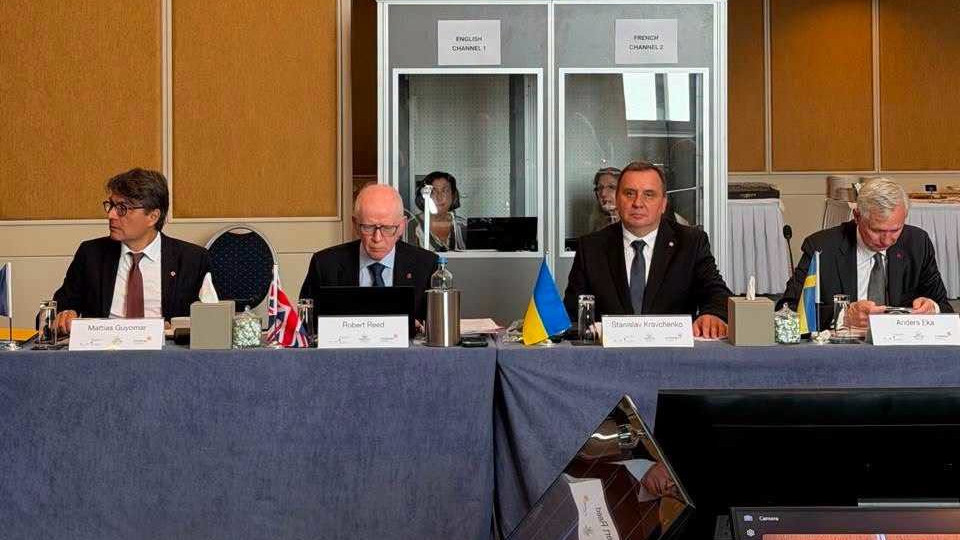










The Chairman of the Supreme Court, Stanislav Kravchenko, participated in the conference of the Network of Presidents of the Supreme Courts of the European Union, dedicated to the modern challenges to the rule of law and the protection of human rights in the context of digitalization and military threats.
The event was held under the auspices of the Supreme Court of Cyprus and the Secretariat of the Cyprus Presidency of the Council of the EU in 2026.
The conference covered issues related to the challenges of the 21st century facing the rule of law and the protection of human rights in the digital space.
Within the framework of the first panel discussion, participants considered manifestations of democratic regression in the modern world, including:
- armed aggression that destroys the foundations of the international legal order;
- threats to weakening the system of checks and balances;
- the danger of politicization of justice;
- narrowing space for independent media, academic environment, and civil society;
- the risk of falsification of evidence or massive abuse of procedural mechanisms in the context of global digitalization, etc.
Opening the discussion, the Chairman of the Network of Presidents of the Supreme Courts of the European Union, Chairman of the Supreme Court of Ireland, Donal O’Donnell, emphasized that unlike authoritarian regimes based on unconditional adherence to a single ideology, democratic society must remain a space for free discussion, critical analysis, and the search for new solutions.
The impact of the war on the rule of law was highlighted by the Chairman of the Supreme Court of Finland, Tatu Leppänen. According to him, the full-scale war of the Russian Federation against Ukraine demonstrates that occupation of territories and violations of international humanitarian law effectively make the existence of the rule of law and proper protection of human rights impossible.
The Chair of the European Court of Human Rights for 2022–2024, a research fellow at New York University, Shifra O’Loughlin, stressed that the rule of law is one of the greatest achievements of post-war Europe. At the same time, she warned against perceiving these values as immutable or guaranteed forever, as even established democratic systems can face gradual erosion of trust in institutions and weakening of legal guarantees.
During the discussion, the First Advocate General of the Court of Justice of the European Union, Maciej Szpunar, noted that the independence of national judges is a necessary condition for the functioning of the entire European legal mechanism. The speaker explained that in response to the phenomenon of democratic regression, the Court of Justice of the EU has developed new legal tools to respond to such processes. One of them is the doctrine of irreversibility, according to which a member state cannot change its legislation in a way that lowers the already achieved level of guarantees of judicial independence and protection of the rule of law.
In the context of mechanisms to protect judicial independence amid growing political pressure on judicial institutions, the President of the ECHR, Matthias Guilloumar, outlined three key directions for responding to modern challenges to the rule of law:
1) judicial solidarity – strengthening cooperation and mutual support between national and international courts;
2) judicial diplomacy – constructive dialogue with representatives of the executive and legislative branches provided unconditional adherence to the principle of separation of powers and judicial independence;
3) judicial communication – open and clear communication of judicial institutions with society.
The Chairman of the Supreme Court of Canada, Richard Wagner, dedicated his speech to criticism of judicial decisions as a necessary element of public dialogue. At the same time, he warned against situations where criticism turns into campaigns to discredit courts or undermine their legitimacy, creating threats to judicial independence.
Conference participants also considered prospects for restoring the rule of law after its systemic weakening, ways to establish communication between the court and society, and the importance of timely strengthening constitutional guarantees of judicial independence.
Within the framework of the second panel session, an extensive discussion took place on the transformation of the digital legal order, the responsibility of online platforms, and challenges related to the application of multi-level regulation in the field of digital rights. Participants emphasized that algorithms increasingly determine the accessibility, visibility, and reach of information, which directly affects the exercise of freedom of expression and freedom of speech.
Subscribe to our Telegram channel t.me/sudua and to Google News SUD.UA, as well as to our VIBER and WhatsApp pages on Facebook and Instagram to stay informed about the most important events.