"Motherhood Penalty": Why Ukrainian Mothers Earn Almost Half as Much as Men with Children













In Ukraine, having a child significantly affects women's participation in the labour market. Caring for preschool children often leads to career interruptions, delayed returns to work, or transitions to lower-paid and less stable employment. These findings are presented in a UNICEF study.
An analysis of employment among women with preschool children reveals that these problems existed even before the full-scale war. However, they intensified after its onset due to increased care needs, economic difficulties, and security challenges.
"Motherhood Penalty" and "Fatherhood Bonus"
As of February 2024, nearly 3.23 million people aged 18–45 in Ukraine had children aged 0 to 6 years. Women constituted 55% of this group, while men made up 45%.
Researchers note that women more often become mothers at the beginning of their professional careers. Although the average age of mothers and fathers is similar (31 and 32 years respectively), the age structure differs significantly. Almost half of women with young children are under 29 years old (44%), whereas among men, this figure is only 28%.
This indicates that a significant proportion of women become mothers early in their work experience, often within three to five years after completing their education. In contrast, men typically have a 10-year period to establish themselves in the labour market before becoming fathers. This disparity has long-term consequences for career trajectories and income levels.
Such trends affect future career opportunities and earnings. Studies refer to these as the "motherhood penalty" and the "fatherhood bonus."
The "motherhood penalty" refers to the economic disadvantage women often face in the labour market after having a child. This includes lower wages, slower career growth, and limited employment opportunities compared to both women without children and men.
Conversely, the "fatherhood bonus" describes the opposite trend, where men, after having children, may receive advantages in the labour market. These can include higher salaries or more positive evaluations as employees, owing to perceptions of them as more stable and responsible.
Employment Rate of Mothers is Almost Half as High
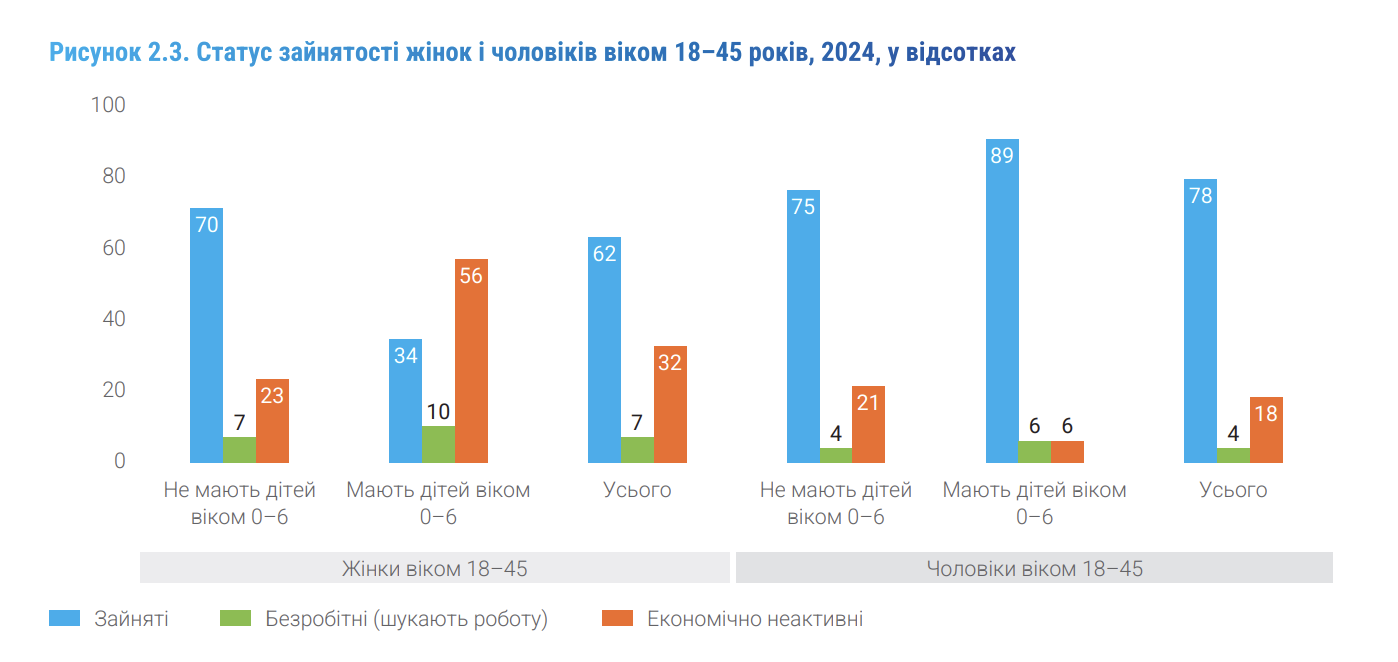
Among women aged 18–45 with children under 7 years old, the employment rate is only 34%. For comparison, among women without young children, this figure reaches 70%.
At the same time, 56% of mothers of young children are economically inactive – they neither work nor look for a job. Among women without young children, only 23% fall into this category.
The situation among men is the opposite. Having young children does not reduce their labour market participation; on the contrary, it may be associated with stable or even higher employment.
According to the study, the employment rate of men with children aged 0–6 increased from 89% at the beginning of 2024 to 94% in mid-2025. Meanwhile, among women in the same group, the figure changed only marginally, from 34% to 35%.
Women Earn Almost Half as Much as Men
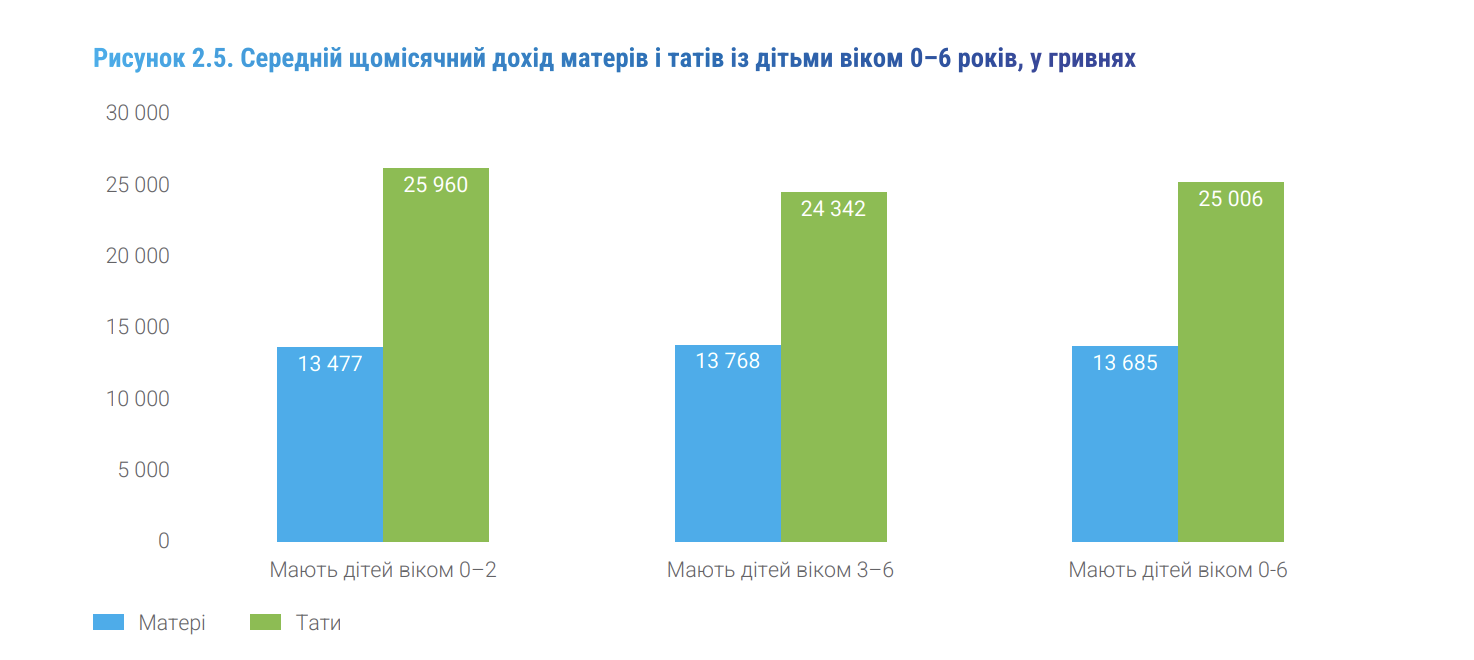
The difference is also evident in income. The average earnings of women with children aged 0–6 amount to 13,704 UAH, while men with children of the same age receive, on average, 25,009 UAH.
Researchers explain this disparity by gender segregation in the labour market. Women with young children more often work in lower-paid sectors.
In contrast, men are more frequently represented in higher-paying sectors.
Almost two-thirds of mothers with young children (67%) work in only three occupational groups: technical specialists, service and trade workers, and administrative staff.
The Biggest Barrier — The First Years After Childbirth
The first years after childbirth are especially challenging for women returning to work.
Among mothers of children aged 0–2 years, only 13% work, 2% are looking for a job, and 85% remain economically inactive.
Among women with children aged 3–6 years, the situation improves: about 54% work, 3% look for a job, and 43% remain outside the labour market.
Overall, nearly two-thirds of women with children under 7 years old (63%) are economically inactive.
Some Mothers Want to Work but Cannot Return
The study shows that economic inactivity does not always imply a lack of desire to work.
Almost 28% of women with young children who are currently not working and not looking for a job state they would like to work but cannot yet actively search.
The main reasons include insufficient availability of childcare services, low expected income, and working conditions that are difficult to combine with parenting responsibilities.
Researchers estimate that removing these barriers could increase the employment rate of mothers with children under 7 to over 50%, compared to the current 35%.
At the same time, 87% of economically inactive mothers plan to return to the labour market in the future. Among them, 64% intend to do so before their child turns seven.
Researchers emphasise that the problem of low employment among mothers is not related to a lack of professional skills or motivation, but to the unequal distribution of childcare responsibilities and insufficient opportunities to combine work and family life.
Subscribe to our Telegram channel t.me/sudua, follow SUD.UA on Google News , and join us on VIBER, WhatsApp, Facebook and on Instagram to stay informed about the important events.