US Court Reviews Plan to Destroy 450,000 Owls: Authorities Aim to Save a Rare Species


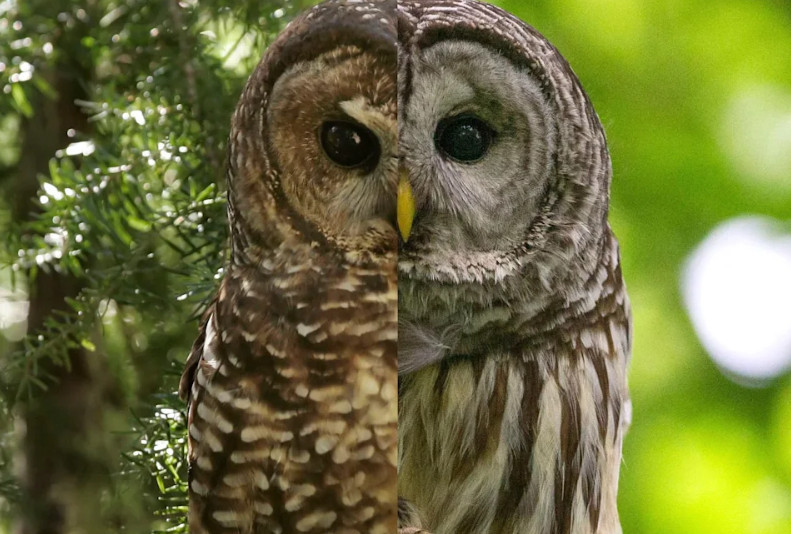










In the US, a court is reviewing a controversial plan to destroy hundreds of thousands of barred owls in order to save spotted owls, writes Yahoo.
On June 3, in a US federal court, the parties presented their arguments in a case regarding the plan to destroy hundreds of thousands of barred owls to preserve the spotted owl population.
The dispute began two years ago after the US Fish and Wildlife Service released its "Final Barred Owl Management Strategy" in August 2024, outlining measures to control this species on the West Coast.
The document states that barred owls have displaced the endangered spotted owls and are one of the reasons for their population decline. The plan involves destroying up to 450,000 barred owls in conservation areas of Oregon, Washington, and California over the next 30 years to support the spotted owl population.
In October 2024, animal welfare organizations Animal Wellness Action and Center for a Humane Economy filed a lawsuit demanding to block the plan's implementation. The legal process has been ongoing for a year and a half, and on June 3, federal judge Adrienne Nelson heard arguments regarding the plaintiffs' motion to halt the plan.
The Plan Divides Environmental Organizations
The initiative has caused a split among organizations that traditionally support both animal protection and species conservation. Some NGOs oppose the plan, while others support the government's position.
The plaintiffs argue that the plan violates the Migratory Bird Treaty Act and the National Environmental Policy Act.
The organization Friends of Animals, which joined the plaintiffs, claims that destroying barred owls will not help spotted owls. They believe that after the culling, other barred owls will simply move into the freed territories, and competition between the species will continue. The organization also disagrees with classifying barred owls as an invasive species.
Barred owls originate from the eastern US and have gradually expanded their range westward over decades. Currently, the habitats of both species fully overlap in the Pacific Northwest—from British Columbia to northern California. Friends of Animals representatives emphasize that barred owls are native to North America and migrated due to habitat changes.
"Our position is that barred owls are one hundred percent a native species of North America," said Wayne Pacelle, president of the plaintiff organizations.
Meanwhile, conservation organizations led by the Environmental Protection Information Center (EPIC) support the government plan, calling it necessary to protect spotted owls.
According to EPIC Executive Director Tom Wheeler, the expansion of barred owls' range was facilitated by settlers in Canada and the US.
"Therefore, as Americans, we bear some moral responsibility to correct this problem," he said.
Wheeler also noted that the spread of barred owls puts additional pressure on other animal species in the Northwest forests, as this species has a significantly broader diet.
Is the Plan Linked to Logging?
Wayne Pacelle acknowledges that barred owls compete with spotted owls for resources but emphasizes that plans to destroy one species to save another are extremely rare.
He believes the real goal of the program may be to expand logging opportunities. He noted that under the Endangered Species Act, companies can receive permits for activities harmful to rare species if they simultaneously implement measures to protect them.
Pacelle thinks that destroying barred owls could open logging companies' access to territories inhabited by spotted owls, using the culling of barred owls as a compensatory measure.
Tom Wheeler admitted that the forestry industry supports this plan and has already received permits to cull barred owls. At the same time, he considers this approach better than the prospect of the complete disappearance of spotted owls due to competition.
It is currently unknown when Judge Adrienne Nelson will make a decision in the case.
Subscribe to our Telegram channel t.me/sudua and to Google News SUD.UA, as well as to our VIBER and WhatsApp, and follow us on Facebook and Instagram to stay updated on the most important events.