Commanders face up to 10 days arrest for ignoring military reports: what changes are being prepared in the Parliament


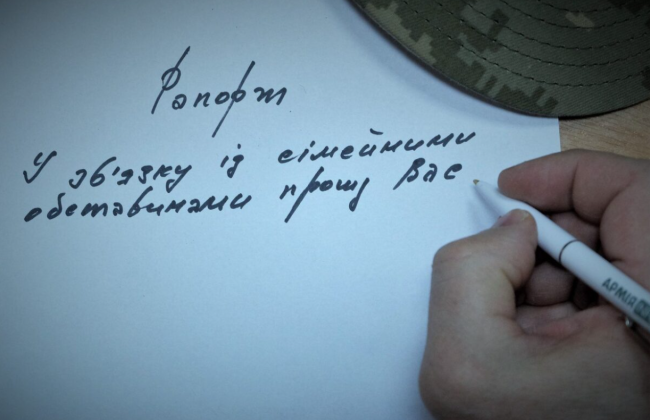










The Verkhovna Rada is considering draft law No. 15120, which proposes to introduce administrative liability for violations of the procedure for reviewing servicemen's reports. As already reported by the "Judicial and Legal Newspaper", the document provides for amendments to the Code of Ukraine on Administrative Offenses — it is proposed to supplement it with a new article 172-21.
The draft law provides the following gradation of fines:
- under normal conditions — a fine from 50 to 100 non-taxable minimum incomes of citizens;
- under special period conditions (except martial law), as well as in case of repeated offenses — a fine from 100 to 200 non-taxable minimum incomes of citizens or arrest with detention in the guardhouse for up to 5 days;
- under martial law — a fine from 200 to 500 non-taxable minimum incomes of citizens or arrest with detention in the guardhouse from 5 to 10 days.
The authors of the draft law justify the need for amendments by stating that in the conditions of full-scale armed aggression against Ukraine, the issue of protecting the rights of servicemen and observing statutory relations becomes critically important. During active hostilities, timely consideration of reports (including those concerning treatment, leave, provision) directly affects the moral and psychological state of personnel and the combat capability of units.
One of the main communication tools between a serviceman and the command is the report, which serves as the basis for exercising key military rights — leave, treatment, relocation, dismissal, etc.
At the same time, according to the authors of the initiative, in practice there are widespread cases of violations of the procedure for reviewing reports, refusal to accept or register them, failure to meet established deadlines for consideration, failure to provide a response, or leaving the report without consideration. The very idea of strengthening discipline in military service is justified by the need to ensure the rights of servicemen, but the proposed changes raise a number of concerns.
In parliament, attention was drawn to the fact that legislative changes should be based on an analysis of the practice of applying current norms. At the same time, the draft law does not provide data confirming the ineffectiveness of current regulation or the existence of gaps leading to avoidance of responsibility.
It is emphasized that the current norms of the Code of Ukraine on Administrative Offenses already contain provisions covering similar acts of military officials. In particular, Article 172-13 of the Code provides liability for abuse of power or official position, i.e., intentional use of official powers contrary to the interests of service, which entails an administrative penalty in the form of a fine.
Article 172-14 of the Code establishes liability for exceeding power or official authority, i.e., committing actions that clearly go beyond the granted powers, and provides for:
- imposition of a fine from seventy to one hundred forty-five non-taxable minimum incomes of citizens or arrest with detention in the guardhouse for up to seven days;
- actions provided for in the first part of this article committed under special period conditions entail a fine from one hundred forty-five to two hundred eighty-five non-taxable minimum incomes of citizens or arrest with detention in the guardhouse for a term from seven to ten days.
Thus, the norms proposed in the draft law contain an almost identical approach to liability.
Moreover, in cases where such actions cause significant harm, criminal liability applies under Articles 425, 426, and 426-1 of the Criminal Code of Ukraine. In particular, these provisions provide liability for negligent attitude to military service, exceeding power or official authority, as well as inaction of military authorities if such actions caused serious consequences — up to criminal punishment, including imprisonment depending on the nature of the crime.
In this regard, experts note that the proposed separation of a separate administrative offense may be an example of excessive legal regulation, as it duplicates existing approaches to liability and potentially complicates law enforcement.
Attention is also drawn to terminological inconsistency: the draft law uses the term "military officials," while current legislation operates with the definition "military servicemen," fixed in the Code of Ukraine on Administrative Offenses. This may create risks of legal uncertainty and complicate practical application of the norm.
Also, the draft law uses the term "military officials," whereas current legislation uses the definition "military servicemen," fixed in the note to the relevant article of the Code of Ukraine on Administrative Offenses. This may create risks of legal uncertainty.
Furthermore, the provisions regarding the entry into force of the law do not take into account the position of the Constitutional Court of Ukraine, according to which a reasonable period of time must be provided between the official publication of the law and its entry into force.
The explanatory note states that the implementation of the draft law will not require additional expenditures from the State and local budgets. At the same time, it also indicates that the introduction of administrative fines for violations of the procedure for reviewing servicemen's reports may affect budget revenues through their payment in case of violations detected.
Despite this, a financial and economic justification with appropriate calculations was not attached to the draft law, which is regarded as non-compliance with the requirements of part one of Article 27 of the Budget Code of Ukraine and part three of Article 91 of the Regulations of the Verkhovna Rada.
Subscribe to our Telegram channel t.me/sudua and to Google News SUD.UA, as well as to our VIBER and WhatsApp pages on Facebook and Instagram to stay informed about the most important events.