Debt can be recovered even without the original contract if it was destroyed during shelling — Supreme Court












For Ukrainian businesses operating in combat conditions, legal risks often become no less critical than physical losses. The destruction of assets is often accompanied by the loss of primary documentation, creating additional opportunities for abuse by counterparties.
The Supreme Court ruling dated May 26, 2026, in case No. 922/2188/25 will become a new tool for protecting the rights of owners under force majeure conditions. The Supreme Court, composed of judges of the Cassation Commercial Court, confirmed the priority of substance over form, emphasizing the need to consider the probability of evidence in situations where standard documents may be objectively lost due to war.
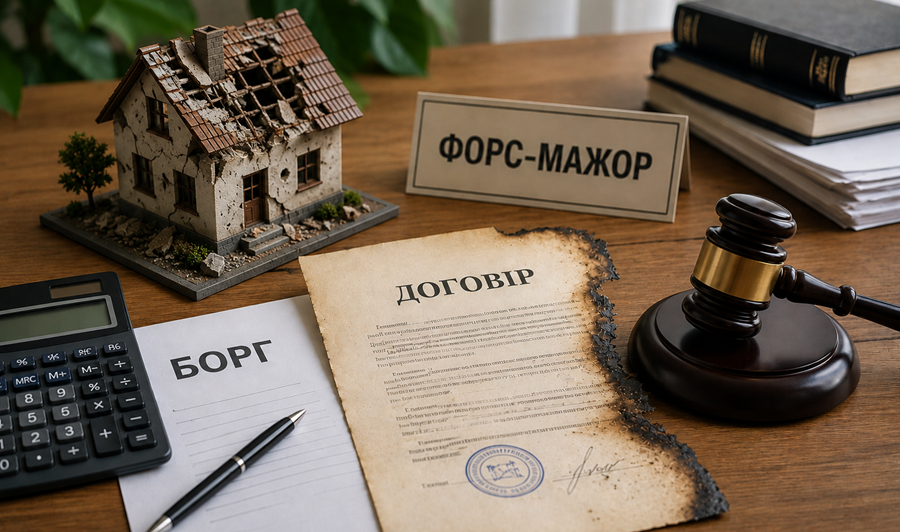
The plaintiff, located in a frontline zone, suffered significant losses due to shelling. The fire destroyed real estate and a significant portion of documentation, including the original supply contract. Taking advantage of this, the defendant, having received a delivery of goods worth over 7.9 million hryvnias, refused to pay, even denying the very existence of legal relations. The defendant's position was based solely on the absence of the original contract. Since the available copies of invoices did not contain all signatures, the defendant claimed that the debt did not exist.
Thus, the plaintiff filed a lawsuit to recover losses from the counterparty for unpaid but delivered goods and penalties.
The first instance court fully dismissed the claim. The court stated that a copy of the contract and reconciliation acts are not proper evidence without the originals of primary documents. The court also did not recognize the fact of the fire as sufficient proof of document loss.
The appellate court applied a different standard of "probability of evidence." The court concluded that even without the main contract, the signed original waybills and reconciliation acts confirm the reality of deliveries. The court found that the contract was concluded in a simplified manner.
The Supreme Court, in turn, dismissed the defendant's cassation appeal, supporting the appellate court's position. The panel of judges emphasized that formal defects cannot nullify the lawful right to receive payment for goods.
Procedural standards in the Supreme Court decision
The Supreme Court took the path of justice and established an approach whereby the formal absence of primary documents due to war cannot block the establishment of real business relations.
The court relied on key legal doctrines and procedural standards, including the principle of jura novit curia, according to which the court independently determines the legal nature of relations regardless of the parties' positions. This allowed the disputed legal relations to be qualified as those arising in a simplified contractual form.
Separately, the court applied the standard of probability of evidence provided by Article 79 of the Civil Procedure Code of Ukraine, emphasizing that a circumstance is considered proven if the totality of submitted evidence is more convincing than the opponent's arguments. In wartime conditions, this means moving away from the requirement of a complete set of documents in favor of assessing the entire evidentiary picture.
Significant importance was also given to the reconciliation act and waybills. Together, these documents can confirm the reality of transactions and the actual acknowledgment of debt, even if some primary documents are lost.
Moreover, appealing to Article 309 of the Civil Procedure Code of Ukraine, the court concluded that a correct and lawful decision on the merits cannot be overturned solely on formal grounds.
The Supreme Court strengthened the protection of businesses affected by hostilities. The loss of documents due to force majeure does not exempt from proving claims but allows the use of alternative sources of confirmation — from tax data and registers to photo documentation of shelling consequences and logistics documents.
Dishonest behavior of counterparties cannot be covered by formal legal requirements to provide original contracts. Even if archives are destroyed, with good faith business conduct and the presence of other evidentiary tools, it is possible to recover million-hryvnia debts.
Subscribe to our Telegram channel t.me/sudua and to Google News SUD.UA, as well as to our VIBER and WhatsApp, Facebook page Facebook and on Instagram to stay informed about the most important events.