Fraudsters Hunt for Property Owners in Temporarily Occupied Territories: Ukrainians May Lose Money and Documents


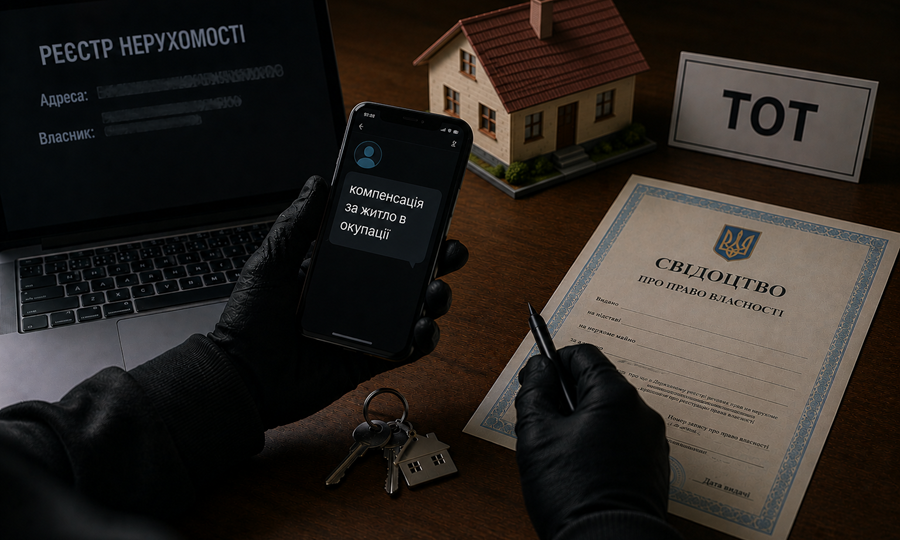










Millions of Ukrainians have lost the ability to use their housing in temporarily occupied territories. In some cases, the property was damaged or destroyed by the war; in others, houses and apartments physically remain, but their owners have lost access to them.
As previously noted by the "Judicial and Legal Newspaper", the greatest difficulties in the compensation procedure arise specifically regarding property in temporarily occupied territories, since conducting inspections and confirming the fact of destruction is often impossible. This legal uncertainty creates a basis for various speculations and fraudulent offers regarding allegedly guaranteed compensation for housing in the TOT.
Against this background, messages regularly appear on social networks, messengers, and even on certain internet resources about the possibility of receiving "compensation for housing in occupation," "fast payment processing," or "guaranteed reimbursement through international funds." Such offers are often accompanied by demands to pay an advance, provide copies of documents, or issue a power of attorney.
To assess the legality of such offers, it is necessary to understand which compensation mechanisms truly exist in Ukrainian legislation and what restrictions they have.
At the same time, the current procedure requires compliance with the legal requirements and does not allow payments to be received through intermediaries or bypassing official mechanisms.
What Ukrainian Legislation Provides
The main regulatory act in the field of compensation for damaged and destroyed housing is the Law of Ukraine No. 2923-IX "On Compensation for Damage and Destruction of Certain Categories of Real Estate Objects Due to Hostilities, Terrorist Acts, Sabotage Caused by the Armed Aggression of the Russian Federation Against Ukraine."
It is on the basis of this law that the state program "eRecovery" operates.
Is It Possible to Submit an Application Regarding Property in Occupied Territory
Ukrainian legislation allows submitting informational notifications about damaged or destroyed property through the "Diia" app, administrative service centers, or a notary.
If the housing was damaged or destroyed as a result of hostilities, the simplest and fastest way to notify the state is to submit an informational notification through the "Diia" app or portal "Diia". To do this, you need to authorize, select the service regarding damaged or destroyed property, verify the data about the real estate object, and send the notification.
At the same time, the "eRecovery" program currently does not provide for the possibility of submitting applications for housing located in temporarily occupied territories. Instead, owners of real estate located in areas of active hostilities can use the established procedure and submit the appropriate application.
The problem is that it is often impossible to establish the actual condition of property in the TOT. If the owner does not have reliable information about whether the housing was damaged or destroyed, and competent authorities cannot inspect the object, confirming the right to compensation may be complicated until the territory is deoccupied or proper evidence is obtained.
It is this uncertainty that fraudsters often exploit, promising to help bypass the procedure, speed up payment, or even guarantee compensation. However, no private individual, legal company, or intermediary has the authority to ensure a positive decision or receipt of state payments outside the procedure established by law.
Most Common Fraud Schemes
In recent years, law enforcement agencies have repeatedly reported fraudulent schemes where citizens were offered compensation for housing in occupied territories through allegedly special international programs or closed state registries. In most cases, the goal was to obtain money or personal data of the victims. Today, several typical schemes can be distinguished.
1) Dishonest Legal Assistance
Certain intermediaries offer legal assistance to obtain compensation and charge significant fees, although they actually only prepare applications or documents that do not guarantee a positive decision.
It is important to remember that no representative can guarantee receiving state compensation.
2) Demand for Prepayment for "Compensation Processing"
A person is offered to pay a certain amount for inclusion in the "register of victims" or for "accelerating payment." In reality, the state procedure does not provide for such payments.
3) Offer to Receive Compensation Through Non-Existent International Funds
Fraudsters refer to fictitious EU, UN, or international organization programs. After that, they ask to pay a commission or provide bank details.
4) Collection of Personal Data
Under the guise of processing compensation, citizens are asked to provide copies of passports, identification codes, property documents, and bank details. Such data may later be used to draw up fictitious contracts, gain access to bank accounts, create forged powers of attorney, or carry out other fraudulent actions on behalf of the property owner. Special caution should be exercised if documents are requested to be sent via messengers, social networks, or unknown websites.
- Issuance of Suspicious Powers of Attorney
Certain intermediaries offer to issue broad powers of attorney allegedly to represent the owner's interests. Unfortunately, such documents may be used against the interests of the principal in the future.
Thus, signs of potential fraud may include:
- guarantees of payment regardless of circumstances;
- demands to pay an advance or commission;
- promises to "bypass" the state procedure;
- references to non-existent state programs;
- demands to hand over original documents without proper justification;
- insistence on urgent decision-making.
Where to Turn in Case of Suspected Fraud
If a person has become a victim of such a scheme or has reasonable doubts about the legality of the offer, it is worth contacting the National Police of Ukraine and not handing over documents or money to third parties before verifying the information. If possible, correspondence, payment details, and other evidence of communication should be saved.
Thus, as of today, there is no universal compensation procedure in Ukraine solely because the housing is located in the TOT.
Therefore, property owners should critically approach any offers of "guaranteed compensation," especially if they involve prepayment for services or the transfer of personal data. In most cases, the only reliable guide remains official state mechanisms and verified legal assistance.
Subscribe to our Telegram channel t.me/sudua and to Google News SUD.UA, as well as to our VIBER and WhatsApp pages on Facebook and Instagram to stay informed about the most important events.