The Supreme Court did not allow the eviction of a serviceman from the former mother-in-law's summer house


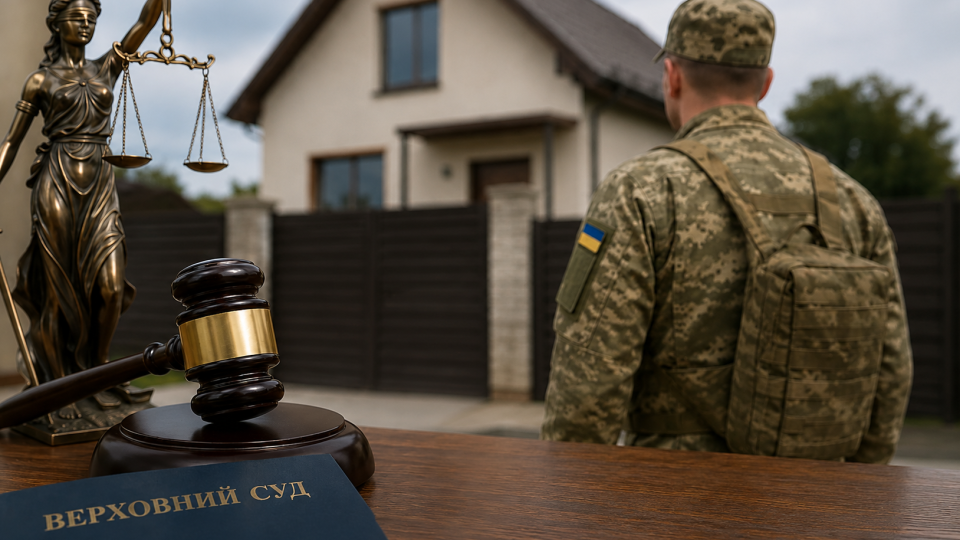










The Supreme Court, in the composition of the panel of judges of the First Judicial Chamber of the Cassation Civil Court in case No. 756/10234/23, confirmed that evicting a serviceman from a summer house, which is his only and permanent place of residence, would be a disproportionate interference with the right to housing, even if the house belongs to another person by ownership rights.
According to the case details, the plaintiff — the mother of the serviceman's former wife — applied to the court demanding the removal of obstacles to the use of the land plot and summer house by evicting her daughter's ex-husband. The plaintiff stated that after the divorce in 2019, the defendant ceased to be a member of her family but continues to live in the house and use the land plot without legal grounds.
The court of first instance agreed with these arguments and satisfied the claim, obliging the defendant to vacate the house and land plot.
However, the appellate court overturned this decision. The court established that the defendant is a serviceman, a combatant, and the disputed house is effectively his only residence. Meanwhile, the property owner permanently resides in her own apartment in Lviv.
Position of the Supreme Court
The Supreme Court reminded that according to Article 47 of the Constitution of Ukraine, no one can be forcibly deprived of housing except on the basis of law and by court decision. The court also noted the guarantees of Article 8 of the Convention for the Protection of Human Rights and Fundamental Freedoms, which provides the right to respect for one's home.
The panel of judges emphasized that according to the practice of the European Court of Human Rights, loss of housing is the most extreme form of interference with the right to respect for one's home. Therefore, even in cases where lawful grounds for housing use have ceased, the court is obliged to assess whether eviction is necessary and proportionate to the intended goal.
Also, the Supreme Court agreed with the appellate court's conclusions that under the established circumstances, evicting the defendant from his only actual place of residence would be a disproportionate interference with his right to housing and would contradict the guarantees of Article 8 of the Convention for the Protection of Human Rights and Fundamental Freedoms. The court reasoned that although the disputed property belongs to the plaintiff by private ownership, the defendant has lived in the house for a long time, has a stable life connection with it, pays maintenance costs, and is not provided with other housing. Additionally, his status as a serviceman and combatant was taken into account, as well as the unresolved dispute between the parties regarding repair costs of the house.
Furthermore, the court noted that the plaintiff did not provide sufficient evidence that the defendant actually obstructs her use or disposal of the disputed property.
Considering the totality of the established circumstances, the court concluded that evicting the defendant from his only home, with which he has a long and stable connection, would not meet the requirements of proportionality and would contradict the guarantees of Article 8 of the Convention and the practice of the European Court of Human Rights.
The Supreme Court also rejected the plaintiff's arguments that the subject of the dispute was only the removal of obstacles to the use of the property. The court stated that the claims directly concerned the removal of such obstacles specifically by evicting the defendant, so the appellate court examined the case within the declared claims.
At the same time, the panel of judges emphasized that the plaintiff's ownership right to the disputed property is not contested. The owner is not deprived of the opportunity to apply to the court with other claims, including regarding the removal of obstacles to access the property, establishing the order of its use, or eviction of the defendant on grounds that were not the subject of consideration in this case.
In conclusion, the Supreme Court decided to leave the cassation appeal unsatisfied and the appellate court's ruling unchanged.
Subscribe to our Telegram channel t.me/sudua and to Google News SUD.UA, as well as to our VIBER and WhatsApp, our page on Facebook and on Instagram to stay informed about the most important events.