Do Territorial Recruitment Centers Have the Right to Stop Vehicles Outside Checkpoints: What the Law Says


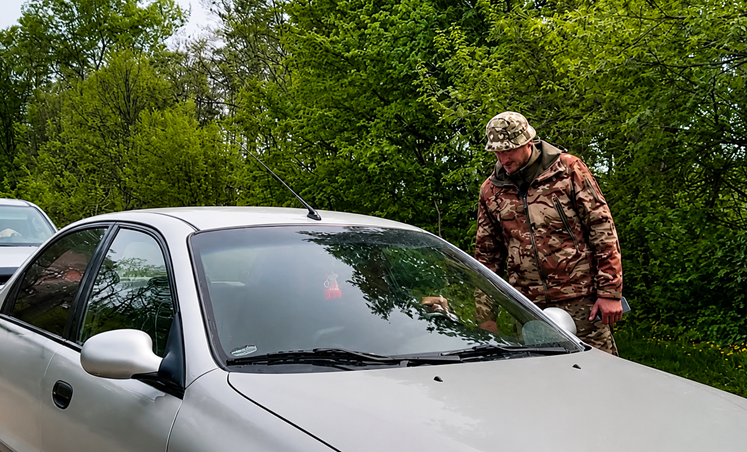










Since the beginning of the full-scale invasion, checkpoints have been established in many cities of Ukraine to check military registration documents and detect sabotage and reconnaissance groups, among other things. During this time, changes have occurred in the legislation, and the question of who exactly has the right to stop vehicles during martial law remains one of the most debated.
This issue arises especially often in situations when a vehicle is stopped outside stationary checkpoints, and document checks are conducted by representatives of territorial recruitment and social support centers together with the police. "Judicial and Legal Newspaper" explains whether such actions are legal, who and under what conditions has the right to stop vehicles.
Who has the right to stop vehicles
According to Cabinet of Ministers Resolution No. 1455, a checkpoint is a reinforced control point temporarily established by the military command at the entrance/exit (entry/exit) to/from a territory where martial law and a special regime have been introduced (except for the state border).
It should be noted immediately that the general rule in Ukraine remains unchanged: the right to stop vehicles belongs exclusively to the National Police. This is explicitly provided for by the Law of Ukraine "On the National Police." Only police officers can initiate stopping a vehicle and request documents from the driver. All grounds for such stopping are defined by law and cannot be applied arbitrarily.
At the same time, during martial law, the police operate taking into account the special legal regime established by the Law of Ukraine "On the Legal Regime of Martial Law." Additionally, the procedure for working at checkpoints and conducting certain inspections is regulated by Cabinet of Ministers Resolutions No. 1455 and No. 1456. From this, it follows that the right to check documents of persons, inspect belongings, vehicles, luggage and cargo, official premises, and citizens' homes is also granted to authorized persons of the Security Service of Ukraine, State Guard Department, National Guard, State Border Guard Service, State Migration Service, State Customs Service, and Armed Forces, as defined in the commandant's order.
The role of Territorial Recruitment Centers during inspections
The law does not grant Territorial Recruitment Centers the independent right to stop vehicles. Their function lies elsewhere – checking military registration documents of citizens, clarifying registration data, and carrying out mobilization measures. That is, representatives of Territorial Recruitment Centers may be present during inspections but only as part of relevant groups together with the police or other authorized persons. They cannot stop vehicles independently.
Important: only the police can initiate a stop, not Territorial Recruitment Centers.
Checkpoints and mobile inspections: what the law allows
During martial law, vehicle inspections may be conducted at checkpoints. Their procedure is regulated by government resolutions, which stipulate that authorized persons at such sites have the right to:
- At checkpoints:
- check identity documents confirming citizenship of Ukraine or special status;
- check documents necessary for cargo transportation (vehicle documents, cargo documents, waybills, etc.);
- inspect vehicles and cargo (goods) for compliance with cargo (goods) documents;
- detain persons, vehicles, cargo (goods), conduct their inspection, and hand them over to authorized law enforcement representatives;
- temporarily restrict (prohibit) movement of vehicles and persons;
2) Outside checkpoints:
- detect violations of the established order of movement of persons, vehicles, cargo (goods) into territories with a special regime;
- detain persons, vehicles, cargo (goods), conduct their inspection, and hand them over to authorized law enforcement representatives.
However, an important condition is the legality of the checkpoint itself. It must be created in the prescribed manner and operate based on a decision of authorized military command or military administration bodies.
Separate discussions arise around so-called "mobile checkpoints." Resolution No. 1455 defines the procedure for working at checkpoints: authorized persons may check citizens' documents and inspect vehicles and belongings only if there is a corresponding order from the military administration about the establishment of the checkpoint and designation of persons with such authority. Resolution No. 1456 also regulates the operation of checkpoints, including those that may be set up within populated areas. Ukrainian legislation does not clearly define this concept as a separate form of checkpoint. Therefore, in law enforcement practice, questions often arise about their legal status and the limits of authority of persons working there.
Is it possible not to stop on demand outside a checkpoint
If a vehicle is stopped outside an official checkpoint, the key factor is who exactly gives the order to stop. If it is a police officer, the driver is obliged to comply, as failure to do so may entail administrative liability.
If the stop order is given by an unauthorized person without police participation, the legal situation becomes more complicated and may require separate assessment of the circumstances, including the presence of legal grounds for such actions.
What liability may arise for the driver
In case of failure to comply with the stop order, administrative liability is most often involved. Usually, materials are drawn up stating that the driver did not comply with a lawful order to stop the vehicle. After that, relevant documents are prepared for further consideration.
In most cases, such situations are limited to administrative procedures without further serious consequences, but each case is assessed individually.
Persons who commit criminal or administrative offenses are detained in accordance with the procedure established by the Criminal Procedure Code of Ukraine and the Code of Ukraine on Administrative Offenses.
What a driver should do if stopped by representatives of Territorial Recruitment Centers
In situations where a vehicle is stopped and document checks begin, it is important for the driver to act calmly and within the law.
The recommended course of action is as follows:
- Clarify who exactly is conducting the stop and inspection. The driver has the right to ask which official stopped the vehicle and on what grounds.
- Request to present official documents. Authorized persons must confirm their authority.
- Find out the legal basis for the stop. It is important to understand whether there is a lawful reason for the inspection in this situation.
- Record events. If possible, it is advisable to make a video recording of the interaction to protect one’s rights in case of dispute.
- Call the police in case of conflict. If there are signs of abuse of authority or obstruction of movement, it is advisable to call the police.
If the driver is taken to the Territorial Recruitment Center. Separate situations arise when a citizen is not just stopped but taken to the territorial recruitment center. In such cases, lawyers advise acting with maximum caution and recording all procedural actions. The person has the right to legal assistance and may contact a lawyer. In practice, different scenarios occur: in some cases, after the inspection, citizens receive a summons and leave the center; in others, additional administrative procedures continue to clarify registration data.
Ukrainian legislation clearly delineates powers: the police have the right to stop vehicles, while Territorial Recruitment Centers are not endowed with such functions. Their role is limited to checking military registration documents within established procedures.
During martial law, these processes often occur jointly with the police and other structures, but even under such conditions, all actions must be carried out strictly within the law. For drivers, the key remains understanding their rights, behaving calmly, and recording all actions of officials in case of contentious situations.
Subscribe to our Telegram channel t.me/sudua and to Google News SUD.UA, as well as to our VIBER and WhatsApp, our page on Facebook and on Instagram to stay informed about the most important events.


Popular news