Constitutional Guarantees of Taxpayer Rights: Constitutional Court Judges Halyna Yurovska and Oleksandr Vodyannikov Held an Online Lecture


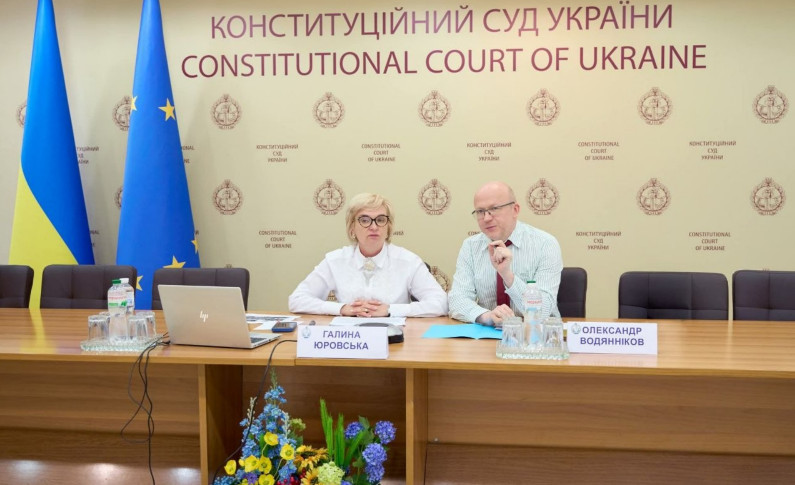










On May 21, a thematic online lecture titled "On Ensuring Constitutional Guarantees of Taxpayer Rights in the Context of the Decision of the Constitutional Court of Ukraine dated November 26, 2025, No. 5-р(II)/2025" took place.
Constitutional Court judges Halyna Yurovska and Oleksandr Vodyannikov focused the audience's attention on the Decision of the Second Senate of the Constitutional Court of Ukraine dated November 26, 2025, No. 5-р(II)/2025 in the case concerning the constitutional complaint of the company "ANDRITZ HYDRO GmbH" regarding the constitutionality of certain provisions of paragraph 120-1.1 of Article 120-1 of the Tax Code of Ukraine.
The subject of constitutional review was the provisions of the Code that establish fines for violating the deadline for registering a tax invoice and/or adjustment calculation in the Unified Register of Tax Invoices. The petitioner argued that the prescribed penalties are clearly excessive, violate the rule of law principles, including fairness, proportionality, and reasonableness, and constitute a disproportionate interference with the constitutionally guaranteed right to property in Ukraine.
During the lecture, the judges emphasized the social importance of proper tax payment. They noted that according to the Constitution of Ukraine, paying taxes is the duty of every citizen, and the effective functioning of the tax system determines Ukraine's viability as a social state, budget balance, and the state's ability to fulfill its functions. The Court's Decision also stressed that budget balance becomes especially important during martial law due to the need to protect Ukraine from the large-scale armed aggression of the Russian Federation.
It was explained that the Court recognized the legitimate purpose of imposing a fine for violating the deadline for registering a tax invoice and/or adjustment calculation, as such a mechanism aims to ensure legality in the electronic administration of value-added tax and, accordingly, to protect Ukraine's economic security.
At the same time, the speakers emphasized that even with a legitimate purpose, interference with the taxpayer's property rights must meet the requirements of proportionality. The Court concluded in the Decision that the second paragraph of clause 120-1.1 of Article 120-1 of the Tax Code of Ukraine, in substantive connection with the first paragraph of this clause, is an appropriate and necessary legislative means to achieve the corresponding goal and does not violate a fair balance between protecting Ukraine's economic security and taxpayers' rights.
Special attention during the lecture was given to the nature of penalties in tax relations. As the judges explained, such sanctions may have not only a compensatory but also a punitive and preventive character. If a fine by its nature and severity is comparable to a criminal penalty, the procedure for bringing a person to responsibility must comply with the relevant constitutional guarantees.
In this context, the practice of the European Court of Human Rights regarding the so-called Engel criteria was analyzed, which determine the presence of a "criminal aspect" of liability: the legal classification of the offense under national law, the nature of the offense, and the character and severity of the penalty. The judges emphasized that financial penalties, including fines, under certain conditions may be comparable to criminal punishment and therefore must provide guarantees of individualization of responsibility and the presumption of innocence.
The speakers explained that in the Decision, the Court formulated an important guideline for legislators and law enforcement agencies: the application of a sanction to a taxpayer that by its nature is comparable to a criminal penalty must be combined with a legislative procedure for bringing to responsibility that ensures the principles of individualization of legal responsibility and the presumption of innocence.
In particular, when applying such sanctions, the decisive factor is the obligation of the law enforcement body to prove the guilt of the subject being held legally responsible. The form and degree of guilt must be among the circumstances considered by both the controlling authority and the court when examining all factual and legal aspects of the specific case.
The judges also drew attention to the international and comparative legal materials used in the Decision. In particular, they referred to the practice of the European Court of Human Rights on ensuring a fair balance between public interest and protection of property rights, the Venice Commission's position regarding the requirements of effectiveness, deterrence, and proportionality of administrative sanctions, as well as approaches of the Constitutional Court of the Republic of Lithuania, the Constitutional Council of the French Republic, and the Constitutional Court of the Republic of Moldova to the individualization of legal responsibility and judicial control over the application of sanctions.
As a result of the case review, the Constitutional Court of Ukraine recognized the second paragraph of clause 120-1.1 of Article 120-1 of the Tax Code of Ukraine, in substantive connection with the first paragraph of this clause, as compliant with the Constitution of Ukraine. At the same time, the constitutional proceedings regarding the constitutionality of paragraphs three to six of clause 120-1.1 of Article 120-1 of the Code were closed due to the inadmissibility of the constitutional complaint, as these provisions were not applied in the final court decision in the applicant's case.
The event also discussed the significance of separate judges' opinions for the development of constitutional doctrine and judicial dialogue. Regarding Decision No. 5-р(II)/2025, separate opinions of Judge Halyna Yurovska, Judge Viktor Horodovenko, a concurring opinion of Judge Vasyl Lemak, and a partly concurring and partly dissenting opinion of Judge Oleksandr Vodyannikov were published. The speakers emphasized that familiarizing oneself with these opinions allows for a deeper understanding of the reasoning accompanying the decision and assessing future directions for the development of constitutional adjudication.
Subscribe to our Telegram channel t.me/sudua and to Google News SUD.UA, as well as to our VIBER and WhatsApp, Facebook page and Instagram account to stay informed about the most important events.