Ukraine on the path to the EU: progress and judicial reform in wartime discussed at the Supreme Court


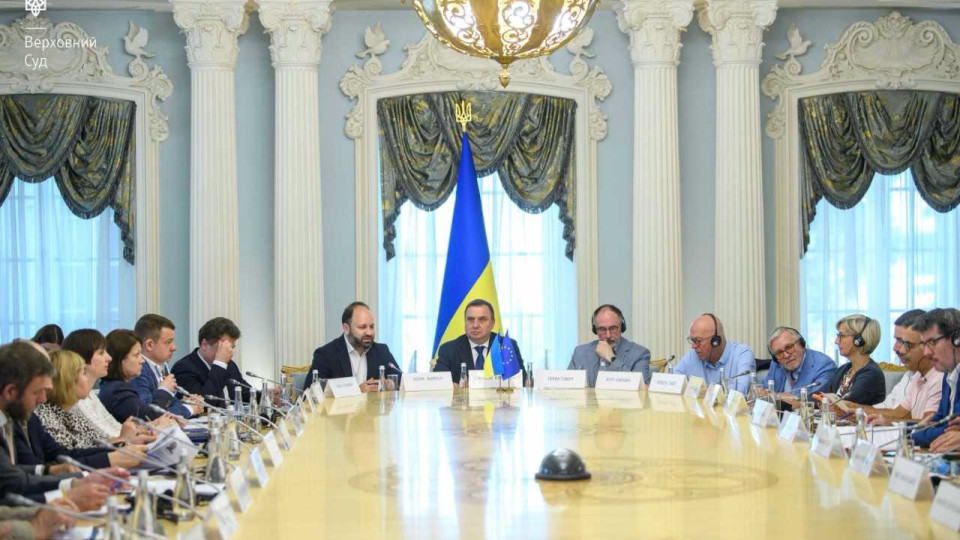










A meeting with representatives of the European Parliament took place at the Supreme Court during the Second meeting of the Subcommittee of the Parliamentary Committee of the Association "Ukraine – EU" dedicated to Ukraine's accession to the European Union.
During the meeting, members of the European Parliament, representatives of the Secretariat of the European Parliament, the Verkhovna Rada of Ukraine, judicial governance bodies, international experts, and judges of the Supreme Court discussed Ukraine's progress in implementing measures provided for in Negotiating Chapter 23 "Judiciary and Fundamental Rights," the status of the Roadmap on the Rule of Law, the specifics of Ukrainian courts' work under wartime conditions, as well as the results of reforms in the context of European integration.
The Chairman of the Supreme Court, Stanislav Kravchenko, on behalf of the entire judicial community of Ukraine, expressed gratitude to the representatives of the European Parliament for their consistent support of our state in the struggle for its independence and European future.
He noted that amid the full-scale war of the Russian Federation against Ukraine, national courts have shown extraordinary resilience, continuing to administer justice under such difficult conditions. Today, the scope of Ukrainian courts' activities is quite broad: consideration of cases related to war crimes (according to the Office of the Prosecutor General, as of the end of June 2026, over 239,000 war crimes have been registered), crimes against the foundations of Ukraine's national security, corruption offenses; resolving issues related to internally displaced persons, compensation for damages caused by the war, social protection of citizens in disputes with the state, and more.
"We understand that our efforts will yield worthy results only if European standards are observed, so Ukraine chose the path of European integration many years ago," emphasized the Chairman of the Supreme Court. For example, this July marks 29 years since Ukraine ratified the Convention for the Protection of Human Rights and Fundamental Freedoms. The national judicial system continues cooperation with the European Court of Human Rights, in particular Ukrainian courts apply its positions in their decisions, forming corresponding judicial practice at the national level. At the same time, work continues on analyzing the practice of the Court of Justice of the European Union.
Joining the large European family remains especially relevant for Ukraine, as this step will determine the post-war reconstruction of Ukraine and its development as a democratic rule-of-law state, added Stanislav Kravchenko. The Supreme Court continues to actively act, ensuring in cooperation with the national parliament the implementation of European integration requirements, including those provided by the Roadmap on the Rule of Law.
According to Stanislav Kravchenko, the current priority areas for the national legal system in the context of approaching EU standards are:
- development of legislation to ensure the unity of judicial practice;
- improvement of cassation review mechanisms and application of cassation filters;
- prevention of abuse of procedural rights;
- further implementation of digital justice and expansion of remote court hearing capabilities.
The Secretary of the Grand Chamber of the Supreme Court, Serhiy Pohrebny, noted that Ukraine's commitment to the fundamental democratic values on which the European Union is based has not a declarative but a practical dimension. National courts, primarily the Grand Chamber of the Supreme Court, have long begun to take into account EU sources of law and legal positions of the Court of Justice of the EU in their law enforcement practice.
In particular, in the ruling dated August 3, 2022, in case No. 910/9627/20, the Grand Chamber of the Supreme Court formulated a legal conclusion regarding the advisability of considering in Ukraine's law enforcement practice the conclusions and principles formulated in the decisions of the Court of Justice of the EU, even if they concern other states.
Application of EU sources of law in the practice of the Grand Chamber of the Supreme Court
Serhiy Pohrebny provided several examples of the application of EU sources of law in the practice of the Grand Chamber of the Supreme Court. Among them is the ruling of the Grand Chamber dated February 15, 2023, in case No. 910/18214/19 concerning a claim by a former shareholder of an insolvent bank to declare invalid transactions made during the procedure of withdrawing the bank from the market with the participation of the state as an investor. When resolving the issue of the effectiveness of the plaintiff's chosen method of protection and interpreting the national norm and the rationale for the conclusion about the ineffectiveness of the chosen method, the Grand Chamber referred to Directive 2014/59/EU of the European Parliament and Council dated May 15, 2014, on the main provisions regarding the recovery and resolution of credit institutions and investment firms.
In case No. 910/13988/20 (ruling of the Grand Chamber dated April 17, 2024) regarding the recognition of a pharmaceutical trademark as well-known and the invalidation of the Ukrainian certificate of trademark registration, the Supreme Court referred obiter dictum to the practice of the Court of Justice of the EU to illustrate the significance of good faith registration of a conflicting mark for limiting the right to protect the owner of a well-known mark.
Cassation Administrative Court within the Supreme Court
As noted by the Chairman of the Cassation Administrative Court within the Supreme Court, Ihor Dashutin, Ukraine is on the path to EU membership under extremely difficult conditions of a full-scale war, not stopping the reform process and demonstrating the ability to act according to the principles of democracy and the rule of law under unprecedented circumstances. Part of this institutional resilience is precisely the courts, which have not ceased their work amid enemy missile strikes, air raid alerts, forced relocation of judges, and changes in territorial jurisdiction of courts located in temporarily occupied or frontline territories.
Every day citizens continue to turn to courts for protection of their rights, the state continues to enforce court decisions, and the Supreme Court ensures the unity of judicial practice. According to Ihor Dashutin, this is the best confirmation of the institutional maturity of the Ukrainian state. The rule of law, independent judiciary, respect for human rights are not only Ukraine's obligations to the EU but also the foundation of our state's resilience, summarized the Chairman of the Cassation Administrative Court.
Cassation Commercial Court within the Supreme Court
The Chairwoman of the Cassation Commercial Court within the Supreme Court, Larysa Rohach, noted that commercial jurisdiction, administering justice in the field of economic legal relations, is one of the main elements of investment protection and building links between state institutions, business entities, and citizens. In the context of the European integration process, it is important that the state has a predictable legal environment based on the rule of law principles, because it is in such an environment that business develops, investments are attracted, and the economy functions effectively.
According to the head of the Cassation Commercial Court, judges of commercial jurisdiction are already active participants in the process of adapting Ukrainian law to EU law. They ensure proper application of legislative novelties adopted within European integration reforms, participate in the official screening of Ukrainian legislation regarding negotiating chapters related to corporate law and intellectual property law. Additionally, the Supreme Court is a co-executor of the National Program for the Adaptation of Ukrainian Legislation to EU Law (EU acquis) in the field of intellectual property, and Supreme Court decisions are included in the WIPO Lex-Judgments database, which provides access to the most important court decisions of various countries in the field of intellectual property law.
At the same time, Larysa Rohach emphasized that bringing Ukrainian law closer to European standards occurs not only through legislative changes. According to her, judicial practice also plays an important role in this process, which must adapt to societal needs and European standards. In this context, the speaker drew attention to the concept of a "reasonable legislator," which is part of a dynamic approach to interpreting legal norms and implies that the court should be guided not only by the intentions of the legislator who adopted the law in the past but also by how the legislator might understand the norm under current conditions.
Overall, Larysa Rohach noted, the Supreme Court directs efforts to form legal positions that allow effectively resolving complex legal issues by properly interpreting current legislation considering European standards without the need to amend the legislation.
Cassation Criminal Court within the Supreme Court
Acting Chairwoman of the Cassation Criminal Court within the Supreme Court, Natalia Antonyuk, emphasized that Ukrainian judges, when considering criminal proceedings, not only analyze the provisions of the Criminal Procedure Code of Ukraine but also actively use the practice of the European Court of Human Rights. She also spoke about the high standards of proof in the national judicial system, particularly regarding requirements for using evidence obtained from open sources (OSINT).
"There is no doubt that standards of justice must be ensured even during wartime. At the same time, the specificity of criminal justice lies in the fact that it provides for the possibility of the most severe restriction of rights and freedoms, so it is necessary to be extremely careful when applying such restrictive measures," noted Natalia Antonyuk.
Regarding the specifics of considering the new category of cases on war crimes, the speaker highlighted the role of European partners in spreading knowledge among Ukrainian judges about the application of the Geneva Conventions, interpretation of the practice of the International Criminal Court, and experience of international tribunals. Natalia Antonyuk added that the main task of criminal jurisdiction is to bring to justice not just anyone but those who truly committed the crime. She expressed hope that thanks to the joint efforts of Ukraine and the European community, persons committing war crimes in Ukraine will receive fair punishment.
Cassation Civil Court within the Supreme Court
The Chairwoman of the Cassation Civil Court within the Supreme Court, Maryna Chervynska, emphasized that Ukraine aspires to be a member of the European Union and that the Ukrainian judicial system, including civil jurisdiction, has made considerable efforts in recent years to make this a reality.
Using civil cases as examples, the speaker demonstrated the dynamics of changes in law enforcement towards harmonization with European legal standards. One of the most illustrative categories of cases is family and children cases. If eight years ago Ukrainian court decisions were dominated by the postulate that a minor child cannot be separated from the mother except in cases where it violated the child's rights, after the ECHR rulings in the cases "Mamchur v. Ukraine" and "Hunt v. Ukraine," national judicial practice began to focus on the principle of equality of rights of father and mother and the need to determine the best interests of the child.
At the same time, new realities related to armed aggression pose challenges for civil jurisdiction, particularly in labor relations and the recovery of property from bona fide purchasers in light of new substantive law norms, noted the Chairwoman of the Cassation Civil Court.
Subscribe to our Telegram channel t.me/sudua and to Google News SUD.UA, as well as to our VIBER and WhatsApp, Facebook page and Instagram page to stay informed about the most important events.