The Supreme Court expressed its position on the accrual of penalties beyond the 6-month period during quarantine


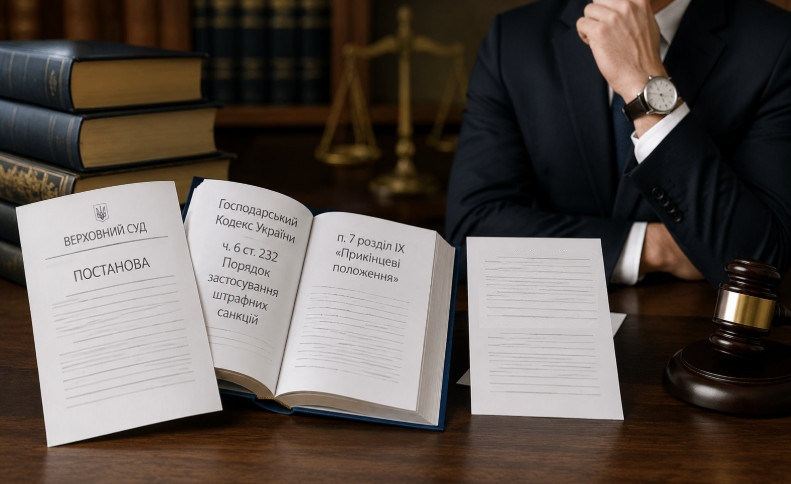










The inconsistency of legislative regulation of terms changed during the quarantine period and the existence of different approaches to the interpretation of the relevant norms do not in themselves indicate the need to deviate from the previously formed conclusion of the Supreme Court regarding the application of part 6 of Article 232 of the Civil Code of Ukraine in connection with paragraph 7 of Section IX "Final Provisions" of the Civil Code of Ukraine concerning the possibility of accruing penalties beyond the six-month period during the quarantine. This conclusion was reached by the Commercial Cassation Panel of the Supreme Court.
The dispute arose between a Private Joint Stock Company and a Limited Liability Company due to the violation of delivery deadlines under a supply contract. The Private Joint Stock Company requested to recover a penalty from the Limited Liability Company for 7 months of delay in fulfilling the obligation.
The court of first instance fully satisfied the claim. The appellate court disagreed with the conclusion of the local commercial court regarding the legality of the plaintiff's penalty accrual for the period exceeding 6 months, stating that the application of paragraph 7 of Section IX "Final Provisions" of the Civil Code of Ukraine in this case is unfounded.
The Commercial Cassation Panel of the Supreme Court faced the question of whether there are grounds to deviate from the Supreme Court's legal conclusion regarding the application of paragraph 7 of Section IX "Final Provisions" of the Civil Code of Ukraine concerning the possibility of accruing penalties beyond the six-month period during the quarantine.
Analyzing the arguments for deviation, the Court noted the peculiarities of legislative changes adopted during the quarantine period. These changes covered terms of different legal nature: procedural terms, terms for filing lawsuits, terms of existence of certain obligations, as well as terms related to the accrual of penalties. Such legislative construction indicates inconsistency in the regulation of the relevant terms and necessitates a cautious approach to assessing the grounds for changing the established judicial practice.
The Court emphasized that justified grounds for deviating from the already formed legal position of the Supreme Court include, in particular: changes in legislation; decisions of the Constitutional Court of Ukraine or the European Court of Human Rights, whose conclusions must be taken into account by national courts; changes in law enforcement caused by the expansion of the scope of application of a certain legal principle or changes in doctrinal approaches to resolving issues, etc.
Based on the case review, the Commercial Cassation Panel of the Supreme Court concluded that there are no sufficient legal grounds to deviate from the previously formed legal position in this case.
The resolution of the Commercial Cassation Panel of the Supreme Court dated June 12, 2026, in case No. 910/22/24 can be found at this link.
Subscribe to our Telegram channel t.me/sudua and to Google News SUD.UA, as well as to our VIBER and WhatsApp pages, and on Facebook and Instagram to stay informed about the most important events.