Head of the Supreme Court Stanislav Kravchenko announced a significant volume of cases in courts concerning war crimes and crimes against national security


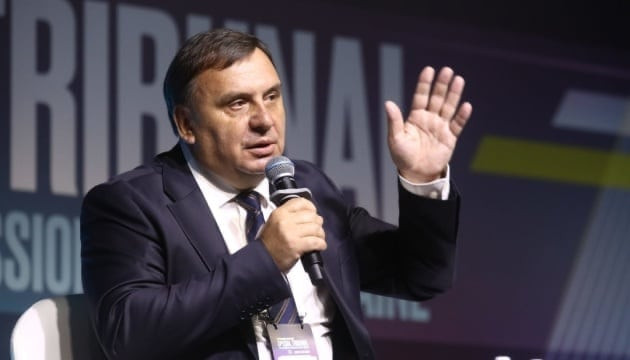










The Head of the Supreme Court Stanislav Kravchenko reported that a significant volume of cases related to war crimes and crimes against the foundations of national security is being recorded.
He said this within the framework of the 2nd International Lawyers' Forum "Kharkiv Unbreakable 2026," which brought together representatives of the legal community from Kharkiv, Kyiv, Lviv, Lutsk, and Uzhhorod.
Stanislav Kravchenko noted that in the conditions of the full-scale war of the Russian Federation against Ukraine, the judiciary performs a special mission – not only making decisions but also ensuring the stability of the legal order, guaranteeing uninterrupted access to justice, and protecting fundamental human rights.
According to him, despite the extraordinary workload, the judicial system demonstrates resilience, professionalism, and dedication to the principles of the rule of law. In 2025, almost 5.8 million cases and materials were pending in Ukrainian courts, of which more than 4.6 million have already been considered.
As Stanislav Kravchenko points out, a significant volume of cases related to war crimes and crimes against the foundations of national security is being recorded. More than three thousand criminal proceedings regarding war crimes have already been submitted to the courts, and their consideration allows for the formation of unified judicial practice and lays the groundwork for the inevitability of responsibility for the guilty. At the same time, the judicial system ensures the consideration of numerous disputes regarding compensation for damages caused by the war, protection of the rights of internally displaced persons, and social security for servicemen and their families.
Additionally, Stanislav Kravchenko also emphasized that despite the difficult challenges of wartime, the judiciary does not deviate from the strategic course toward European integration, and the Supreme Court actively participates in fulfilling Ukraine's obligations on the path to European Union membership and is responsible for implementing several positions within the negotiation process.
Earlier, the Criminal Chamber of the Supreme Court noted that courts have learned to better consider war crimes cases, but in absentia problem remains.
Some courts try to apply adaptive approaches for proper notification of the accused, including sending documents to email addresses or using contacts on social networks (mainly in cases concerning crimes against the foundations of national security). However, currently, such steps depend solely on the subjective discretion of the judge and do not have clear legislative support.
Subscribe to our Telegram channel t.me/sudua and to Google News SUD.UA, as well as to our VIBER and WhatsApp pages on Facebook and Instagram to stay informed about the most important events.