Private and State Executors: What They Have in Common and Their Powers


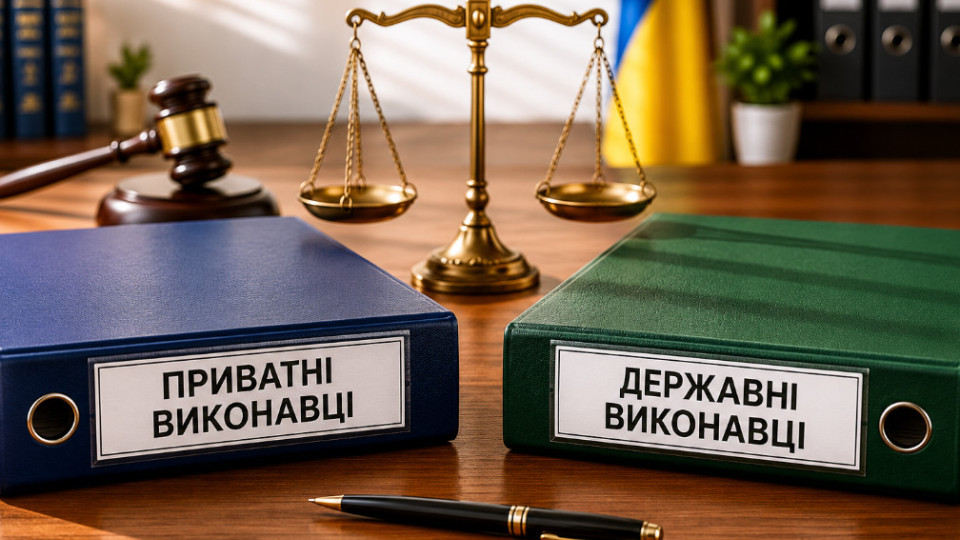










Enforcement of a court decision is the final stage of the judicial process and an important component of human rights protection. In Ukraine, state and private executors are responsible for the compulsory enforcement of court decisions and decisions of other bodies.
Until 2016, compulsory enforcement of decisions in Ukraine was carried out exclusively by the state executive service bodies. After the reform of the compulsory enforcement system, a mixed model was introduced, under which private executors operate alongside state executors in cases defined by law.
The Ministry of Justice clarified the key differences between state and private executors and what they have in common in their activities.
What They Have in Common
State and private executors, when conducting enforcement proceedings, operate within a unified legal framework and are guided, in particular, by the Laws of Ukraine "On Enforcement Proceedings" and "On Bodies and Persons Who Carry Out Compulsory Enforcement of Court Decisions and Decisions of Other Bodies."
Private executors, in the course of their professional activities, have the right to take the same compulsory enforcement measures as state executors (except for applying temporary restrictions to a debtor who has arrears in alimony payments).
They can seize the debtor's funds and property, search for the debtor, enforce claims on the debtor's property and income, and take other measures defined by law.
Resolutions, demands, and other documents issued by both state and private executors are mandatory for execution by all authorities, banks, enterprises, and citizens.
Both categories of executors are obliged to strictly adhere to the principles of legality, fairness, and impartiality.
Key Differences
Both state and private executors are authorized by the state to carry out compulsory enforcement activities; however, state executors are civil servants, while private executors are subjects of independent professional activity.
A state executor is an official of the state executive service body, acts on behalf of the state, and is under its protection.
A private executor can be a citizen of Ukraine who has passed the procedure established by law for admission to the profession and passed a qualification exam. A private executor begins their compulsory enforcement activities after being entered into the Unified Register of Private Executors of Ukraine.
It should also be noted that the law provides a list of decisions that are subject to enforcement exclusively by the state executive service bodies. In particular, private executors do not have the authority to enforce decisions related to the collection of funds from or in favor of the state, child custody and transfer, eviction and settlement, property confiscation, administrative court decisions, and decisions of the European Court of Human Rights.
There are fundamental differences in the organization of activities of state and private executors. A state executor is an employee of the state executive service body whose competence extends to a certain administrative-territorial unit (a district in a city, a district in a region, a city, or a region).
A private executor, within the enforcement district chosen by them, is obliged to organize an office that must provide proper conditions for carrying out compulsory enforcement activities. An enforcement district is the territory of the Autonomous Republic of Crimea, a region, the city of Kyiv, or Sevastopol. Enforcement actions in enforcement proceedings opened by a private executor in their enforcement district may be carried out by them throughout the territory of Ukraine.
Whom to Contact
If the law allows enforcement of a decision by both a state and a private executor, the person in whose favor the enforcement document was issued may independently decide whom to contact for compulsory enforcement.
If contacting a private executor, they can be chosen from those entered in the Unified Register of Private Executors of Ukraine, taking into account the amount to be collected and the place of enforcement of the decision.
If the law provides that a certain category of decisions cannot be enforced by private executors, it is necessary to contact the state executive service bodies.
Subscribe to our Telegram channel t.me/sudua and to Google News SUD.UA, as well as to our VIBER and WhatsApp, our page on Facebook and on Instagram to stay informed about the most important events.