Battle for the "Lost" Billions: A Lawsuit Filed in the US for Ownership of 39 Thousand Inactive Bitcoin Wallets













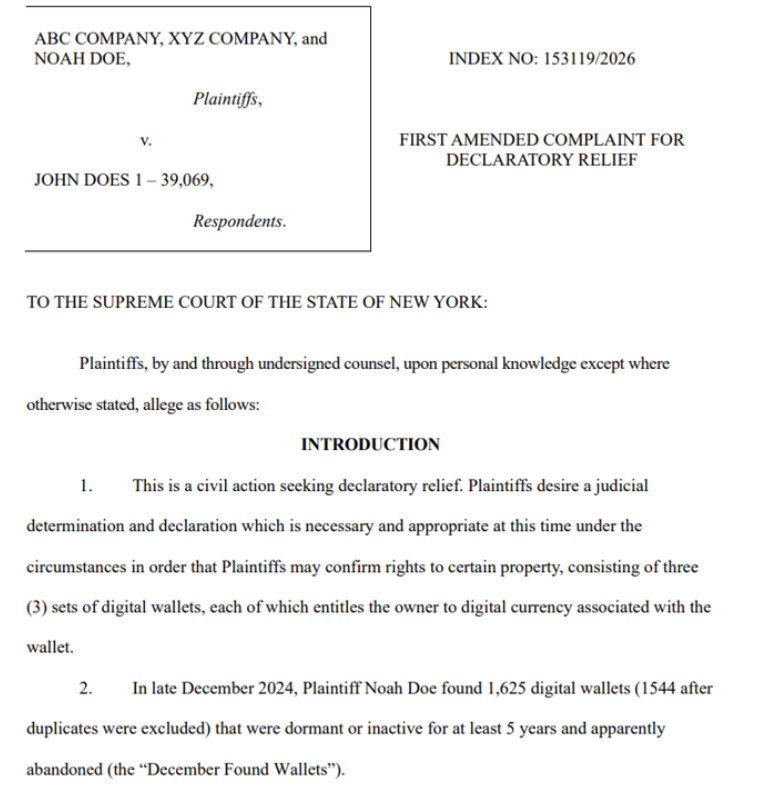
In the US, a lawsuit was filed in a New York court by Noah Dow and two Wyoming limited liability companies — ABC Company and XYZ Company — for ownership of 39,069 "lost" bitcoin wallets.
The lawsuit was filed on May 1. It claims that the coins associated with these addresses are legally abandoned property, which the plaintiffs discovered, reported to the New York Police, and asserted their rights to in accordance with New York State's abandoned property laws.
The plaintiffs argue that inactive bitcoin wallets are legally "abandoned" property they found. This includes wallets of early Bitcoin miners and addresses attributed to the cryptocurrency's creator Satoshi Nakamoto, as well as other lost coins and addresses of unidentified persons. In their view, such assets can be seized similarly to traditional bank accounts.
As Cointelegraph writes, the lawsuit raises important questions about the legal status of bitcoin wallets that have remained inactive for many years, including tokens from the Satoshi era that have not been used for over a decade. At the same time, the legal grounds for such a lawsuit are doubtful, as it is unclear how the plaintiffs could access the bitcoins without having the private keys to the respective wallets.
According to a leading analyst from the investment research company Castle Labs, known under the pseudonym Noveleader, even if the court rules in favor of the plaintiffs, the decision would be largely symbolic and technically unenforceable, since the Bitcoin network has no mechanism for "reassigning funds without a private key."
He said the only exception might be if such coins are moved to an account of a regulated custodial service or cryptocurrency exchange. In that case, the court could compel the relevant intermediary to enforce the decision.
The analyst also noted that a significant portion of these coins may belong to deceased owners, individuals who lost their private keys, or long-term investors who simply have not conducted any transactions for a long time. In his opinion, none of these circumstances indicate a legal abandonment of ownership rights to the assets.
According to the founder of the on-chain analytics platform Bitcoin Timechain Index, the mentioned addresses contain approximately 3.7 million BTC worth about 285 billion US dollars.
He also noted that most of the old tokens from the Satoshi era are currently stored in Pay-to-Public-Key (P2PK) format, while the plaintiffs sent legal notices only to the corresponding hashed public keys in Pay-to-Public-Key-Hash (P2PKH) format, which often hold no value.
This may call into question the claim that the owner was properly notified of the abandonment of the property, since the plaintiffs sent legal notices to empty P2PKH addresses, while the actual BTC balance is stored in P2PK scripts, to which no notices were sent.
More than 39 thousand wallets mentioned in the lawsuit contain bitcoins considered inactive or lost, meaning they have not participated in on-chain transactions for many years.
Subscribe to our Telegram channel t.me/sudua and to Google News SUD.UA, as well as to our VIBER and WhatsApp, our page on Facebook and on Instagram to stay updated on the most important events.