The Supreme Court Obliged a Bank Client to Return Over 7.4 Thousand Euros Mistakenly Credited Due to a System Failure


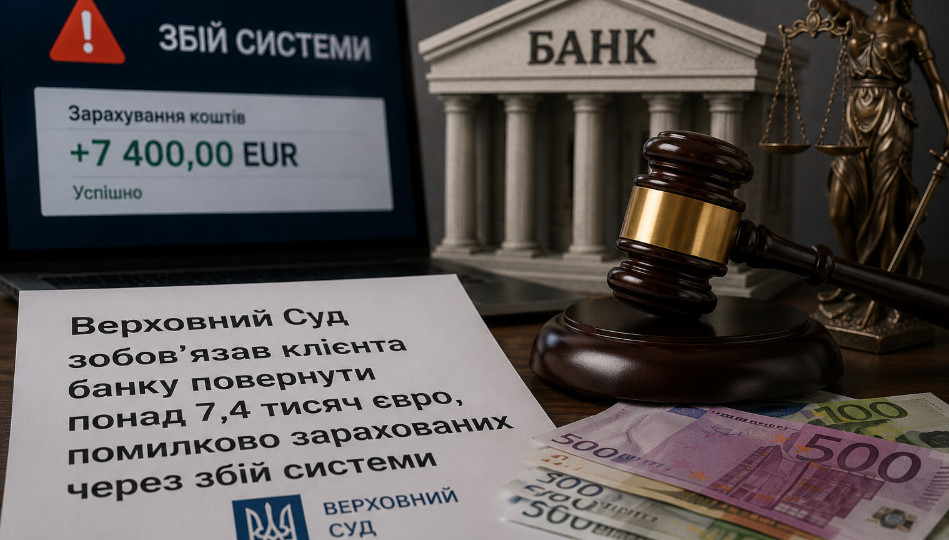










The Supreme Court, composed of a panel of judges of the Second Judicial Chamber of the Cassation Civil Court, considered a dispute between a bank and a bank client regarding the return of funds mistakenly credited to the account as a result of a technical failure of the processing system.
Circumstances of the case
The parties concluded a banking service agreement and opened a euro card account with a Visa payment card for the client. On September 24, 2022, international transfers in Malagasy ariary (MGA) were received to the account, but during conversion to euros at the bank's processing center, a technical error occurred. Due to an incorrectly set parameter, instead of 75.52 euros, 7,552.10 euros were credited to the respondent's account. After discovering the error, the bank made adjustments to the operations, which caused a technical (unauthorized) overdraft, but the client did not voluntarily return the funds.
The bank insisted that the funds were mistakenly credited and must be returned as unjust enrichment. The client objected, referring to contractual relations and the right to dispose of the funds as their own, and also argued that there were no grounds for applying the rules on unjust enrichment.
The court of first instance satisfied the bank's claim and recovered 7,445.60 euros from the respondent as unjustly acquired funds, rejecting the client's counterclaim. The court reasoned that the funds were mistakenly credited due to a technical failure in the banking system and must be returned under Article 1212 of the Civil Code of Ukraine. The appellate court upheld this decision, agreeing that the conclusions of the first instance court were lawful and justified, and there were no grounds for cancellation.
Disagreeing with this decision, the bank client, represented by a proxy, filed a cassation appeal.
Reasons on which the Supreme Court relied
The Supreme Court, dismissing the cassation appeal, established that according to parts one and two of Article 1212 of the Civil Code of Ukraine, a person is obliged to return unjustly acquired property if it was received without sufficient legal grounds, regardless of whether such acquisition was the result of the acquirer's actions, other persons, or a technical error.
The court also applied the legal conclusions of the Grand Chamber of the Supreme Court, according to which the institution of unjust enrichment applies in cases where property is acquired outside the scope of legal grounds, and the existence of a contract alone does not legalize mistakenly credited funds.
Thus, the Supreme Court agreed with the conclusions of the lower courts that the received funds are unjustly acquired because their crediting occurred due to a calculation error in the banking software, as a result of which the actual amount of transfers of 307,423.49 MGA was mistakenly reflected at a hundredfold amount. The court noted that the client has no legal grounds to retain the excessively credited funds, and the technical error itself led to an increase in the available account balance and the emergence of a technical (unauthorized) overdraft. At the same time, it was established that the received funds were not voluntarily returned despite the bank's demands.
The court noted that for the emergence of an obligation arising from unjust enrichment, three conditions must be established — acquisition of property, its acquisition at the expense of another person, and the absence of legal grounds. In this case, all these conditions were present.
The Supreme Court also emphasized that even the existence of contractual relations between the parties does not exclude the application of Article 1212 of the Civil Code of Ukraine if the specific receipt of funds is not based on the terms of the contract.
The Supreme Court concluded that the decisions of the lower courts are lawful and justified because the disputed funds were received without sufficient legal grounds and must be returned as unjustly acquired.
Subscribe to our Telegram channel t.me/sudua and to Google News SUD.UA, as well as to our VIBER and WhatsApp, page on Facebook and on Instagram to stay informed about the most important events.