Ukrainians Can Record Losses for Lost Education, Medical Care, and Moral Damage


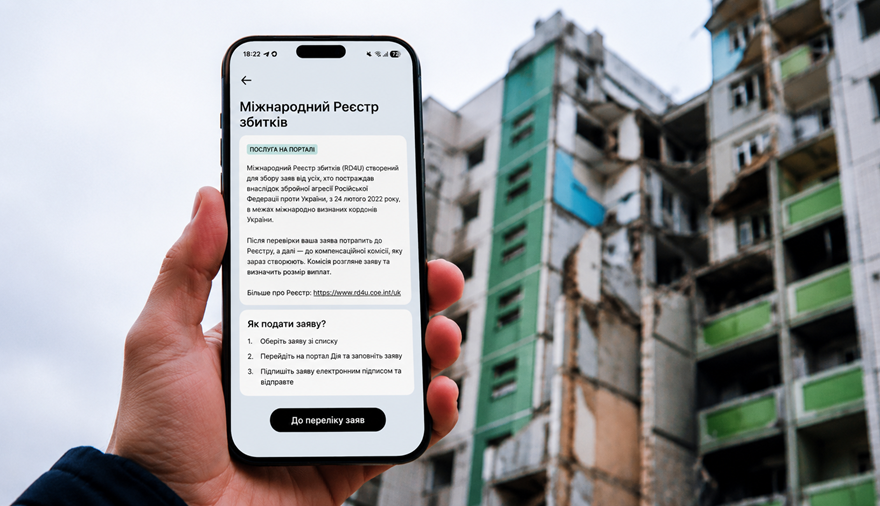










The International Registry of Damages caused by the aggression of the Russian Federation against Ukraine (RD4U) is transforming into a flexible legal protection tool. An important step on this path was the adoption by the Cabinet of Ministers of Ukraine of Resolution No. 670 dated May 27, 2026.
The government is making further changes to the basic Procedures for submitting claims by both individuals and legal entities, previously approved by Cabinet Resolution No. 365.
While in the initial stages of the Registry's operation the focus was mainly on recording physical destruction or damage to immovable property, the new rules change this approach.
The main goal of Resolution No. 670 is to ensure maximum coverage of all types of damage without exception. From now on, legal protection extends not only to material assets but also to basic intangible human goods.
From now on, an asset is interpreted quite broadly — as any material or intangible value that creates economic benefits.
Special attention is paid to family ties. The concept of “close family members” now includes not only parents and children but also stepfathers, stepmothers, stepsons, and persons in de facto marital relationships. A separate category of “other family members” is distinguished, who may claim compensation if they prove a legitimate interest and elements of dependence on the victim.
Categories for Individuals
The most anticipated change was the introduction of new categories related to human capital.
In particular, compensation is provided for loss of access to education (A4.2) in cases where schooling was impossible due to the destruction of institutions or actions of occupying forces, as well as loss of access to medical care (A4.1), if due to the destruction of hospitals or absence of medical personnel the applicant's health condition significantly and irreversibly deteriorated.
A separate category of “other human rights violations” (A2.10) covers moral and psychological suffering caused by armed aggression that do not fall under other types of compensation.
The list also includes “other economic losses” (A3.7), which cover, among other things, loss of material support from family due to death or disappearance of close relatives, burial and repatriation expenses, as well as damage to valuable movable property.
Categories B and C for the State and Legal Entities
For business entities and the state, Resolution No. 670 opens opportunities for compensation of strategic losses.
In particular, it concerns environmental damage (B3.1), which includes not only direct negative impact on the environment but also costs for monitoring, assessment, and restoration of ecosystems.
Damage to cultural values (B2 / C2) is highlighted, relating to damage to museums, libraries, archives, and UNESCO-listed sites.
Also provided is the possibility to file claims for demining expenses (B5), which include humanitarian demining, clearing territories, and training relevant specialists at the expense of state budgets.
The list also includes theft of natural resources (B3.2), covering losses from illegal appropriation of minerals and other resources for further commercial use.
Business in Evacuation
Compensation issues for businesses in evacuation are separately regulated. Legal entities may file claims for relocation of economic activity (C3.3).
This includes transportation and logistics costs, expenses for restoring operations at a new location, housing rental for employees evacuated with the enterprise, as well as loss of profit caused by the relocation itself.
Technical Improvements in Diia
To confirm damages, it is allowed to use information from remote inspection reports prepared according to the specifics of conducting remote inspections of destroyed categories of immovable property located in possible combat zones where state electronic information resources operate.
A mechanism for identifying the main and designated representative of a legal entity through the Diia Portal has been introduced, simplifying the management of claim packages.
Additionally, when forming a claim, the system will automatically pull data from the Insured Persons Registry, the State Civil Status Acts Registry, and border crossing databases.
Thanks to the introduction of categories related to education and medicine, the circle of potential claimants significantly expands — potentially by millions of people. The new approach to compensating indirect losses allows recording expenses for employee evacuation. At the same time, the mechanism for proving damages in category A2.10 raises questions, as the concept of “psychological suffering” is largely subjective. Therefore, claimants will likely have to provide extended explanations and, if possible, additional evidence, including psychological reports, although the resolution allows describing such circumstances at the claimant's discretion.
Resolution No. 670 demonstrates the state's readiness to form a comprehensive package of claims against the aggressor state. For business, this means the ability to record not only property loss but also loss of market positions and costs to preserve human capital. Hopefully, in the near future, it will not only be about recording damages but also about creating an effective mechanism for their actual compensation.
Subscribe to our Telegram channel t.me/sudua and to Google News SUD.UA, as well as to our VIBER and WhatsApp, Facebook page and Instagram to stay informed about the most important events.