Explanations Beyond Declarations: What Candidate Interviews for the HRC Showed in the Ethical Council


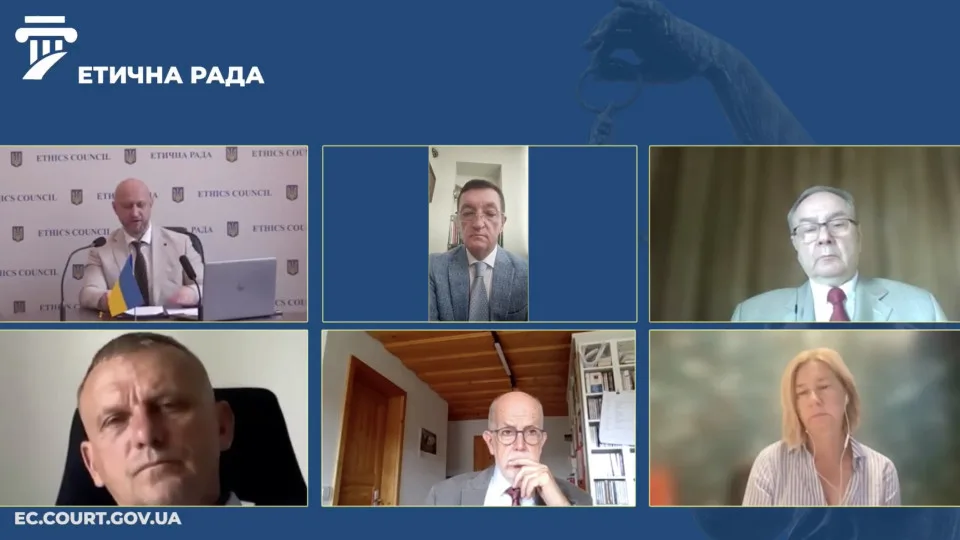










The formation of the new High Council of Justice is a crucial stage of judicial reform. This constitutional body is responsible for participating in the formation of the judiciary, exercising disciplinary powers over judges, and ensuring the independence of the judiciary. According to Article 9-1 of the Law of Ukraine "On the High Council of Justice," the Ethical Council assesses candidates for compliance with professional ethics and integrity criteria.
Interviews conducted in July 2026 revealed that the Ethical Council pays significant attention not only to the content of declarations or the results of other state checks but also to candidates' ability to consistently, logically, and factually substantiate their explanations regarding financial status, income sources, professional activities, and other verifiable circumstances.
An analysis of interviews with Pavlo Hultay, Raisa Minchenko, and Nataliya Savinova demonstrates varying approaches to candidate evaluation. The examples below reflect only the course of the interviews, questions from Ethical Council members, and candidates' explanations, rather than establishing facts of legal violations or legal liability.
Interview with Pavlo Hultay: a car registered to a relative and questions about the transaction value
Pavlo Mykhailovych Hultay, head of the department for preventing and counteracting corruption at the Kyiv Regional Prosecutor's Office, was interviewed on 8 July 2026. A central issue was the purchase and subsequent re-registration of a Lexus RX 350 car.
The amount specified in the contract raised additional questions. Ethical Council members noted that, at the time of the transaction, it corresponded to the threshold relevant for financial monitoring and asked the candidate to explain why that particular value was indicated in the documents.
Pavlo Hultay explained that he did not personally determine the price; it was entered by the service staff during document processing.
In this instance, the Ethical Council evaluated not the correctness of the car's market value or compliance with financial legislation, but primarily the candidate's explanation and his professional diligence during the preparation of legally significant documents.
The candidate also referred to the results of checks by other state bodies. In response, the Ethical Council emphasised that, according to Article 9-1 of the Law of Ukraine "On the High Council of Justice," it conducts an independent assessment of candidates, and conclusions from other bodies are not decisive for its decision-making.
During the meeting, Pavlo Hultay suggested possible influence of third parties on the Ethical Council's work and disagreed with some inspection materials. The Council Chair, Lev Kyshakevych, urged the candidate to maintain a respectful tone, after which the interview continued according to the established procedure. The Council members then returned to discussing property issues and other materials from the competition dossier.
Interview with Raisa Minchenko: sources of funds, family savings, and declaration data
Raisa Mykolaivna Minchenko, Doctor of Law, professor, and vice-rector of the National University "Odesa Law Academy," was interviewed on 10 July 2026.
One of the key areas of questioning concerned the purchase of a Mercedes-Benz ML 350 in 2010 and the sources of funds for its acquisition. Ethical Council members also noted the ratio of the candidate's officially declared income for the previous period to the car's value.
Raisa Minchenko explained that the car was purchased with her own long-term savings and financial assistance from a close person. She declined to name this person, citing the right to respect for private life.
Separate discussions concerned the sources of funds for acquiring a non-residential premises in Odesa, which was later gifted to the candidate. She reported that these funds were formed from family savings, including income from the sale of agricultural products and other family accumulations.
During the interview, some questions regarding information stated in the declarations were also considered.
The Ethical Council verified the explanations provided and evaluated them alongside other materials in the competition dossier. The interview's purpose was not to establish the illegality of property origin or any offences committed by the candidate. The evaluation was carried out exclusively within the procedure of verifying compliance with professional ethics and integrity criteria.
Interview with Nataliya Savinova: repeated declaration inaccuracies and professional diligence
Nataliya Andriivna Savinova, Doctor of Law, director of the Educational and Scientific Institute of Maritime Law and Management at the National University "Odesa Maritime Academy," had previously undergone evaluation by the Ethical Council during the previous competition.
During the interview, Ethical Council members drew attention to certain information in the 2025 declaration, particularly regarding attorney status, corporate rights, family members' use of property, and some data in the integrity declaration.
Additionally, questions were discussed about the candidate's participation in business companies and certain scientific publications, which became the subject of Council members' inquiries.
Nataliya Savinova explained that some information was omitted due to technical errors or a misunderstanding of legislative requirements. Regarding scientific publications, she provided her explanations about their disclosure process.
The Ethical Council checked the completeness and consistency of these explanations and their compliance with other materials in the competition dossier. Particular attention was paid to the fact that some similar issues had already been discussed during the candidate's previous evaluation.
However, the mere presence of repeated questions or the need for repeated analysis of relevant circumstances does not automatically signify dishonesty or legal violations. Such issues are assessed by the Ethical Council in conjunction with other competition materials.
Practice of forming integrity standards
The analysed interviews indicate several trends in the Ethical Council's approaches to candidate evaluation.
During interviews, significant attention is paid not only to declarations but also to the candidate's ability to provide consistent, logical, and factually supported explanations regarding financial status, professional activities, and other verifiable circumstances.
If certain questions arose during previous competition procedures, the Ethical Council may pay special attention to whether previous remarks were taken into account and corresponding shortcomings rectified. In such cases, not only the facts themselves but also the candidate's explanations and actions after the previous evaluation are assessed.
The evaluation is comprehensive. The mere presence of questions, doubts, or information requiring verification does not automatically mean non-compliance with integrity criteria. The Ethical Council's powers are limited to verifying candidates' compliance with the criteria of professional ethics and integrity defined by the Law of Ukraine "On the High Council of Justice."
Based on the interview results, the Ethical Council did not recommend Pavlo Hultay, Raisa Minchenko, and Nataliya Savinova for further participation in the competition. Their cases demonstrate that today, for a candidate to the High Council of Justice, it is no longer sufficient merely to correctly complete declarations or pass checks by other state bodies. Equally important is the ability to convincingly explain property issues, professional decisions, and other verifiable circumstances. The Ethical Council's final decision is determined by the totality of all materials, the candidate's explanations, and the presence or absence of reasonable doubts.
Subscribe to our Telegram channel t.me/sudua, follow SUD.UA on Google News , and join us on VIBER, WhatsApp, Facebook and on Instagram to stay informed about the important events.