Ex-wife threatened and insulted a serviceman: The Supreme Court prohibited her from approaching the husband and son due to the risk of repeated domestic violence


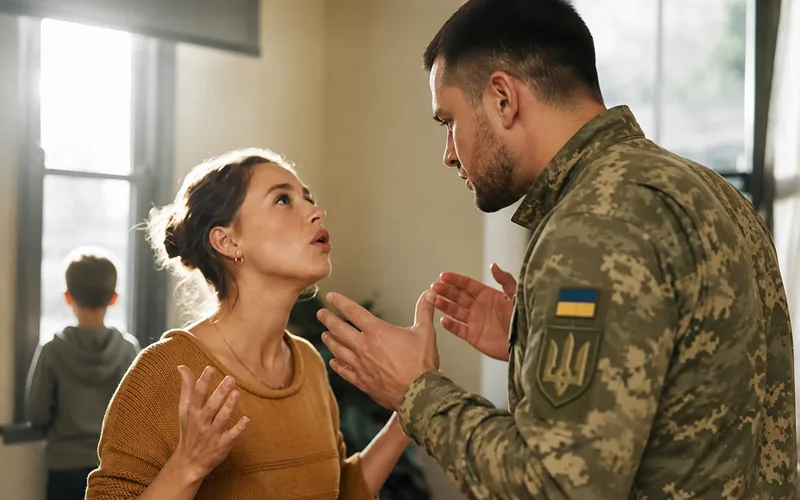










Domestic violence remains one of the most acute problems in Ukraine. Administrative and criminal liability is provided for its commission, and victims have a legal right to protection. One of the mechanisms of such protection is a restraining order against the offender—a special measure to counter domestic violence, issued by the court in accordance with the Law of Ukraine "On Prevention and Counteraction to Domestic Violence."
A restraining order may provide for temporary restrictions on the offender’s rights, including a ban on staying at the place of joint residence with the victim, approaching them, contacting them personally or through communication means, as well as searching for the victim. Mostly, women apply with complaints about domestic violence, but among the victims there are also men and children.
At the same time, the mere fact of a conflict between family members or the existence of a dispute over the child is not an automatic basis for issuing such an order. The court must assess the evidence of domestic violence, the risks of its recurrence, and the necessity of applying protective measures.
This is exactly the assessment given by the Civil Cassation Court in case No. 336/6805/25, where the child’s father requested the issuance of a restraining order against his ex-wife. The court concluded that the provided evidence confirmed the risks of repeated domestic violence and upheld the decision to restrict the mother’s contacts.
Circumstances of the case
The father applied to the court with a request to issue a restraining order against the ex-wife for six months. He stated that after the divorce, the mother systematically committed psychological violence against him and the child, as well as harmed the son’s mental state.
According to the case materials, on July 1, 2025, the father ensured the child’s communication with the mother via video call in the Viber mobile app in compliance with the ruling of the Shevchenkivskyi District Court of Zaporizhzhia. On the same day, around 5:30 p.m., the mother arrived unannounced at the applicant’s residence and tried to take the minor son, who was in the park with his grandmother.
The father claimed that as a result of these actions, the child sustained bodily injuries and psychological trauma, after which he again required treatment by a pediatric surgeon and psychiatrist. Specialists recommended providing the child with a stable positive atmosphere and avoiding stressful psychotraumatic situations.
The case also notes that the police are conducting a pre-trial investigation in a criminal proceeding under Article 126-1 of the Criminal Code of Ukraine regarding possible domestic violence against the child and the applicant.
Additionally, the applicant reported systematic offensive messages, calls, and threats from the ex-wife, as well as publications on social networks with his and the child’s photos accompanied by humiliating statements. According to him, the ex-wife also contacted law enforcement agencies and the military unit where he serves with allegations of alleged corruption and misconduct. The conducted investigation did not confirm these accusations.
On July 28, 2025, the Shevchenkivskyi District Court of Zaporizhzhia granted the father’s request and issued a restraining order against the mother for six months. The court prohibited her from approaching within 200 meters of the father’s and child’s residence, contacting the son by any means—personally, by phone, correspondence, or through third parties—and searching for them if they are in a safe place unknown to her. Furthermore, the mother was prohibited from approaching the father’s workplace, kindergarten, and other frequently visited places, as well as from corresponding or making phone calls to the applicant and the child.
In December 2025, the Zaporizhzhia Court of Appeal canceled this decision and refused to issue a restraining order. The appellate court noted that the evidence provided did not properly confirm the risks of repeated domestic violence, and there was a long-standing conflict and dispute over the child’s place of residence between the parties.
The Supreme Court overturned the appellate court’s decision
The court emphasized that according to the Law of Ukraine "On Prevention and Counteraction to Domestic Violence," a restraining order is a special measure to counter domestic violence. It can be applied regardless of whether the offender has been held administratively or criminally liable. The decision to issue such an order is made based on risk assessment—the likelihood of continuation or repetition of domestic violence, the occurrence of serious consequences for the victim, or a threat to their life.
The Supreme Court noted that in such cases, the applicant only needs to provide evidence of violence and indicate the existence of risks. After that, the burden of disproving these circumstances shifts to the person against whom the restrictive measures are requested.
During the case review, the court considered that the child’s father provided evidence confirming, in his opinion, facts of domestic violence by the ex-wife. These included video recordings of events, screenshots of social media correspondence, photographs with humiliating statements, and payment documents containing insults, threats, and humiliation in their description.
The court of first instance found that the mother’s actions were systematic and involved physical and psychological violence against the ex-husband and minor son. Such actions, according to the court, caused concern for the safety of the child and father and harmed their mental health.
The Supreme Court also took into account the child’s condition, who was undergoing treatment at a psychiatric care and rehabilitation facility. According to the psychologist’s conclusion, the child showed signs of fear of the mother, and emotional changes were observed during communication about her. Specialists recommended providing the child with a positive atmosphere for further recovery.
The panel of judges concluded that the evidence collectively confirmed the risks of repeated violence, and therefore the six-month restraining order was a necessary and proportionate measure.
The Supreme Court disagreed with the appellate court’s conclusion that there was only a long-standing conflict over the child’s place of residence between the parties. The court noted that the mere fact of such a dispute does not exclude the possibility of applying a restraining order if facts of domestic violence are established. The Supreme Court also pointed out that the absence of contact between the mother and child after the first-instance court’s decision does not indicate the loss of relevance of the case circumstances. On the contrary, it confirms that the applied measure achieved its goal—ensuring the safety of the victims.
As a result, the Supreme Court satisfied the father’s cassation appeal, canceled the Zaporizhzhia Court of Appeal’s ruling, and upheld the Shevchenkivskyi District Court of Zaporizhzhia’s decision to issue a restraining order against the mother for six months.
Thus, the Supreme Court confirmed that the existence of a dispute over the child’s place of residence alone does not exclude the possibility of issuing a restraining order. If evidence confirms facts of domestic violence and risks of its recurrence, such an order is lawful and necessary to protect the victims.
Recall that, as previously reported by the "Judicial and Legal Newspaper", domestic violence is often limited to one victim. It affects the entire family, and children often become the most vulnerable witnesses and hidden victims of violence. At the same time, the child may remain unnoticed during the assessment of the situation when the main victim is considered to be one of the adult family members. This, in turn, may create additional opportunities for the offender to exert psychological or physical pressure on the children.
In this regard, the Verkhovna Rada proposes to change this approach. Draft law No. 15418 provides that support services should assess the level of danger not only for the person seeking help but also for each child living in the family where domestic violence occurs. This approach aims to make the response system more comprehensive and focused not only on overcoming the consequences of violence but also on timely identifying threats to all potentially affected family members.
Subscribe to our Telegram channel t.me/sudua and to Google News SUD.UA, as well as to our VIBER and WhatsApp, Facebook page and Instagram account to stay informed about the most important events.