Every Third Submission to the Constitutional Court Comes from the Supreme Court












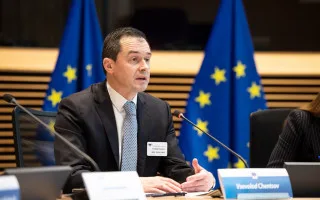
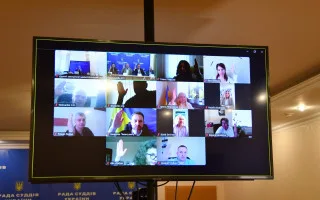
As noted by the Secretary of the Grand Chamber of the Supreme Court, Serhiy Pohrebny, courts of general jurisdiction in everyday practice apply the Constitution of Ukraine as a normative act almost most often – not only the first articles of the Basic Law, which define the principles of state functioning, but also Article 19 of the Constitution, which underpins the resolution of all public-law disputes.
Since 2017, procedural codes – the Civil Procedure Code of Ukraine, the Commercial Procedure Code of Ukraine, and the Administrative Procedure Code of Ukraine – have given courts of general jurisdiction the ability to assess a law for its inconsistency with the Constitution of Ukraine and, in case of such inconsistency, to apply the norms of the Basic Law as directly applicable norms. In such cases, after making a decision in the case, the court refers the matter to the Supreme Court to decide on submitting a constitutional submission to the Constitutional Court of Ukraine regarding the constitutionality of a law or other legal act.
In practical application of this provision, Serhiy Pohrebny pointed out two examples.
Thus, the Grand Chamber of the Supreme Court, during the consideration of exemplary administrative case No. 440/14216/23 concerning an annual one-time monetary payment to persons with disabilities due to the war, in the ruling dated May 14, 2025, concluded that part 4 of Article 7 of the Administrative Procedure Code of Ukraine does not allow the application of a law provision that has lost its force, nor any other legal norm except the provision of the Constitution of Ukraine as a directly applicable norm.
In the ruling dated February 19, 2026, in exemplary case No. 240/7215/24 regarding the accrual and payment of seniority allowance to civil servants in 2024, the Grand Chamber of the Supreme Court emphasized that the legislator forms a unified system of legislation in the field of public legal relations, in which the constitutionality of each law approved by the parliament is presumed until this presumption is refuted by a decision of the Constitutional Court of Ukraine. The Grand Chamber noted that the relevant provisions of the Law of Ukraine "On the State Budget of Ukraine for 2024" have not been declared unconstitutional, so there are no grounds for conclusions under part 4 of Article 7 of the Administrative Procedure Code of Ukraine, since the reduction of the seniority allowance did not lead to a narrowing of the social rights and guarantees of the civil servant. These conclusions of the Grand Chamber of the Supreme Court demonstrate respect for the sphere of constitutional jurisdiction.
Ukrainian legislation does not define a fourth instance for resolving disputes under the jurisdiction of courts of general jurisdiction, and neither the Constitutional Court of Ukraine nor the European Court of Human Rights is such a fourth instance. He explained that the unconstitutionality/constitutionality of a law, other legal act, or their individual provision established by the Constitutional Court of Ukraine, applied by the court in resolving a case, if the court decision has not yet been executed, is grounds for reviewing court decisions due to exceptional circumstances.
According to the Law of Ukraine "On the Judiciary and the Status of Judges," the Secretary of the Grand Chamber of the Supreme Court reminded, it is within the powers of the Supreme Court to apply to the Constitutional Court of Ukraine regarding the constitutionality of laws, other legal acts, as well as regarding the official interpretation of the Constitution of Ukraine. According to him, from 2017 until June 2026, the Plenum of the Supreme Court submitted 27 constitutional submissions to the Constitutional Court of Ukraine.
As noted by the Supreme Court, in fact, every third constitutional submission for which the Constitutional Court of Ukraine opens proceedings is sent by the Supreme Court, and therefore, in wartime conditions, the Supreme Court is an active participant in the process of establishing constitutionalism, protecting constitutional values, and fundamental human rights and freedoms in Ukraine.
Additionally, Serhiy Pohrebny pointed out that since February 24, 2022, cases related to the protection of the principles of the constitutional order, holding accountable for armed aggression against Ukraine, committing crimes against humanity by invaders, protecting the rights of servicemen and military pensioners, and property rights of civilians affected by Russian armed aggression have increasingly appeared in the practice of the Grand Chamber of the Supreme Court.
Among the examples, he mentioned rulings:
- dated September 13, 2023, in case No. 757/64569/16-c, which determined the procedure for receiving compensation for forcibly alienated (mobilized) property under the legal regime of martial law;
- dated January 18, 2024, in case No. 560/17953/21, which resolved the issue of jurisdiction over cases establishing the fact of living with a deceased serviceman by one family;
- dated February 28, 2024, in case No. 415/2182/20, which resolved an exceptional legal issue regarding the characteristics of the subject of a crime defined by Article 437 of the Criminal Code of Ukraine "Planning, preparation, initiation, and waging of an aggressive war";
- dated July 2, 2025, in case No. 902/122/24, which concluded on the legal regime of lands located in the border zone, which are defense lands, may only be in state ownership, and are not subject to alienation;
- dated February 11, 2026, in case No. 308/17634/23, which resolved the issue of jurisdiction over the case establishing the fact of a person being dependent on a deceased serviceman for the purpose of receiving a one-time monetary assistance.
Courts of general jurisdiction and the Constitutional Court of Ukraine constitute a unified judicial system but perform fundamentally different tasks: in its established judicial practice, the Supreme Court clearly defined the boundaries of the exclusive powers of the Constitutional Court of Ukraine and the powers of courts of general jurisdiction, treating constitutional jurisdiction with particular caution. According to the Secretary of the Grand Chamber of the Supreme Court, the current task of the Supreme Court is to ensure the high quality, motivation, and persuasiveness of court decisions in order to establish the constitutional principle of the rule of law in the practice of national courts.
Subscribe to our Telegram channel t.me/sudua and to Google News SUD.UA, as well as to our VIBER and WhatsApp pages on Facebook and Instagram to stay informed about the most important events.