Does a serviceman lose the right to 100 thousand hryvnias after AWOL: the position of the Supreme Court


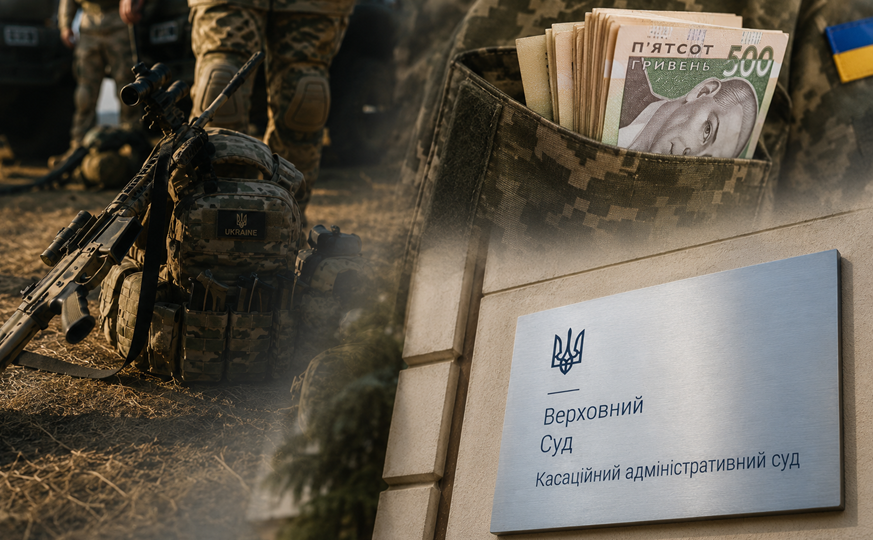










The Supreme Court, sitting as the Cassation Administrative Court, considered a dispute regarding the legality of stopping the payment of monetary allowance, bonuses, and additional rewards to a serviceman whom the military unit command recognized as having unauthorizedly left the place of service. The Court also evaluated arguments about whether entering information into the Unified Register of Pre-Trial Investigations is a mandatory condition for stopping such payments.
Case summary
A serviceman filed a lawsuit against the military unit, requesting to recognize as unlawful and cancel the provisions of the orders of the unit commander regarding the non-payment of his bonus and additional reward provided by the Cabinet of Ministers of Ukraine Resolution No. 168, as well as to recognize unlawful the inaction regarding the non-payment of the basic monetary allowance for the period from March to July 2023 and to oblige the appropriate accruals and payments.
The plaintiff argued that he was unjustly recognized as having unauthorizedly left the place of service. He claimed that after March 13, 2023, he was in the area of the military unit's location together with other servicemen and awaited further orders from the command. He also noted that he was later undergoing inpatient treatment, confirmed by medical documents, and therefore his absence could not be considered unauthorized departure from the military unit.
Additionally, the plaintiff emphasized that the fact of unauthorized departure from the military unit was not established in a criminal proceeding and was not confirmed by a guilty verdict of the court. In his opinion, in the absence of relevant information in the Unified Register of Pre-Trial Investigations and a guilty verdict, there were no legal grounds for stopping the payment of monetary allowance, bonuses, and additional rewards.
The courts established that in March 2023, the military unit command recorded the serviceman's absence in the area of task execution. Based on the report of the unit commander, an official investigation was conducted, which concluded unauthorized departure from the place of service. By order of the unit commander, the payment of monetary allowance was stopped from the day of unauthorized departure, and a decision was made not to pay the bonus and additional reward for March 2023 and the subsequent period of absence.
Decisions of previous courts
The Dnipropetrovsk District Administrative Court denied the claim. The Third Administrative Court of Appeal upheld this decision.
The courts reasoned that the fact of unauthorized departure from the place of service was confirmed by the materials of the official investigation. They noted that establishing such a fact is sufficient legal grounds for stopping the payment of monetary allowance, as well as for non-payment of bonuses and additional rewards in accordance with the requirements of the Procedure for Payment of Monetary Allowance to Servicemen of the Armed Forces of Ukraine.
Regarding the arguments about being under treatment, the courts stated that the validity of reasons for absence must be confirmed by properly executed documents and agreed upon with the military unit command. The case materials did not contain evidence of the serviceman being sent for treatment or proper notification of the command about the need to leave the place of service.
The courts also rejected the argument that the fact of unauthorized departure can only be established by a guilty verdict of the court. In their opinion, this case did not address criminal liability but only assessed the grounds for stopping the relevant payments.
Legal conclusions of the Supreme Administrative Court of the Supreme Court
The Supreme Court noted that the subject of the dispute is the legality of non-payment of monetary allowance, bonuses, and additional rewards to a serviceman due to unauthorized departure from the place of service.
In case No. 160/19666/23, the Court pointed out that paragraph 15 of Section I, paragraph 5 of Section XVI, and paragraph 14 of Section XXXIV of Procedure No. 260 directly provide legal consequences for unauthorized departure from the military unit or place of service. In particular, monetary allowance is suspended from the day of unauthorized departure and resumed from the day of return; the monthly bonus is not paid for the month in which the violation occurred; and the additional reward is not paid for the month of violation and the entire period of unauthorized absence.
The Supreme Court emphasized that the confirmed fact of unauthorized departure from the military unit is an independent legal ground for applying the restrictions on monetary payments provided by Procedure No. 260.
The Court agreed with the conclusions of the lower courts that the official investigation confirmed the fact of unauthorized departure from the place of service. At the same time, the case materials do not contain evidence of the legality of the serviceman's departure from the place of service, proper documentation of referral for treatment, or notification of the command about the necessity of such absence.
The Supreme Court also supported the conclusion that the arguments about the necessity of a guilty verdict for applying the consequences in the form of stopping payments are unfounded. The Court stressed that this dispute did not address criminal liability but established grounds for applying special rules regulating the procedure for paying monetary allowance to servicemen.
Separately, the Supreme Court considered arguments regarding the necessity of entering information into the Unified Register of Pre-Trial Investigations. The Court noted that suspension of monetary allowance payments, as well as non-payment of bonuses and additional rewards in case of establishing the fact of unauthorized departure from the military unit, are independent legal consequences regulated by Procedure No. 260.
The Supreme Court emphasized that paragraph 15 of Section I, paragraph 5 of Section XVI, and paragraph 14 of Section XXXIV of Procedure No. 260 define the fact of unauthorized departure from the military unit or place of service as a legal fact sufficient to suspend monetary allowance payments, and to withhold bonuses and additional rewards. These provisions do not link the possibility of stopping payments with entering information into the Unified Register of Pre-Trial Investigations.
The Court stressed that the provisions of paragraph 144-1 of the Regulation on Military Service by Citizens of Ukraine in the Armed Forces of Ukraine and part two of Article 24 of the Law of Ukraine "On Military Duty and Military Service" regulate the suspension of military service and do not establish a direct link between entering information into the Unified Register of Pre-Trial Investigations and stopping the payment of monetary allowance.
Thus, the Supreme Court concluded that the absence of an entry in the Unified Register of Pre-Trial Investigations does not prevent stopping the payment of monetary allowance, bonuses, and additional rewards in case of establishing the fact of unauthorized departure from the military unit. The cassation appeal was dismissed, and the decisions of the courts of first and appellate instances remain unchanged.
The ruling takes legal effect from the date of its adoption, is final, and not subject to appeal.
Subscribe to our Telegram channel t.me/sudua and to Google News SUD.UA, as well as to our VIBER and WhatsApp, Facebook page Facebook and on Instagram to stay updated on the most important events.