Individualization of Legal Liability for Committing an Offense in the Field of Road Traffic Safety – The Constitutional Court of Ukraine Considers the Case


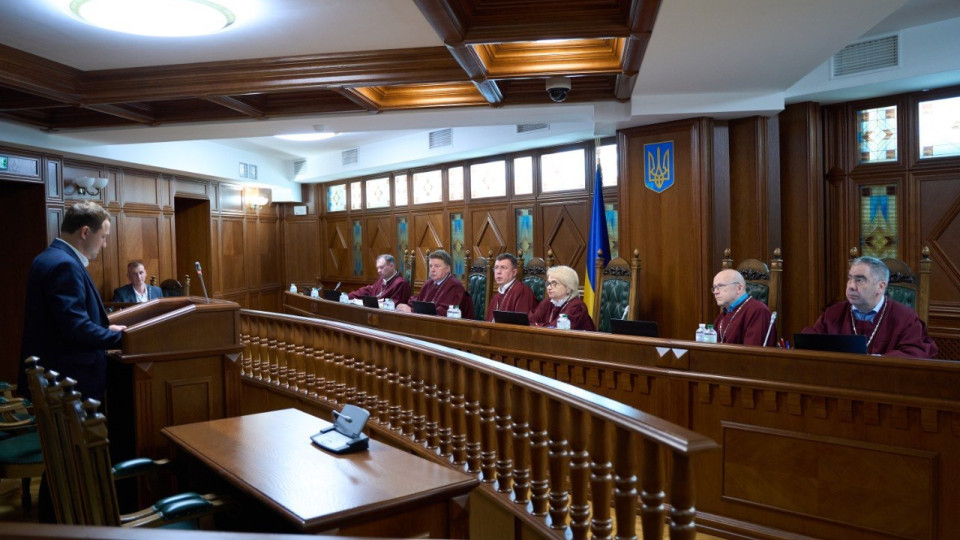










The Second Senate of the Constitutional Court of Ukraine, at an open part of the plenary session in the form of written proceedings, considered the case on the constitutional complaint of Yevhen Serhiyovych Andronnikov.
During the plenary session, the reporting judge in the case, Viktor Horodovenko, outlined the essence of the case, the course of consideration of the relevant case in the courts of the judicial system, and the grounds for the applicant's claims.
The judge noted that Andronnikov Y. S. applied to the Constitutional Court of Ukraine with a petition to verify the compliance of part two of Article 61 of the Constitution of Ukraine with part two of Article 33, part one of Article 130 of the Code of Ukraine on Administrative Offenses (hereinafter – the Code) "regarding the prohibition of taking into account the nature of the committed offense, the person of the offender, the degree of his guilt, property status, circumstances mitigating and aggravating liability when imposing a penalty for committing an offense in the field of road traffic safety" and "regarding the lack of alternatives in the penalty."
According to part two of Article 33 of the Code, when imposing a penalty, the nature of the committed offense, the person of the offender, the degree of his guilt, property status, circumstances mitigating and aggravating liability are taken into account, except, in particular, cases of imposing a penalty for an offense in the field of road traffic safety.
Part one of Article 130 of the Code establishes, in particular, that driving vehicles by persons in a state of alcohol, narcotic, or other intoxication or under the influence of medicinal drugs that reduce their attention and reaction speed, as well as refusal to undergo an examination for intoxication, entails the imposition of a fine on drivers in the amount of one thousand non-taxable minimum incomes of citizens with deprivation of the right to drive vehicles for one year.
From the content of the constitutional complaint and the attached materials, it appears that an administrative offense report was drawn up against the applicant. According to the report, Andronnikov Y. S. was driving a car in a state of alcohol intoxication. The examination for intoxication was conducted with his consent in the prescribed manner at the place where the vehicle was stopped.
The Bershad District Court of Vinnytsia region, by its ruling, found Andronnikov Y. S. guilty of committing an administrative offense defined by part one of Article 130 of the Code and imposed an administrative penalty in the form of a fine of one thousand non-taxable minimum incomes of citizens with deprivation of the right to drive vehicles for one year.
Disagreeing with the district court's ruling, the lawyer acting in the interests of Andronnikov Y. S. filed an appeal. The Vinnytsia Court of Appeal dismissed the lawyer's appeal and left the ruling of the court of first instance unchanged.
Justifying its decision, the Vinnytsia Court of Appeal stated that the sanction of part one of Article 130 of the Code is without alternatives, as it provides only "an administrative penalty in the form of a fine combined with deprivation of the right to drive vehicles," and in such a case, "the general principles of imposing administrative penalties, defined in part 1 of Article 33 of the Code, do not grant the court the right to choose one of the forms of implementing liability for the committed administrative offense."
The applicant believes that "the legislative prohibition to take into account when imposing a penalty the nature of the committed offense, the person of the offender, the degree of his guilt, property status, circumstances mitigating and aggravating liability for offenses in the field of road traffic safety (part 2 of Article 33 of the Code) contradicts the principle of individualization of legal liability." In his opinion, "the lack of alternatives in the penalty under part 1 of Article 130 of the Code, given the absence of judicial discretion to exempt the offender from additional punishment or impose a milder punishment," also violates this principle.
The reporting judge also informed that to ensure a full and objective consideration of the case, letters were sent to express positions on the merits of the constitutional complaint, in particular, to the President of Ukraine, the Verkhovna Rada of Ukraine, the Ministry of Internal Affairs of Ukraine, the Supreme Court, as well as to the Yaroslav Mudryi National Law University, Taras Shevchenko National University of Kyiv, the V. M. Koretsky Institute of State and Law of the National Academy of Sciences of Ukraine, and the public organization "International Federation for the Protection of Drivers' Rights."
The court examined the case materials and proceeded to the closed part of the plenary session for further discussion of issues related to constitutional proceedings in this case.
Subscribe to our Telegram channel t.me/sudua and to Google News SUD.UA, as well as to our VIBER and WhatsApp pages on Facebook and Instagram to stay informed about the most important events.