The Parliament proposes introducing professional reservation due to the risk of losing qualified personnel


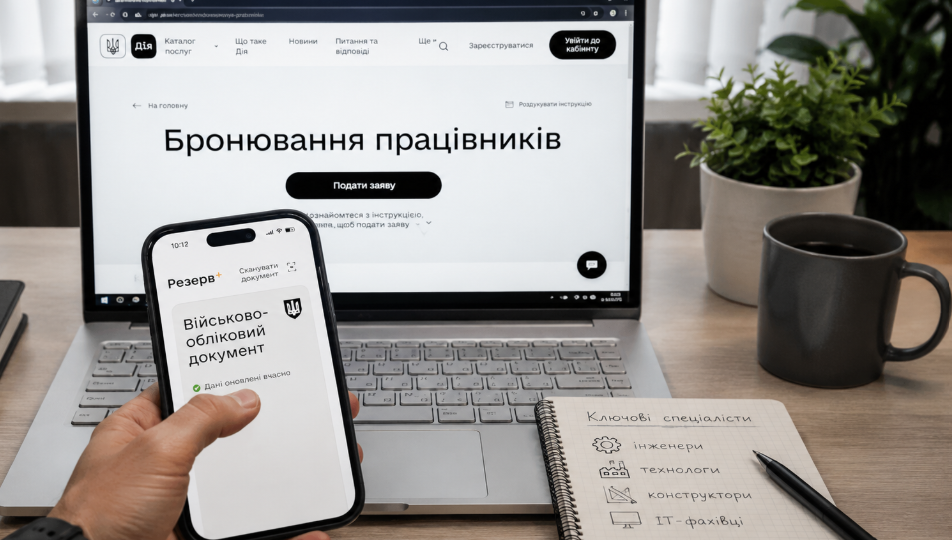










The update of the rules for reserving military personnel, recently approved by the Cabinet of Ministers, aims to make the system more transparent and controllable. At the same time, the new requirements may affect some enterprises in the real sector of the economy that do not have direct government contracts but are important participants in the production chains of the defense industry.
The Verkhovna Rada believes that in the future the state should focus not only on the economic criteria of reservation but also on preserving highly qualified specialists on whom the operation of critically important productions depends.
The new reservation rules will hardly affect defense enterprises
The Parliamentary Committee on National Security, Defense, and Intelligence points out that enterprises directly working for defense needs will not experience significant changes. However, not all companies in the real sector of the economy will be able to meet the increased requirements regarding the average wage level, which are considered when determining the right to reserve employees.
In this regard, it is proposed to develop not only economic reservation but also mechanisms for reserving specialists, since a significant number of enterprises are part of the production chains of the defense industry, although they do not have direct government contracts.
Defense industry suppliers may be left without quotas
The Parliament draws attention to the fact that a whole ecosystem of enterprises has formed in Ukraine that ensures the fulfillment of defense orders. Large manufacturers cooperate with hundreds of smaller suppliers who produce individual parts, components, or provide specialized services.
Due to the lack of critically important status, such enterprises often do not have the opportunity to reserve their employees. According to parliamentary representatives, this problem needs to be addressed.
Possible options include either uniting such manufacturers to obtain the status of critically important enterprises or the government making changes to the current rules that would allow granting them reservation quotas.
As an example, the production of ground robotic complexes is cited, where a significant part of the components is made by small companies. Such enterprises may not meet the criticality criteria but at the same time ensure the operation of the entire production chain. Therefore, the Parliament emphasizes the importance of creating conditions to retain highly qualified engineers and other specialists at these enterprises.
Automatic reservation is being improved in Ukraine
It is also noted that there is currently a certain balance in Ukraine between the needs of the Armed Forces and the necessity to retain critically important specialists in the economy.
Special attention is given to the development of automated reservation mechanisms. Thanks to the integration of state electronic registries, certain categories of citizens no longer need to regularly confirm their status at territorial recruitment and social support centers.
This particularly applies to caregivers, students, parents of many children, and other categories whose information is confirmed electronically. The Parliament believes that the reservation system is gradually improving and becoming more automated.
What changes to reservation were introduced by the Cabinet of Ministers
Recall that the Cabinet of Ministers published Resolution No. 692, which introduced extensive changes to the procedure for reserving military personnel. As previously reported by the "Judicial and Legal Newspaper", the innovations are aimed at strengthening control over reservation, digitalizing checks, and introducing new economic criteria for enterprises claiming critically important status.
The new government decision is primarily intended to prevent the use of the reservation mechanism solely to obtain a deferral from mobilization without the enterprise performing an important function for the economy or the state's defense capability.
Economic justification for reservation
One of the key innovations was the establishment of a mandatory wage level for reserved employees. According to the updated procedure, employees of critically important enterprises and institutions, with some exceptions, must receive a monthly salary throughout the deferral period of at least three times the minimum wage. Currently, this amounts to 25,941 UAH.
For enterprises actually operating in territories of possible or active hostilities according to the list of the Ministry of Communities and Territories Development, a lower threshold is set — 2.5 times the minimum wage.
At the same time, the new requirements do not apply to state and municipal enterprises, Diia City residents, religious organizations, energy producers whose capacities were damaged due to Russian aggression, as well as gas distribution system operators and fuel and energy complex enterprises with 100% state ownership.
Importantly, the provisions regarding increased wage coefficients come into force on September 1, 2026.
Review of critically important enterprise statuses
The government has also started a large-scale review of critically important enterprise statuses.
All decisions granting such status made before May 30, 2026, remain valid until the end of the specified term but no later than September 1, 2026.
State authorities must review sectoral and regional criteria for determining critically important enterprises to ensure their objectivity, relevance, and proper justification.
If an enterprise received critically important status based on a criterion that will be excluded after such a review, the corresponding decision will be subject to cancellation.
By September 1, 2026, a comprehensive check of all previously adopted decisions on granting critically important enterprise status and bringing them into compliance with updated requirements must be completed.
Thus, all enterprises currently holding such status must undergo verification for compliance with new criteria, or they may lose it.
New rules for employee accounting and quota control
From September 1, 2026, the rules for accounting military personnel employees when determining reservation quotas will change.
Employees who have deferrals from mobilization on other grounds provided by law, as well as those working part-time, will be counted in the total number of military personnel only at one place of work. This aims to prevent double counting when calculating quotas.
Additionally, the government is strengthening control over compliance with established reservation limits, which in most cases do not exceed 50% of the military personnel employees of the enterprise.
If the allowed quota is exceeded, the enterprise head must submit an application through the "Diia" portal within 10 working days to cancel the reservation of employees exceeding the established limit.
Now exceeding the quota is a separate ground for revoking the critically important enterprise status. Moreover, the risk of losing such status may arise even due to personnel accounting errors or untimely recording of employee dismissals.
Therefore, enterprises need to constantly monitor the number of reserved employees and promptly respond to any personnel changes.
Automatic control through state registries
By August 1, 2026, the Ministry of Defense, Ministry of Digital Transformation, and Pension Fund must ensure the integration of information systems for automatic control of wage levels, employee numbers, and compliance with established reservation quotas.
At the same time, due to the review of sectoral and regional criteria, some enterprises may lose grounds for retaining critically important status already during inspections.
Therefore, businesses are advised to assess compliance with updated requirements in advance and, if necessary, prepare documents to confirm criticality to avoid losing the right to reserve employees after September 1, 2026.
Subscribe to our Telegram channel t.me/sudua and to Google News SUD.UA, as well as to our VIBER and WhatsApp, Facebook page and Instagram account to stay informed about the most important events.