The Ministry of Justice reminded what information the State Register of Encumbrances on Movable Property contains


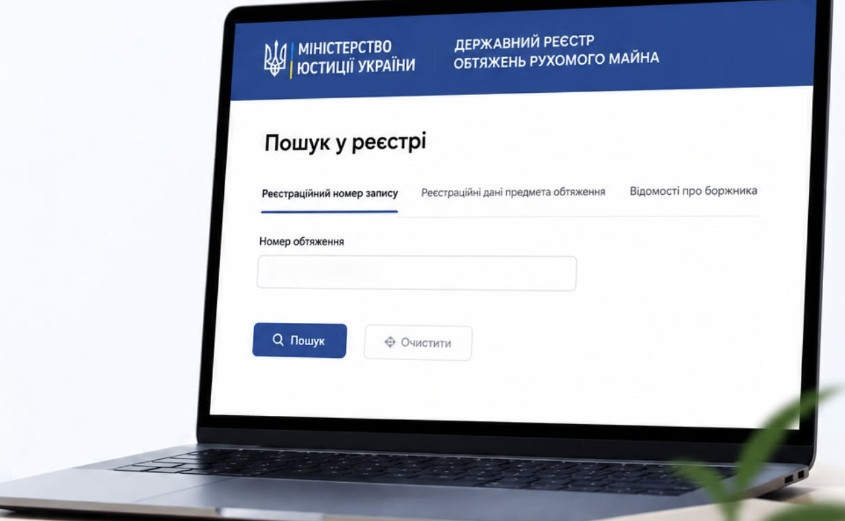










The Ministry of Justice of Ukraine reminded that the State Register of Encumbrances on Movable Property (hereinafter – the Register) is the only computerized database containing information about the emergence, change, termination of encumbrances on movable property, as well as about enforcement on the encumbered item.
The legal basis for the operation of the Register is the Law of Ukraine "On Securing Creditors' Claims and Registration of Encumbrances." The procedure for maintaining the Register is approved by the Cabinet of Ministers of Ukraine Resolution No. 830 dated July 5, 2004.
The state registration of encumbrances on movable property is carried out to ensure the fulfillment of obligations, protect the rights of legal entities and individuals regarding movable property, as well as to provide information in their interests about the presence or absence of encumbrances on movable property.
Thus, maintaining the Register aims to ensure the protection of bona fide acquirers and creditors. Additionally, it is important to note that an encumbrance on movable property registered in the Register has priority over an unregistered encumbrance and is a publicly known fact. The Register allows anyone to check whether movable property (a vehicle, equipment, goods, etc.) is encumbered.
Information about encumbrances on movable property is entered into the Register based on an application from the encumbrancer (creditor) or their authorized person. The application can be submitted electronically, and in certain cases – on paper. When submitting a paper application, the encumbrancer must present an identity document, and if an authorized person acts on behalf of the encumbrancer (individual or legal entity), they must attach a power of attorney or another document confirming their authority.
The following types of encumbrances on movable property are entered into the Register:
- pledge of movable property;
- tax lien;
- prohibition of alienation (by court decision or contract terms);
- arrest;
- other types of encumbrances.
The entities authorized to perform registration actions in the Register are:
- for state registration of private encumbrances on movable property based on applications submitted on paper – any notary or their assistant; for applications submitted electronically – the Register administrator (SE "NAIS") and its branches;
- for state registration of encumbrances on movable property that are the subject of pledges under agricultural notes – the Register administrator (SE "NAIS");
- for state registration of public encumbrances on movable property – the Register administrator (SE "NAIS") and its branches.
In established cases, registrars also include state or private bailiffs (during enforcement of decisions) and tax managers (when registering a tax lien).
Individuals and legal entities have the right to obtain an extract from the Register in paper or electronic form. Both forms have equal legal force.
The extract confirms the entry of records about encumbrances or their absence and contains up-to-date information as of the date and time of the extract issuance.
The main criteria for searching information in the Register are:
for an individual: last name, first name, patronymic, and taxpayer identification number (TIN);
for a legal entity: full name and EDRPOU code;
for the object: registration number of the encumbrance (if known) or serial number and data of the state registration document of the movable property (VIN code of the vehicle, chassis/body number, etc.).
Summarizing the above, it can be concluded that the Register is an important tool for ensuring legal certainty in the field of civil and commercial law, as it allows citizens and business entities to check for the presence of encumbrances on movable property before concluding transactions, assess potential risks, and properly protect their property rights. For example, before purchasing a vehicle, one can check whether it is pledged or under another encumbrance.
This mechanism helps avoid legal risks and financial losses, ensuring transparency and security of property turnover.
Subscribe to our Telegram channel t.me/sudua and to Google News SUD.UA, as well as to our VIBER and WhatsApp, our page on Facebook and on Instagram to stay informed about the most important events.