From 16 to 86 hours: in which countries you can earn $1,000 the fastest













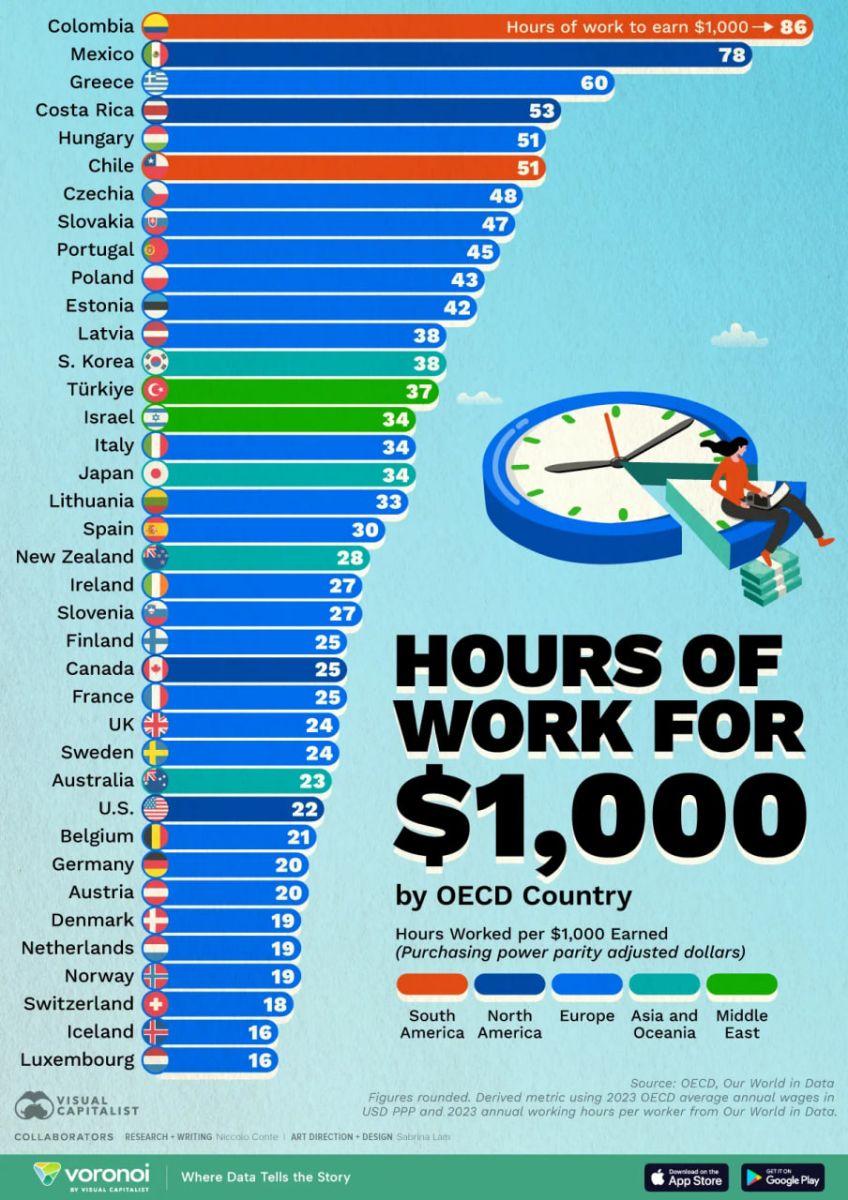
To earn 1000 dollars, workers in different countries around the world need to work from 16 to 86 hours. The least time is spent in Luxembourg and Iceland, while the most is in Colombia. These data were published by Visual Capitalist based on OECD and Our World in Data statistics.
Ranking leaders
According to researchers' calculations, the fastest way to earn 1,000 USD is in Luxembourg and Iceland — about 16 working hours.
Countries with the best results also include:
- Switzerland — 18 hours;
- Netherlands — 19 hours;
- Norway — 19 hours;
- Denmark — 19 hours;
- Germany — 20 hours;
- Austria — 20 hours;
- Belgium — 21 hour;
- USA — 22 hours;
- United Kingdom — 24 hours;
- Sweden — 24 hours;
- France — 25 hours;
- Finland — 25 hours;
- Spain — 30 hours.
Indicators of Central and Eastern European countries
Among Central and Eastern European countries, it takes significantly more time to earn 1,000 USD:
- Poland — 43 hours;
- Czech Republic — 48 hours;
- Greece — 60 hours.
The lowest indicators among the countries included in the study were recorded in Latin America. In Mexico, to earn 1,000 USD, one needs to work about 78 hours, and in Colombia — 86 hours.
How the calculations were made
The ranking was compiled based on data from the Organisation for Economic Co-operation and Development (OECD) on average annual wages and statistics from Our World in Data on annual hours worked.
The calculations were made in US dollars taking into account purchasing power parity (PPP), which considers differences in price levels between countries. Taxes and mandatory contributions were not included in the calculations.
Why the difference is so large
According to the study, workers in countries with the lowest indicators need more than five times as much time to earn 1,000 USD than in leading countries. The gap ranges from 16 hours in Luxembourg and Iceland to 86 hours in Colombia.
European countries occupy the top positions in the ranking due to high average wages and labor productivity. In particular, Denmark, Norway, Iceland, and Finland combine a high level of pay with a developed economy.
Luxembourg, in turn, has one of the highest average wages in the world due to a significant concentration of jobs in the financial sector and professional services.
What affects income levels
The Our World in Data study shows that in countries with lower income levels, workers usually work longer but receive lower pay per hour worked.
Economists explain this by lower labor productivity, a large share of the informal economy, limited access to capital, and slower wage growth.
The authors of the study also emphasize that using purchasing power parity allows for more accurate income comparisons between countries, as it takes into account differences in the cost of living, not just official exchange rates.
Subscribe to our Telegram channel t.me/sudua and to Google News SUD.UA, as well as to our VIBER and WhatsApp, Facebook page and Instagram to stay updated on the most important events.