Competition for the Prosecutor General Position or Change in Constitutional Balance: What Risks Does Bill 15343 Contain


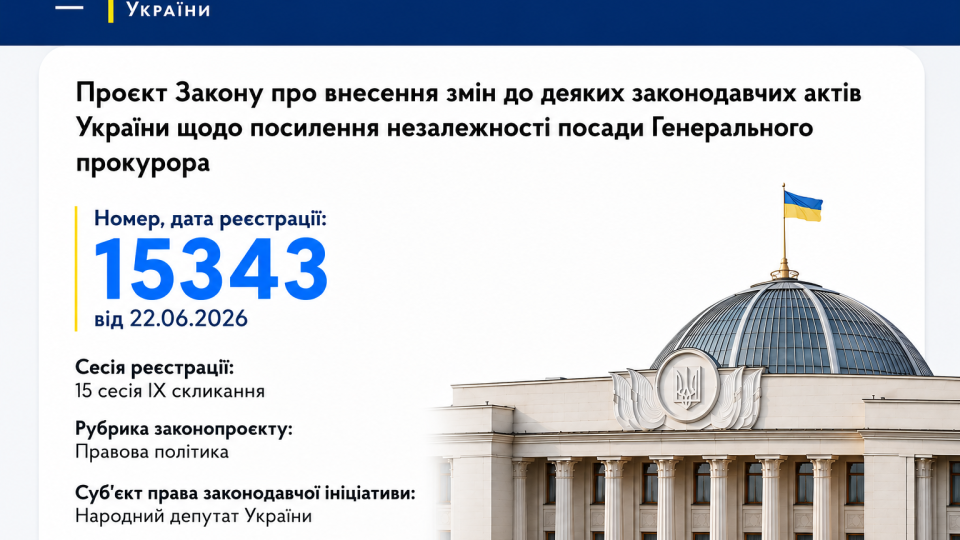










The opening of the negotiation cluster "Foundations" sets a task for Ukraine not just to reform justice, but to find a model that simultaneously satisfies partners from Brussels and does not destroy the constitutional architecture of the state. Bill No. 15343, submitted to the Verkhovna Rada, proposes to introduce a competitive selection system for the Prosecutor General involving international experts. However, an analysis of European practices and national law indicates significant legal risks: from the threat of constitutional collapse to the inconsistency with models operating in EU countries.
The draft Law "On Amendments to Certain Legislative Acts of Ukraine Regarding Strengthening the Independence of the Position of the Prosecutor General of Ukraine" declares an ambitious goal. However, the tools proposed by the legislator to achieve this goal contain legal flaws. In particular, the idea of introducing an open competition for the position of Prosecutor General and creating a competition commission with the "decisive vote" of international experts.
Procedure for Dismissing the Prosecutor General
The draft complicates the procedure for expressing no confidence in the Prosecutor General and his subsequent dismissal. The current mechanism allowed easy initiation of the Prosecutor General's resignation for political reasons.
According to the draft, expressing no confidence will require signatures from half, not a third, of the constitutional composition of the Verkhovna Rada (226 votes).
The issue cannot be put to a vote without the prior creation of a Temporary Investigative Commission (TIC), which must verify facts and provide legal justification for dismissal grounds.
The bill clearly regulates the procedure for hearing the TIC report and the mandatory speech of the Prosecutor General himself, ensuring the right to defend his position.
In case of dismissal or termination of powers of the Prosecutor General, his powers are exercised by the First Deputy Prosecutor General, and in the absence of the First Deputy – one of the Deputy Prosecutors General according to the distribution of duties. In such a case, the exercise of the Prosecutor General's powers cannot last more than six months.
New Appointment Architecture: Open Competition Procedure
The bill provides that candidates for the position of Prosecutor General are submitted to the President exclusively based on the results of an open competition conducted by a special Competition Commission.
Composition of the Commission: Six persons, three of whom are appointed by the High Council of Justice, and three by the HCJ based on proposals from international and foreign organizations assisting Ukraine in the rule of law and anti-corruption. The Commission must select two candidates, from whom the President must submit one to parliament. Candidate selection for the commission will be conducted by public announcement of the procedure start, after which applicants submit a package of documents including an application, autobiography, motivation letter, confirmation of professional experience in justice or anti-corruption, as well as documents on legal education and information on business reputation.
Selection Criteria: The candidate must have not only 10 years of legal experience but also at least 5 years in leadership positions, including in international organizations or abroad.
Transparency: The competition is held publicly with online broadcasting of meetings and free media access.
The discussion on introducing a competitive procedure for selecting candidates for the Prosecutor General position has again raised the debate about the limits of the President's constitutional powers.
The main legal risk is the possible narrowing of the head of state's discretion due to the introduction of a competition commission with international experts, which is not provided by the Constitution of Ukraine as a mandatory element of the appointment procedure. Article 106 of the Constitution of Ukraine clearly states that the President appoints the Prosecutor General with the consent of the Verkhovna Rada, and the Basic Law does not mention mandatory competition commissions as a condition for exercising this power.
The authors of the bill, in turn, emphasize that the Constitution allows the introduction of a preliminary selection that does not change the appointing subjects themselves (the President and the Rada) but only structures the procedure.
Competition Commission
The Competition Commission for selecting the Prosecutor General receives key powers in the appointment procedure: from defining candidate evaluation criteria and conducting testing to the final selection of two candidates, from whom the President submits a nomination to the Verkhovna Rada. Organizational support for its work is assigned to the High Council of Justice, and funding may be provided from international technical assistance.
The Commission independently forms regulations, evaluation methodology, and integrity criteria, conducts comprehensive candidate checks, and makes decisions on their compliance with professional and ethical requirements.
At the same time, Commission decisions can be appealed in court only regarding procedural compliance, which further emphasizes the limited nature of judicial review of the substance of decisions made.
Within the Prosecutor General selection procedure, any individuals and legal entities will have the right to submit information and materials to the Competition Commission regarding candidates' compliance or non-compliance with established requirements.
Effectively, this introduces an open mechanism for collecting external reports about candidates, not limited to official participants or state bodies. Such information may be used by the Commission during the assessment of candidates' professional competence and integrity.
At the same time, the bill does not establish specific requirements for the sources or form of such materials, which expands the Commission's discretion regarding their consideration in the competition procedure.
Role of International Experts
According to the draft, international experts act as guarantors of impartiality. The document establishes that a Competition Commission decision is considered adopted if at least 4 members vote for it, including at least two representatives of the international community.
This construction inevitably raises questions about the limits of permissible external influence on one of the state's key law enforcement positions. The reform should not destroy the system of checks and balances.
The Constitution clearly defines the status and appointment procedure of the head. Establishing additional procedural filters at the law level without amendments to the Basic Law creates a risk of narrowing constitutionally defined powers.
Transfer of Disciplinary Functions to the HCJ
It is proposed to transfer disciplinary proceedings regarding the Prosecutor General from the Qualification and Disciplinary Commission of Prosecutors (QDCP) to the High Council of Justice.
On the one hand, such a change integrates the prosecution into the justice system (according to Article 131-1 of the Constitution). However, there is a risk of overloading the HCJ and a possible conflict of interest if HCJ members simultaneously participate in both the appointment and dismissal of the Prosecutor General.
"Foundations" Cluster – Framework, Not a Template
The opening of the first negotiation cluster "Foundations" on June 15 in Luxembourg officially began the process of adapting Ukrainian law to EU standards. The issues of the rule of law and depoliticization of law enforcement agencies are the central "benchmark" of this stage.
However, it is important to understand: European standards require a result – independence and transparency – but do not always dictate a specific mechanism.
The prosecution reform is critical for closing the "Foundations" cluster, but it should not become a legal experiment detached from the realities of continental law.
Analysis of the experience of France and Germany proves that independence is ensured not through "casting" but through a clear list of grounds for dismissal, transparency of budget financing, and professional self-governance.
The optimal option may be strengthening the role of professional bodies in providing recommendations and conclusions regarding candidates without depriving the President and Parliament of their direct powers defined by the Basic Law. Ukraine must demonstrate to Brussels the ability to build sustainable institutions that respect its own Constitution.
Subscribe to our Telegram channel t.me/sudua and to Google News SUD.UA, as well as to our VIBER and WhatsApp pages on Facebook and Instagram to stay informed about the most important events.