Criminal Code of the Future: Working Group to Submit the Draft of the Largest Criminal Law Reform to the President


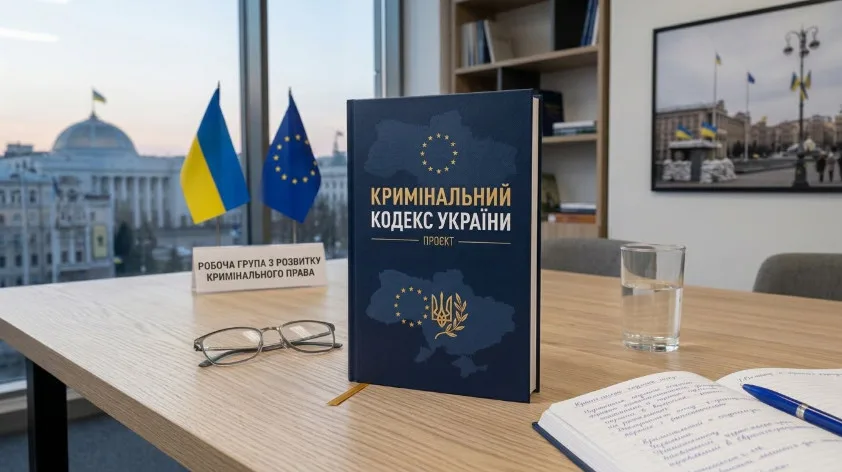










More than 1500 amendments to the current Criminal Code have turned it into a "patchwork quilt," which has recently sparked many discussions within the legal community. Currently, Ukraine is approaching the largest criminal law reform since independence, as in June the development of the draft of the new Criminal Code was completed and a decision was made to send it to the President of Ukraine for consideration of its submission to the Verkhovna Rada.
The draft of the new Criminal Code was developed by the Working Group on the Development of Criminal Law, operating within the Commission on Legal Reform under the President of Ukraine. The group included leading criminal law scholars and practitioners, as well as representatives of the Supreme Court, law enforcement agencies, members of parliament, and independent experts.
The path to creating the final text, published on June 25, 2026, lasted over six years. Preparation of the draft began in 2020, including the development of the General Part and professional consultations with judges, prosecutors, investigators, and scholars. From 2023 to 2025, expert verification took place. The draft underwent comprehensive national and international examination involving Ukrainian specialists, experts from Lithuania, Germany, and the EU Advisory Mission. The final version was published on June 25. The Working Group presented the control text of the new Criminal Code draft, completing a multi-year preparation phase.
Why is the current Code outdated?
The need to adopt a new Criminal Code of Ukraine is explained by the authors of the draft as a crisis of the current 2001 act. Over 25 years, it lost its integrity, becoming an unpredictable law. About 1500 amendments were made, with some articles rewritten up to 15 times. The current Criminal Code often ignores human dignity, habitually considering punishment as the primary means of combating any negative phenomena, which contradicts the principle of ultima ratio (criminal law as a last resort).
As emphasized in the explanatory note, unlike the current Code, all provisions of the draft Criminal Code have already been aligned with international treaties ratified by Ukraine, decisions of the European Court of Human Rights concerning Ukraine, as well as the EU acquis communautaire. The draft also takes into account legislative errors made during wartime.
What does the new Criminal Code change?
The draft new Criminal Code consists of 12 books, 77 sections, and 707 articles. The General Part contains 180 articles, the Special Part — 509. The document also includes 277 crime compositions and 92 compositions of criminal offenses.
One of the main innovations is a complete change in the classification of criminal offenses. The authors propose abandoning the current approach, where severity is primarily determined by the type and size of the punishment. Instead, the main criterion will be the nature of the harm caused and the form of guilt.
Thus, criminal offenses are proposed to be considered acts that caused significant (in cases of intent) or considerable (in cases of negligence) harm. At the same time, crimes will be divided into nine degrees of severity depending on consequences and other objective criteria. According to the developers, this model aims to make the qualification of criminal offenses more predictable and unified, reducing the scope for subjective interpretation.
Fewer types of punishments and unified rules for their assignment
The draft new Criminal Code proposes to reduce the list of criminal punishments from 14 to 5 types.
Remaining will be community service, fines, restriction of liberty, fixed-term imprisonment (from 3 months to 20 years, and up to 30 years for international crimes), and life imprisonment, which will be applied only for the highest — 8th and 9th — degrees of severity crimes.
Another change is the introduction of typical sanctions. For all criminal offenses and crimes of the same degree of severity, unified punishment limits will be established. The developers believe this will ensure more consistent sentencing and eliminate situations where the current Criminal Code provides significantly different sanctions for offenses of equal severity.
Calculation unit and Glossary
For the first time, the Code contains a Glossary with 65 cross-cutting terms used with the same meaning throughout the text.
Moreover, an autonomous calculation unit is introduced for calculating property damage and fines. It is set at 1/30 of the minimum wage as of January 1 of the year the offense was committed. This allows the law to remain relevant without constant amendments due to inflation.
Decriminalization of certain acts
Another important proposed change is the removal from the Criminal Code of acts that, by their legal nature, should be considered administrative or disciplinary offenses. As the developers note in the explanatory note, the document provides for the decriminalization of offenses for which liability is already established by other laws, ensuring clearer separation of criminal and other types of legal responsibility.
This is done to harmonize the Criminal Code with the Code of Administrative Offenses and to adhere to the constitutional principle that no one can be prosecuted twice for the same offense under the same type of legal responsibility.
The accompanying documents to the draft provide examples of acts that currently (under the 2001 Code) have criminal status but are not criminal by content:
- negligent minor bodily injury;
- appearing at the workplace under the influence of alcohol;
- willful disobedience to the administration of a penal institution;
- possession of pornographic items or weapons.
The main goal of this step is to free up human and material resources of the law enforcement system. Decriminalizing acts whose severity is insufficient to be recognized as crimes or offenses will allow criminal justice bodies to focus on truly dangerous offenses.
New institutions: probation and security measures
Probation becomes an independent institution of substantive law, including supervisory and socio-educational measures.
Security measures are a new type of criminal-legal impact, including restrictive measures (e.g., prohibition to visit certain places), compulsory psychiatric care, and publication of information about convictions.
New approaches to protecting life
The draft new Criminal Code proposes to revise approaches to criminal-legal protection of human life and health.
In particular, intentional causing of fetal death after the 22nd week of pregnancy is proposed to be equated with murder.
A privileged form of intentional murder motivated by compassion is provided. This concerns cases where the act is committed at the repeated request of a seriously ill person. Under such circumstances, liability is proposed to be mitigated compared to ordinary intentional murder.
The draft also clarifies the concept of torture, aligning it with the UN Convention against Torture. Liability for this crime will be borne only by public officials acting with the use of their official powers.
Expansion of grounds excluding criminal liability
The draft new Criminal Code significantly updates the list of circumstances excluding the unlawfulness of an act.
In particular, it proposes to regulate harm caused with the voluntary consent of a person, during sports competitions, in case of conflict of legal or professional duties, as well as to enshrine official and combat immunity for persons acting within their powers or performing combat tasks.
Official immunity applies to public officials acting under martial law or armed conflict conditions. Harm is recognized as lawful if a significant socially useful result (repelling aggression) could not be achieved otherwise, and the harm corresponded to the situation.
Combat immunity, in turn, exempts a combatant from liability for harm caused during repelling aggression or eliminating armed conflict if the decision on combat actions was made according to their authority and based on available information.
Special attention is given to protection of Ukraine from armed aggression. The draft explicitly states that causing harm to the enemy during repelling aggression is lawful if such actions do not contain signs of war crimes, crimes against humanity, or genocide. The draft explicitly enshrines the right of every person to defend the homeland. This approach aims to legally regulate the limits of criminal liability for military personnel and civilians participating in the defense of the state.
Possible risks
Despite the progressiveness of the reform, the draft new Criminal Code has been subject to thorough analysis by Ukrainian and international experts.
Main remarks include some unusual legislative formulations, the need to clarify norms regarding international law and universal jurisdiction, as well as risks in the practical application of certain provisions, particularly the presumption of culpability and new criteria for establishing guilt.
Additionally, experts note that the proposed model for determining the degree of severity of criminal offenses is extremely detailed. In their opinion, this may complicate its application without modern digital tools.
When might the new Criminal Code come into effect?
After review by the Office of the President, the bill should be submitted to the Verkhovna Rada as a priority. Alongside the adoption of the Criminal Code, new versions of the Code of Administrative Offenses and the Criminal Executive Code, as well as a package of coordinating amendments to other laws, need to be developed and adopted.
The draft provides that the new Criminal Code will come into force no earlier than the end of martial law — from January 1 of the year occurring three years after its official publication.
According to the authors, the new Criminal Code is intended to make criminal law more understandable, predictable, and systematic. At the same time, the success of the reform will depend not only on the quality of the document itself but also on the readiness of the judicial system and law enforcement agencies to operate under the new rules.
The project faces political and professional discussion ahead, after which its fate will be determined by state authorities. "Judicial-Legal Newspaper" will monitor the progress of the reform and promptly report all important changes.
Subscribe to our Telegram channel t.me/sudua, Google News SUD.UA Google News SUD.UA, as well as our VIBER and WhatsApp pages on Facebook and Instagram to stay informed about the most important events.


Popular news