In Zhytomyr Region, a serviceman struck a police officer near the TRSSC when his son was brought there: court decision


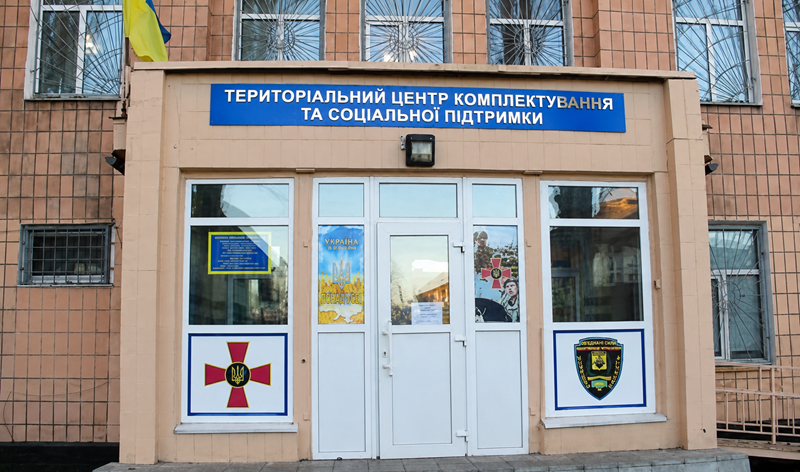










The Zvyagel City District Court of Zhytomyr Region considered a criminal case against a serviceman accused of intentionally inflicting minor bodily injuries on a law enforcement officer in connection with the performance of his official duties, i.e., committing a criminal offense under Part 2 of Article 345 of the Criminal Code of Ukraine.
Circumstances of the case
The court established that inspectors of the patrol police response sector of the Zvyagel District Police Department of the Main Directorate of the National Police in Zhytomyr Region were performing their official duties to ensure public order and implement mobilization measures on the territory of the Territorial Recruitment and Social Support Center (TRSSC).
At that time, the accused arrived at the TRSSC territory and began a verbal conflict with one of the police officers. As stated in the verdict, during the conflict, he formed the intent to inflict bodily injuries on the law enforcement officer.
The court found that the accused was aware that the person before him was a police officer performing official duties, dressed in a uniform of the established pattern with insignia indicating affiliation to the police, and armed with a service firearm.
Acting on his intent, the accused grabbed the police officer by his uniform, then struck him in the face with his head, followed by another punch with his fist.
As a result, the victim sustained a bruise on the nose area extending to the periorbital regions, a displaced nasal bone fracture, hemorrhage and abrasion of the mucous membrane of the upper lip, and a marginal chip of the first upper jaw tooth. According to the expert's conclusion, these injuries are classified as minor bodily injuries causing a short-term health disorder.
During the trial, the prosecutor filed a motion to conduct the hearing under the procedure provided by Part 3 of Article 349 of the Criminal Procedure Code of Ukraine, without examining evidence, limiting the review to data characterizing the accused and procedural documents regarding physical evidence and court costs.
The defense and the victim did not object to this procedure and gave voluntary and informed consent.
The accused fully admitted his guilt and confirmed that the circumstances set out in the indictment correspond to reality.
He explained that on that day his son called him and informed that police officers were taking him to the Territorial Recruitment and Social Support Center. After that, he arrived at the TRSSC, where he saw his son being taken out of a vehicle. According to the accused, he tried to protect his son, but the police officers prevented him from doing so.
A conflict arose between him and the victim, during which, in a state of strong anger, he first struck the police officer with his head and then with his hand. After that, handcuffs were applied to him.
The accused also confirmed that during the conflict he was aware that the victim was a police officer, understood the illegality of his actions, but, as he said, anger clouded his thoughts.
He informed the court that at the time of the trial his son had already been mobilized, but he did not know the place of his service.
The accused also stated that he partially recognizes the civil claim in the amount of 30,000 UAH. Additionally, he reported that before the verdict was issued, he transferred 15,000 UAH to the victim by postal transfer as partial compensation for moral damage, but the victim did not receive these funds.
In the court session, he sincerely repented for his actions, agreed with the legal qualification of his actions, and did not object to the shortened trial procedure.
The victim police officer explained that during the service, the accused's son was detained as a person wanted for violating military registration rules. After detention, he was taken to the Territorial Recruitment and Social Support Center, where the accused later arrived.
According to the victim, the accused behaved aggressively and tried to start a fight, so he tried to calm him down but was met with blows.
The victim noted that due to the injuries sustained, he underwent surgery for a nasal fracture, was treated for one month, and did not receive a salary during that period.
Furthermore, he informed the court that after the incident, negative publications concerning him personally were spread on social networks, including Facebook, so he considered the claimed amount of moral damage justified.
Position and conclusions of the court
Considering that the accused fully admitted his guilt for the criminal offense charged under the circumstances set out in the indictment, correctly understood these circumstances, and the factual circumstances of the criminal proceedings were not disputed by any participant, the court, guided by Part 3 of Article 349 of the Criminal Procedure Code of Ukraine, with the consent of all participants, deemed it inappropriate to examine evidence.
The court explained to the participants that due to the application of this procedure, they would be deprived of the right to appeal the circumstances that were not disputed.
The court separately noted the practice of the European Court of Human Rights, particularly the decision of February 27, 1980, in the case of "Deweer v. Belgium." The court stated that the state and its judicial bodies must ensure the proper realization of the right to a fair trial even when applying simplified criminal procedures. In this regard, the court must verify that the choice of a shortened trial is not motivated solely by the desire to quickly conclude the proceedings without a full trial, without attracting public or media attention, or by the wish to obtain a lighter sentence.
The court concluded that the accused's consent to the trial under the procedure provided by Part 3 of Article 349 of the Criminal Procedure Code of Ukraine was voluntary and not related to the mentioned factors, and therefore there were no grounds to doubt the voluntariness of his position.
Having examined the materials characterizing the accused, the court found his guilt proven and concluded that his actions were correctly qualified under Part 2 of Article 345 of the Criminal Code of Ukraine as intentional infliction of minor bodily injuries on a law enforcement officer in connection with the performance of official duties.
During the trial debates, the prosecutor requested to sentence the accused to five years imprisonment and to release him from serving the sentence with probation, establishing a probation period of three years and imposing obligations provided by Article 76 of the Criminal Code of Ukraine.
The prosecutor also drew the court's attention to two mitigating circumstances: sincere remorse and active assistance in solving the criminal offense.
At the same time, the court established that during the trial, the accused provided evidence of partial voluntary compensation for moral damage to the victim by transferring 15,000 UAH, confirmed by a payment document dated April 27, 2026.
According to the court, these actions indicate the accused's desire to partially make amends for the harm caused and his critical attitude toward his actions. Taking into account the provisions of Part 2 of Article 66 of the Criminal Code of Ukraine, the court recognized partial voluntary compensation for moral damage as another mitigating circumstance.
The court did not find any circumstances that aggravate the punishment according to the law.
When deciding on the type and size of the punishment, the court considered the severity of the criminal offense, which according to Article 12 of the Criminal Code of Ukraine is classified as a minor crime, its nature, and information about the accused.
The court noted that the accused had no prior convictions, admitted his guilt, was not registered with a psychiatrist or narcologist, is a serviceman who was repeatedly wounded in combat while performing tasks to defend Ukraine.
Additionally, the court took into account a positive character reference from the place of service, according to which the accused showed himself as a disciplined and responsible serviceman, repeatedly conducted combat missions to firing positions, during which he saved the lives of wounded comrades, for which he was awarded the "Iron Cross" medal and other commendations from the military unit command.
The court also relied on the provisions of Articles 50 and 65 of the Criminal Code of Ukraine, according to which punishment must be necessary and sufficient for the correction of the person and the prevention of new crimes.
Separately, the court considered the victim's position, who did not insist on imposing a severe punishment on the accused.
The verdict emphasized that punishment is a measure of state coercion involving the restriction of the convicted person's rights and freedoms but primarily has a corrective and preventive nature. The court stressed that when imposing punishment, not excessive but only necessary coercive measures should be applied, and the correction of the person is the ultimate goal of punishment.
Based on the principles of justice, proportionality, and individualization of punishment, the court agreed with the prosecutor on the type of punishment but considered the proposed prison term and probation period excessive.
Therefore, in case No. 285/6411/25, the court concluded that it is necessary to impose a punishment of three years imprisonment.
At the same time, the court did not find legal restrictions on applying the provisions of Article 75 of the Criminal Code of Ukraine and noted that considering the accused's personality, attitude toward the committed act, awareness of the illegality of his actions, and the prosecutor's position, he is not a person dangerous to society.
Accordingly, the court concluded that the correction of the accused is possible without isolation from society, so it released him from serving the sentence with probation, establishing a probation period of one year and imposing the obligations provided by Article 76 of the Criminal Code of Ukraine.
The court noted that such punishment corresponds to the severity of the committed criminal offense, will contribute to the correction of the person, prevention of new crimes, will not impose an excessive personal burden on the convicted person, and will ensure a fair balance between the interests of society and the protection of fundamental human rights.
Subscribe to our Telegram channel t.me/sudua and to Google News SUD.UA, as well as to our VIBER and WhatsApp, Facebook page and Instagram page to stay updated on the most important events.