Can a Car Collision with a Person Be Considered Intentional Infliction of Bodily Harm — The Supreme Court's Position


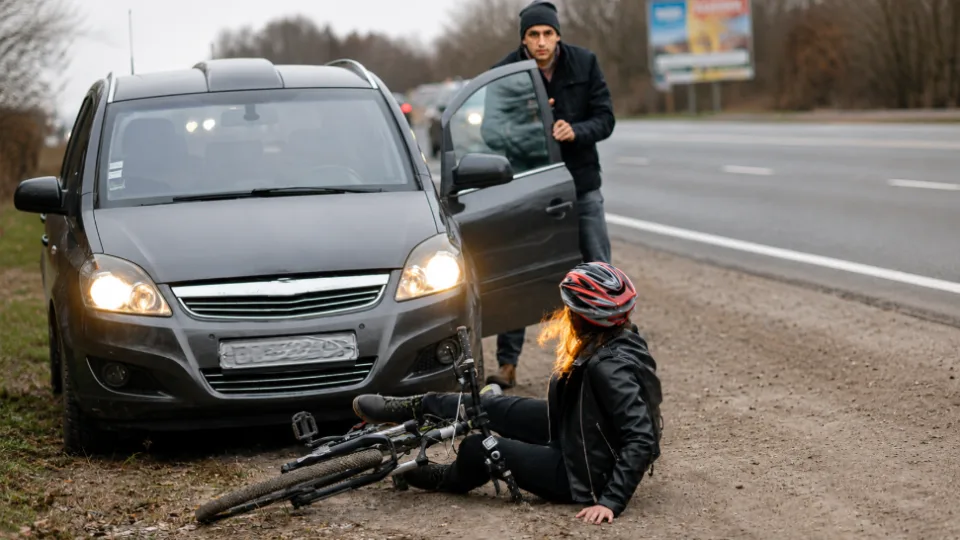










The Criminal Cassation Court of the Supreme Court upheld the acquittal verdict for the driver who, during a conflict with cyclists, ran over the leg of one of them. The court emphasized that a mere conclusion about a traffic rules violation cannot automatically serve as proof of intent to inflict bodily harm, and for liability under Part One of Article 125 of the Criminal Code of Ukraine, the prosecution must prove such intent beyond a reasonable doubt.
The Criminal Cassation Court of the Supreme Court dismissed the cassation appeals of the prosecutor and the victim's representative and agreed with the decisions of the lower courts acquitting the driver accused of intentional minor bodily harm.
Case circumstances
The incident occurred on July 16, 2020, in the village of Khodosivka, Kyiv region.
As established by the courts, the Audi driver stopped at a traffic light. A group of cyclists approached the car. According to the courts' findings, they surrounded the vehicle, knocked on the body and windows, tried to open the doors, and damaged the side mirror.
Two cyclists stood in front of the car, effectively blocking its movement. After a few seconds, the car briefly moved forward, causing both cyclists to fall. One of them sustained minor bodily injuries from the collision with his leg.
After that, the driver sharply turned the wheels to the left, bypassed the cyclists, and left the scene.
He was charged under Part One of Article 125 of the Criminal Code of Ukraine — intentional infliction of minor bodily harm.
Why the driver was acquitted
The trial court and later the appellate court found that the driver violated traffic rules by not ensuring the maneuver was safe and did not pose a threat to other road users before starting it.
However, the courts concluded that the prosecution failed to prove the key element of the alleged crime — the driver's intent to cause bodily harm to the victim.
Due to the lack of proof of the subjective side of the crime, the driver was acquitted.
What the prosecutor and victim requested
In their cassation appeals, the prosecutor and the victim's representative insisted that the nature of the car's movement indicated intent to cause bodily harm.
They also argued that the courts unjustifiably declared certain evidence inadmissible, including the video review protocol and the expert's conclusion, and incorrectly applied procedural law norms.
The Supreme Court's position
The Criminal Cassation Court agreed with the cassation arguments that the lower courts wrongly declared some evidence inadmissible.
Specifically, the Supreme Court noted that if a written order from the head of the pre-trial investigation body contains all the requisites typical of a resolution, clearly defines the scope of authority, and is issued by a competent person, it grants the investigator proper authority and cannot by itself be grounds for declaring the evidence obtained inadmissible.
The Court also pointed out that the circumstances of this criminal proceeding did not fall under cases requiring mandatory participation of a defender as per Article 52 of the Criminal Procedure Code of Ukraine, and Chapter 22 of the CPC does not impose an imperative requirement for a lawyer's participation during the delivery of a suspicion notice.
At the same time, the Criminal Cassation Court emphasized that these procedural errors did not affect the legality of the courts' final conclusions.
The court noted that although the trial court unjustifiably declared the video review protocol inadmissible, it directly examined the original surveillance video during the court session and used it to establish the factual circumstances of the incident. Furthermore, declaring the expert's conclusion inadmissible did not affect the courts' established fact that the victim sustained minor bodily injuries.
According to the Supreme Court, despite the erroneous application of Article 87 of the CPC by the courts, they correctly established the factual circumstances of the case, and therefore these procedural errors alone are not grounds for overturning the court decisions.
Key legal conclusion
The Supreme Court stressed that the central issue in the case was not whether the driver violated traffic rules, but whether he had intent to cause bodily harm to the victim.
The panel of judges noted that to hold a person criminally liable under Part One of Article 125 of the Criminal Code of Ukraine, the prosecution must prove beyond a reasonable doubt that the person desired or consciously allowed harm to another person's health.
A mere conclusion about a traffic rules violation cannot automatically serve as proof of intent to cause bodily harm.
The Criminal Cassation Court also highlighted the fundamental difference between the subjective side of a traffic rules violation and an intentional crime against a person. By its legal nature, a traffic safety violation is a negligent act, whereas criminal liability under Article 125 of the Criminal Code of Ukraine is possible only if intentional infliction of minor bodily harm is proven.
Therefore, the mere fact that the driver started moving without due caution cannot be sufficient grounds to qualify his actions as an intentional crime against a person's health.
Final decision
The Supreme Court concluded in case 369/16593/20 that the prosecution failed to prove beyond a reasonable doubt the driver's intent to cause minor bodily harm to the victim.
Accordingly, the Criminal Cassation Court dismissed the cassation appeals of the prosecutor and the victim's representative and left the acquittal verdict of the Kyiv-Sviatoshynskyi District Court of Kyiv region and the ruling of the Kyiv Appellate Court unchanged.
Subscribe to our Telegram channel t.me/sudua, Google News SUD.UA here, as well as our VIBER and WhatsApp pages, and follow us on Facebook and Instagram to stay updated on the most important events.