Husband locked wife in apartment to prevent divorce: Supreme Court classified it as torture


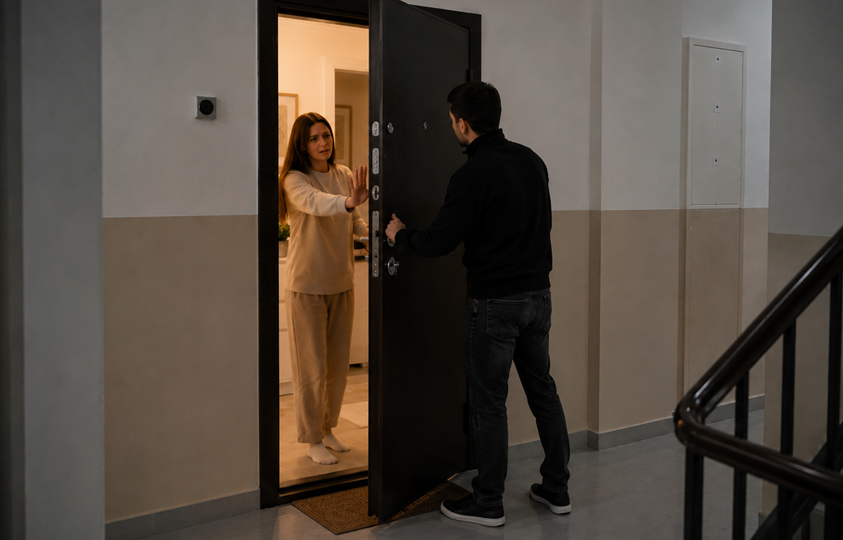










The boundary between intentional bodily harm and torture is not always clear in practice. Especially when violence is used not only to cause pain but also for psychological pressure, intimidation, or coercion of the victim to certain behavior. Therefore, for courts, it is crucial to establish not only the nature of the injuries inflicted but also the purpose behind the perpetrator's actions.
In the ruling in case No. 344/15512/21 dated May 20, 2026, the Criminal Cassation Court within the Supreme Court examined the issue of distinguishing torture from causing minor bodily injuries, evaluating evidence in cases of illegal deprivation of liberty, and criteria for proving guilt beyond a reasonable doubt.
Case circumstances
The courts established that the accused arrived at the apartment where his wife was staying, who had previously announced her intention to divorce.
While in the apartment, the man locked the entrance door and blocked it with furniture, preventing the victim from freely leaving the premises. He then continued to detain her against her will and did not allow her to leave the apartment.
According to the case materials, the accused, seeking to force his wife not to divorce him and to continue living together, took knives, inflicted cuts on himself, and also inflicted cuts and numerous blows on various parts of the victim's body. The victim was under the accused's control for approximately two hours.
As a result, the victim suffered a nasal bone fracture, cuts, numerous abrasions, bruises, and other bodily injuries, confirmed by medical documents and the forensic medical examination report.
The court of first instance found the accused guilty, in particular under Part 2 of Article 146 and Part 1 of Article 127 of the Criminal Code of Ukraine. After a new appellate review, the appellate court upheld the findings of guilt under these articles and sentenced him to three years of imprisonment.
The defense in the cassation appeal argued that the accused's actions did not constitute torture or illegal deprivation of liberty and should have been qualified only as intentional minor bodily injury.
Supreme Court's position
The court noted that each element important for the legal qualification of the act must be proven beyond a reasonable doubt: both those forming the objective side of the act and those defining its subjective side.
On one hand, the standard of proof beyond a reasonable doubt means that doubt should not be purely speculative but based on certain circumstances established by the court or the lack of proof of important facts in the case, which would allow for an alternative version of events contradicting the prosecution's version and which cannot be refuted by the evidence presented.
On the other hand, to meet the standard of proof beyond a reasonable doubt, it is not enough that the prosecution's version is merely more probable than the defense's version. The legislator requires that any reasonable doubt about the prosecution's version of events be dispelled by facts established on the basis of admissible evidence, and the only version that a reasonable and impartial person can use to explain the entire set of facts established in court is the version that justifies recognizing the person as guilty of the charges.
The court decided that in this criminal proceeding, the mentioned standard was met, and the courts' conclusions were based on a combination of testimonies from victims, witnesses, medical documents, expert conclusions, and the results of the crime scene inspection.
Regarding the qualification of the accused's actions, the Supreme Court agreed with the appellate court's conclusions that the accused locked and blocked the apartment door, preventing it from being opened from both inside and outside for a prolonged time, while staying in the apartment with the victim, inflicted numerous blows with his hands to various parts of her body and knife cuts (causing physical suffering) with the purpose of forcing the victim not to divorce him and to continue living together.
Thus, the accused subjected the victim to torture over a prolonged period to achieve his desired outcome by inflicting systematic and numerous bodily injuries causing severe pain and insult, which collectively caused intense physical pain and moral suffering.
The Supreme Court agreed that the violent actions involved causing mental and physical suffering, the victim's expectation of death for two hours, deprivation of liberty, and infliction of pain.
Separately, the Supreme Court addressed the defense's arguments about the inadmissibility of the crime scene inspection protocol and stated that the criminal procedural law does not specify a particular place where seized items and documents must be inspected by authorized persons, so such circumstances have no bearing on the lawful obtaining of the inspection results.
The court also emphasized that an incorrect naming of the investigative action does not render the obtained data inadmissible, as the investigator actually conducted an inspection fully consistent with the provisions of Article 237 of the Criminal Procedure Code of Ukraine.
Based on the above, the Supreme Court upheld the appellate court's verdict and denied the defense's cassation appeal.
Therefore, the Court confirmed that detaining a wife against her will, inflicting physical and psychological suffering, and violence to prevent divorce constitute torture and illegal deprivation of liberty. The Supreme Court also reminded about the standard of proving guilt beyond a reasonable doubt and noted that formal errors in the name of an investigative action alone do not make evidence inadmissible.
Subscribe to our Telegram channel t.me/sudua and to Google News SUD.UA, as well as to our VIBER and WhatsApp, and follow us on Facebook and Instagram to stay updated on the most important events.