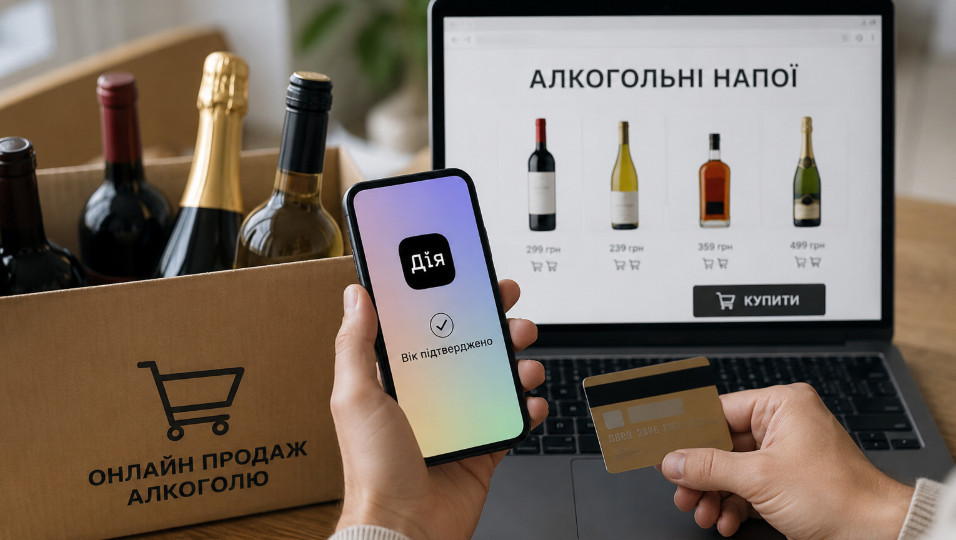
The law on OLX tax expanded: alcohol online will be sold only through “Diia”












The implementation of international automatic exchange of information on income received through digital platforms (DPI standard) is part of a global trend towards de-shadowing the economy. Ukraine, as a future EU member, implements rules similar to the DAC7 Directive. The main goal of the law is to force platform operators to report on users' activities.
As reported by the “Judicial and Legal Newspaper”, the Verkhovna Rada supported automatic data exchange on income from digital platforms. This concerns bill 15111-d.
The law introduces a very broad definition of a digital platform. It is any software, website, or mobile application that allows sellers to connect with users to carry out reportable activities. Platform operator means an organization that enters into agreements with sellers to provide access to this platform.
The law does not include in the concept of “platforms” software that performs purely technical functions, such as payment processing or ordinary advertising without the possibility of connecting parties for a transaction.
Who falls under reportable activities
Reportable activity is considered the provision of any of these types of services through a platform for remuneration:
- Rental of real estate (residential and non-residential, parking spaces).
- Provision of personal services (including freelancing, online consultations, etc.).
- Sale of goods.
- Rental of vehicles.
Not all users will become reporting subjects. The law provides for the category of “excluded seller”, whose data is not transmitted. These include:
- State bodies and government organizations.
- Public companies whose shares are traded on stock exchanges.
- “Small” sellers of goods: those who made fewer than 30 sales during the year and whose total remuneration did not exceed 2,000 euros.
This is an important safeguard for ordinary citizens selling used items on OLX, but for active sellers on Etsy or eBay, it means full transparency.
Penalties
The bill establishes strict liability for violations. Failure by the operator to submit a report on sellers' income or submission of false data entails a fine of 20 minimum wages (as of 2026, about 160,000 UAH).
A very important amendment to the Labor Code is introduced. The law explicitly states that the Labor Code does not apply to relations between reportable sellers and platform operators if they are registered according to the Tax Code and provide personal services through the platform. This effectively legalizes the Uber or Glovo work model without the risk of “reclassification” of civil relations into labor relations.
Read about the risks hidden by automatic exchange of income data from digital platforms in the previous article by the “Judicial and Legal Newspaper”
Main rejected amendments
The committee rejected the vast majority of over 3,500 amendments to the bill on implementing international automatic exchange of income data through digital platforms (DPI).
Attempts to raise the threshold of non-taxable operations from 2,000 euros to 2,720–7,880 euros were rejected. The limit remained at 2,000 euros.
All amendments to postpone the law’s launch or set alternative implementation dates were rejected.
Proposals to soften sanctions for platforms, introduce “flexible” fines, or a transitional moratorium on punishment for technical failures were rejected. Fixed fines remain.
Amendments on limiting the volume of transmitted data (invoices, tax IDs, addresses), as well as attempts to prohibit platforms from having tax agent status, were rejected.
Hidden provisions
During preparation for the second reading, provisions not directly related to digital platforms were included in the draft.
Thus, an export duty on certain types of stone was introduced. The duty applies to the export of granite in raw, roughly processed, cut into blocks or slabs, as well as other stones used for monuments or construction.
A fixed rate of 0.3 euros per kilogram of the actual weight of the goods is established. These rates are introduced for a long period — 10 years.
The duty on stone will take effect in 45 days from the day following the publication of this law. The explanations to the amendments state that the export duty is introduced as a measure to protect the vital security interests of Ukraine in accordance with GATT 1994 rules.
In addition, electronic communications providers are obliged, by court decision or order of the National Center for Operational and Technical Management, to restrict access to platforms that are not properly registered or conduct illegal sales of excise goods.
The bill effectively builds a new vertical of control over online sales of excise goods (alcohol, beer, tobacco, electronic cigarettes, and liquids for them).
Thus, electronic trade in alcohol and tobacco is allowed only if requirements are met. The seller must have a valid license for the relevant activity.
A special state register is created, where licensees are obliged to enter the addresses of their websites, URLs, domain names, and even names of mobile applications through which sales are made.
If the State Tax Service detects a website or app selling alcohol or tobacco but not included in this Register, this is grounds for a decision to restrict access to such a resource.
The law prohibits sales without prior age identification of the buyer. This must be done by obtaining data from an e-passport or e-driver’s license via the “Diia” portal, or by using facial recognition technologies or involving an operator for remote real-time identification.
The procedure for restricting access to violating sites must be prompt. The State Tax Service makes the decision to restrict access. The National Center for Operational and Technical Management issues orders to providers within 3 working days. Electronic communications providers are obliged to block within 3 working days.
Failure to restrict access to sites designated by the State Tax Service results in a fine of 2,000 non-taxable minimums (34,000 UAH), and for repeated violations within a year — 4,000 minimums (68,000 UAH).
Sales of excise goods through unregistered platforms lead to license cancellation and resource blocking. The regulator’s sanction decisions are mandatory, and their appeal does not suspend enforcement (unless otherwise decided by the court).
Subscribe to our Telegram channel t.me/sudua and to Google News SUD.UA, as well as to our VIBER and WhatsApp, Facebook page and Instagram to stay updated on the most important events.