Does the Prosecutor General Competition Comply with the Constitution: The Proposed Model Has No Analogues in Most EU Countries












The issue of the procedure for forming the leadership of prosecution bodies is one of the key elements in ensuring a balance between the independence of the prosecution and democratic accountability. European practice demonstrates the absence of a single model for appointing the Prosecutor General. Instead, different states apply various approaches to nominating and appointing candidates depending on the constitutional model, the role of the prosecution in the system of power, and national legal traditions.
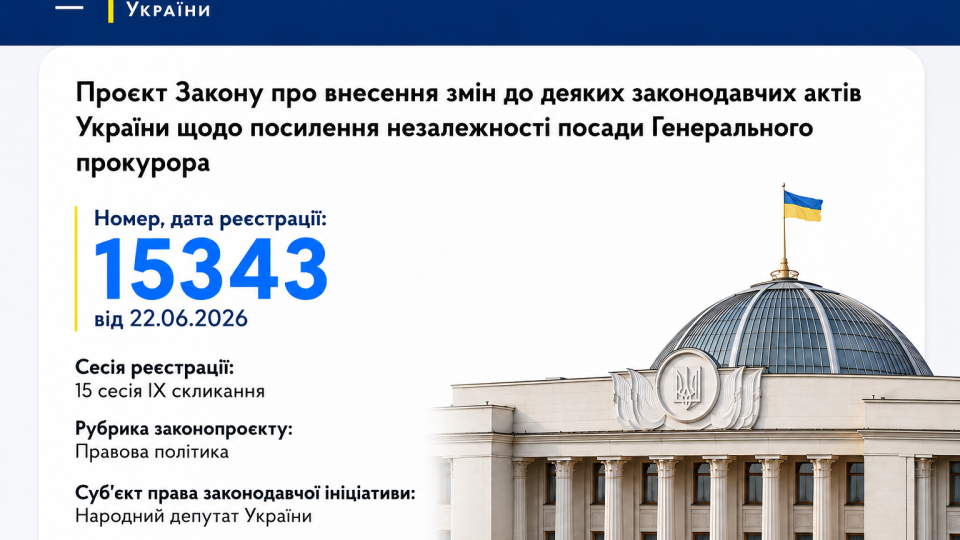
The model of appointing the Prosecutor General proposed by draft law No. 15343 effectively creates a constitutionally unprovided stage in the formation of the position. The Constitution of Ukraine directly defines the President and the Verkhovna Rada as the subjects of appointing the Prosecutor General. At the same time, the draft law effectively creates an additional constitutionally unprovided filter in the form of a competition commission, without whose decision the President will not be able to exercise his constitutional authority.
This calls into question the draft law’s compliance with the principle of the supremacy of the Constitution and the established approach of the Constitutional Court of Ukraine regarding the inadmissibility of changing the constitutionally defined scope of powers of state authorities by law, as well as the conclusions of the Venice Commission.
The Venice Commission emphasizes that there is no single "correct" model for appointing the Prosecutor General in Europe. In some countries, the prosecution is more closely linked to the executive branch, while in others it has a significantly higher level of institutional autonomy.
The decisive factor is not the model itself, but the presence of procedural guarantees that ensure the independence of the prosecutor from political influence. There is a difference in the subject who has the right to propose a candidate for a certain position:
- in countries where the Prosecutor General is part of the government, the government has the right to appoint a candidate for the position of Prosecutor General;
- in countries where the Prosecutor General acts as an independent institution, the Prosecutor General is appointed either by the president of the country or the supreme legislative body.
That is why the Commission recommends adhering to two key conditions during the selection and appointment of the Prosecutor General:
1 the right to nominate candidates must be clearly defined, and
2 consultations on the professional qualifications of candidates should be obtained from relevant persons, such as representatives of the legal community (including prosecutors) and civil society.
Subjects nominating candidates for the position of Prosecutor General in European countries
European practice shows that the appointment of the Prosecutor General is mostly under the control of the executive branch.
In 21 of the 28 EU countries and the United Kingdom, candidates are nominated by ministers of justice, governments, prime ministers, or presidents. At the same time, the parliamentary nomination model is practically an exception: among the studied countries, only Slovakia granted such authority to the legislative body. The Slovak Republic is the only state that authorizes the highest legislative body to nominate a candidate for the position of Prosecutor General.
- in ten countries — Belgium, Czech Republic, Denmark, Estonia, France, Netherlands, Luxembourg, Germany, Austria, and Romania — the right to nominate a candidate for the respective position belongs to the Minister of Justice;
- in six countries — Finland, Croatia, Greece, Portugal, Spain, and Sweden — the right to nominate a candidate for the position of Prosecutor General belongs to the government;
- in two countries — Malta and Poland — the candidate for the position of Prosecutor General is directly nominated by the prime minister;
- in three countries — Hungary, Lithuania, and Cyprus — the right to nominate a candidate belongs to the president.
The examples of Ireland and the United Kingdom are specific because these countries apply a selection procedure open to potential candidates. In the case of the United Kingdom, submitted candidacies are reviewed by a committee chaired by the Civil Service Commissioner. Then this committee provides recommendations to the Attorney General, who selects the so-called head of prosecutors.
In other countries, the right to nominate a candidate for the position of Prosecutor General belongs to judicial authorities or prosecutorial self-government. In particular, these powers are exercised by the Judicial Council in Bulgaria and Italy, the Head of the Supreme Court in Latvia, and the State Prosecutors’ Council in Slovenia.
In Latvia, the procedure is more oriented toward professional evaluation of candidates. A person who meets the established criteria submits documents to the Judicial Council. After receiving conclusions from competent bodies and conducting an evaluation, the Judicial Council determines the most suitable candidate and submits their candidacy for approval to the Saeima, which makes the appointment of the Prosecutor General.
Subjects authorized to appoint Prosecutors General
Based on the analysis of legal acts and norms, the following conclusions can be drawn:
- in 17 cases, the Prosecutor General is appointed by the king or president (Belgium, Bulgaria, Cyprus, Denmark, Finland, France, Greece, Lithuania, Luxembourg, Malta, Germany, Poland, Portugal, Austria, Romania, Slovakia, and Spain);
- in 4 cases, the highest legislative body appoints or approves the position of Prosecutor General (Croatia, Hungary, Latvia, Slovenia);
- the government is authorized to appoint or comment on the nomination of a candidate for the position of Prosecutor General in 6 countries (Czech Republic, Estonia, Ireland, Netherlands, Slovenia, and Sweden);
- only in one (1) EU country, a collegial body of judges, namely the Judicial Council (Italy), appoints the Prosecutor General (Mališka and Csudai 2020).
The Venice Commission in its document took into account the fact that parliamentary participation in the appointment or election of the Prosecutor General may pose a certain risk of politicizing the process.
However, on the other hand, the Venice Commission recommended involving parliament as a way to mitigate this risk, noting that:
a) the opinion of the relevant parliamentary committee, as well as an expert council, should be taken into account, and
b) a qualified majority of two-thirds of votes should be used during voting (Collection of opinions and reports of the Venice Commission on prosecutors, p. 26).
Analysis of models for appointing Prosecutors General in European Union countries shows that the vast majority of states leave the decisive role in this process to national authorities — presidents, governments, or parliaments. At the same time, draft law No. 15343 proposes a model that has no direct analogue among the studied European jurisdictions and may become the subject of constitutional discussion due to the potential limitation of the powers of the President of Ukraine and the introduction of an additional mechanism influencing the formation of the list of candidates for the position of Prosecutor General.
Subscribe to our Telegram channel t.me/sudua and to Google News SUD.UA, as well as to our VIBER and WhatsApp pages on Facebook and Instagram to stay informed about the most important events.