Fine for a Crack on the Windshield or Non-Working Parking Lights: How a Driver Can Win a Court Case Against the Patrol Police












The effectiveness of protecting drivers' rights in Ukraine today directly depends on understanding the procedural aspects of law enforcement agencies' work. An analysis of court decisions over the past year shows that the presumption of guilt of the authority figure remains the main instrument of justice.
Courts increasingly emphasize that a police officer’s visual observation of a violation cannot be the sole evidence—it must be supported by proper technical recording. In this digest, we will examine key legal positions regarding cracks on glass, parking rules, and standards of proof.
Speed Mode: TruCAM and Standards of Proof
The issue of using handheld laser speed meters TruCAM remains controversial, but the absence of video recording is grounds for canceling the fine.
Zarichny District Court of Sumy in case 591/480/26 satisfied the driver’s claim because the police did not provide video recording due to the expiration of the 30-day storage period. The court also agreed that handheld use of TruCAM contradicts Article 40 of the Law "On the National Police," which requires stationary installation.
The patrol recorded the violation using the TruCAM laser speed meter, but the driver appealed the ruling, claiming he was driving at about 65 km/h. The device’s readings (111 km/h) were unreliable due to difficult weather conditions. The measurement was taken from over 400 meters away at a large angle without correction.
The court concluded that the patrol police did not provide proper and admissible evidence of the violation. In particular, the use of the TruCAM laser speed meter in handheld mode requires strict adherence to the established procedure, but the case materials did not contain confirmation of the correct measurement procedure. Moreover, the court could not examine the video recording, so under these circumstances, the evidentiary base was recognized as insufficient to hold the driver liable.
Industrial District Court of Dnipro in case No. 202/2713/25, on the contrary, recognized the use of TruCAM in the hands of a police officer as lawful, referring to the fact that the device’s design includes a handle for holding.
Unlike cases where courts cancel fines due to deficiencies in the evidentiary base, in this case, the patrol police provided proper, admissible, and sufficient evidence of the violation. The court examined body camera recordings of the police officers, photographic materials, and other documents, which collectively confirmed the fact of speeding.
Crack on the Windshield: Damage or Malfunction?
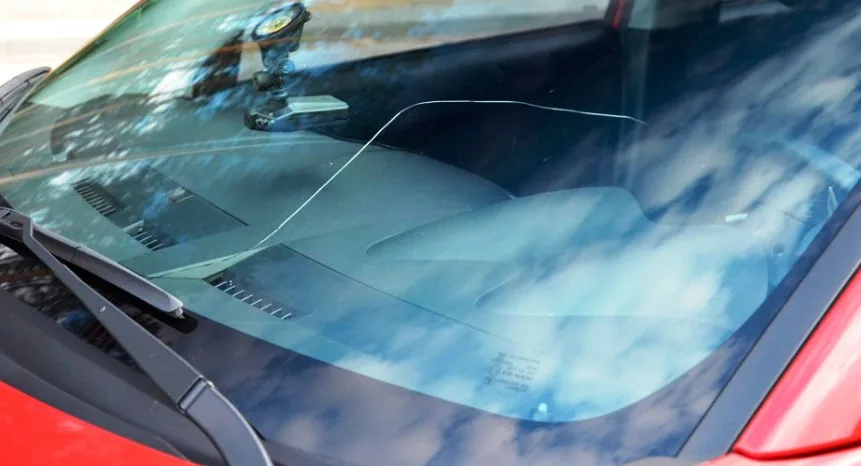
Courts have developed a clear position: a crack on the glass is damage, not a technical malfunction that prohibits vehicle operation under traffic rules.
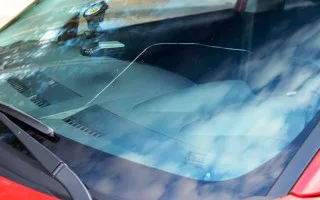
Second Administrative Court of Appeal in case No. 536/579/26 canceled the patrol police fine for a crack on the glass, establishing that the presence of cracks and chips in the windshield wiper area does not prohibit vehicle operation under Part 1 of Article 121 of the Code of Administrative Offenses, since traffic rules do not classify this as a critical malfunction.
The court concluded that a crack or chip on the windshield in the wiper area, although not meeting the requirements of DSTU 3649:2010, is not classified by the Traffic Rules as a technical malfunction that prohibits vehicle operation. Therefore, such damage alone does not constitute an administrative offense under Part 1 of Article 121 of the Code of Administrative Offenses. The court emphasized that the basis for liability is violation of traffic rules, not DSTU provisions.
Samarsky City District Court of Dnipropetrovsk Region in case No. 183/6834/26 also canceled the ruling for a crack on the glass because the defendant did not provide evidence of measurements and did not prove that the damage obstructed visibility.
Parking and Rights of Persons with Disabilities
Shevchenkivskyi District Court of Kyiv in case No. 761/23036/25 canceled the fine for unpaid parking because the plaintiff is a person with a Group III disability. The court emphasized that the law allows such persons to park free of charge in any spot on the lot if special places are absent or occupied.
The court established that the plaintiff is a person with a disability and therefore, according to Article 30 of the Law of Ukraine "On the Basics of Social Protection of Persons with Disabilities in Ukraine," has the right to free parking in specially equipped lots. Since the defendant did not prove a parking violation or the absence of grounds for applying this benefit, the court concluded there was no administrative offense in the plaintiff’s actions and canceled the ruling.
Zavodskyi District Court of Zaporizhzhia in case No. 332/4286/25 denied the cancellation of the fine, establishing that the driver parked in an area with the "Paid Services" sign, and his claim about parking on the sidewalk was refuted.
The court found that the inspection provided sufficient and proper evidence of the violation. Photo documentation confirmed the place, time, and duration of the vehicle’s parking, the presence of road sign 5.43 with a "Paid Services" plate and corresponding blue markings, and the automated system confirmed the absence of payment for parking. The driver’s arguments that the vehicle was parked on the sidewalk were rejected as contradicted by photographic evidence. As a result, the inspector’s ruling was upheld.
Technical Condition and Metrological Errors
Shevchenkivskyi District Court of Lviv in case No. 466/1571/26 canceled the fine for headlight adjustment violation (Article 121 of the Code of Administrative Offenses) because measurements were taken on a loaded vehicle, whereas DSTU 3649:2010 requires measurements only in the empty mass state.
The court recognized that the patrol police did not prove the offense. In particular, the vehicle stop time (07:17) did not correspond to dark hours, the headlight adjustment measurements were conducted in violation of DSTU requirements because the vehicle was loaded, and the ruling did not contain a proper description of the violation circumstances. Due to insufficient evidence of the event and offense, the court canceled the ruling, closed the case, and recovered the court fee from the Patrol Police Department.
Tomakivskyi District Court of Dnipropetrovsk Region case No. 195/184/26. The ruling for non-working parking lights was canceled because the police officer did not specify in the ruling the technical device used for video recording, making the video inadmissible evidence.
Analysis of judicial practice indicates the formation of stable approaches in disputes regarding patrol police rulings.
Inspector explanations alone are no longer sufficient—courts require proper photo and video recording, as well as compliance with procedural requirements for issuing rulings. If speed, lighting devices, or other technical parameters are measured with deviations from established rules, such evidence may be deemed inadmissible.
When assessing the legality of holding a person liable, courts consider not only formal compliance with procedure but also the person’s objective life circumstances, including health status, military service, and other valid reasons.
Modern judicial practice shows that successful appeal of fines increasingly depends not on formal objections but on the quality of the evidentiary base, police compliance with procedural requirements, and correct application of substantive and procedural law norms. Knowledge of current court legal positions becomes one of the key tools for effective protection of citizens' rights.
Subscribe to our Telegram channel t.me/sudua and to Google News SUD.UA, as well as to our VIBER and WhatsApp, Facebook page Facebook and on Instagram to stay informed about the most important events.


Popular news