Being a Relative is not Enough to Receive Payment for a Deceased Serviceman — Supreme Court












The Supreme Court's Civil Cassation Court has affirmed that merely demonstrating kinship, past cohabitation, or isolated instances of support and care are insufficient to confirm an individual's status as a family member of a deceased serviceman. To establish such status, a claimant requesting recognition of cohabitation as a single family must prove a combination of circumstances as stipulated by Article 3 of the Family Code of Ukraine: joint residence, a shared household, a common economy, and mutual rights and obligations.
In the case in question, the deceased serviceman's grandfather and grandmother sought to establish their status as cohabiting family members with their grandson. This was necessary because, without such a court decision, the Ministry of Defence could not process their entitlement to a share of the one-time financial assistance, as outlined in Cabinet of Ministers Resolution No. 168. However, courts at all levels concluded that the evidence presented by the grandparents did not substantiate the existence of family relations in the legal sense. The Supreme Court upheld these conclusions.
Circumstances of the Case
Following the serviceman's death during a combat mission, his grandfather and grandmother applied to the Ministry of Defence for one-time financial assistance, claiming to be family members of the deceased.
The Ministry of Defence responded that the submitted documents were inadequate to confirm this status. The agency noted that without a court order establishing the fact of joint residence, a common household, and the presence of mutual rights and obligations, it was impossible to determine the applicants' right to receive the payment. Subsequently, the grandfather and grandmother initiated legal proceedings to establish this legal fact.
The plaintiffs asserted that, after reaching adulthood, their grandson had, in fact, lived with them, except for periods of military service. They claimed to have maintained a common household and a joint budget. They stated that their grandson contributed to house repairs and covered certain family expenses. Furthermore, they noted that his personal documents remained with them after his death. They also cited witness testimonies, reports on living conditions inspections, and other written evidence.
Conversely, the case materials included evidence of the serviceman's family relations with his wife, comprising a registered marriage, documentation of their joint residence, his wife's initiation of an inheritance case after his death, and her receipt of official notifications from military authorities.
What the Supreme Court Decided
The Civil Cassation Court upheld the decisions of the courts of first and appellate instances to deny the claim.
The Supreme Court reiterated that, according to Article 3 of the Family Code, a family comprises individuals who cohabit, share a household, and have reciprocal rights and obligations. It is the confluence of these characteristics that must be demonstrated in cases seeking to establish the fact of living as one family, particularly when entitlement to social payments is contingent upon it. No single characteristic is sufficient, on its own, to establish this legal fact.
The court underscored that mere blood relation between a grandfather, grandmother, and grandson does not, in itself, confirm their membership of one family within the meaning of family law.
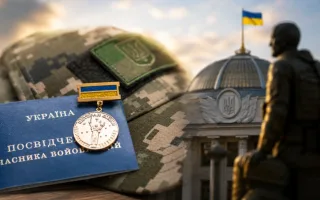
The cassation court further concurred with the lower courts' assessment of the evidence. Specifically, it noted that the presence of some of the deceased's personal documents with the grandparents, the bestowal of his medals and honorary citizen diploma upon them, the erection of a monument, the placement of a photo on the Alley of Heroes, the grandson's payment for a festive dinner in honour of the grandfather, or his listing as a payer in house repair documents are not, in themselves, sufficient evidence of joint residence as one family, shared household management, and the existence of reciprocal rights and obligations.
In case 345/3886/24, the Supreme Court agreed with the conclusions of the lower courts that the plaintiffs failed to provide appropriate, admissible, and sufficient evidence confirming joint residence with the grandson as one family, shared household management, and the existence of reciprocal rights and obligations during the period claimed.
Separately, the Civil Cassation Court observed that the legal conclusions of the Supreme Court, as articulated in other cases, are applied with due consideration for the specific factual circumstances of each case and cannot be automatically transposed to other disputes. Furthermore, the cassation court lacks the authority to re-evaluate evidence or establish new factual circumstances.
Consequently, the Supreme Court dismissed the cassation appeal and upheld the decisions of the courts of first and appellate instances.
Subscribe to our Telegram channel t.me/sudua, follow SUD.UA on Google News , and join us on VIBER, WhatsApp, Facebook and on Instagram to stay informed about the important events.