Is it possible to recover debt on an online loan agreement signed with a one-time identifier


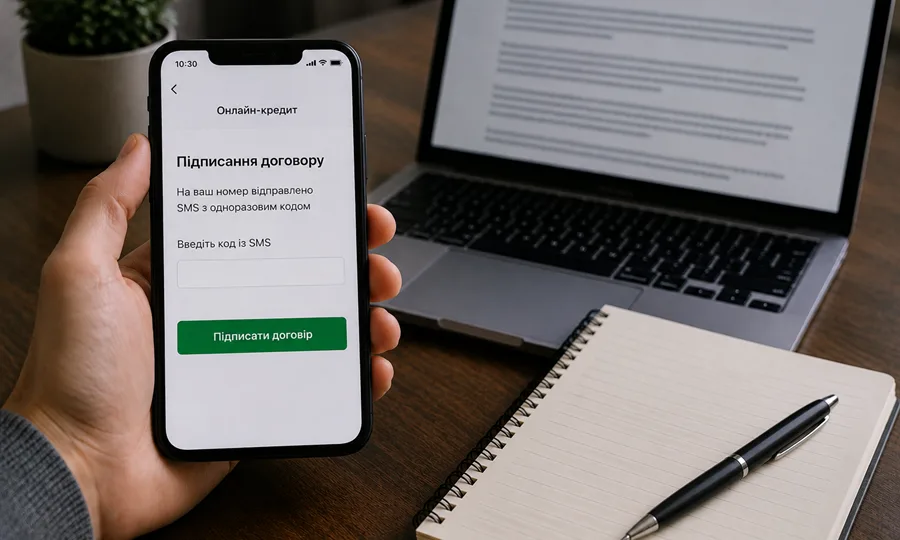










The Rozhniativ District Court of Ivano-Frankivsk region considered civil case No. 350/672/26 on the claim of a LLC to recover debt under a loan agreement concluded in electronic form. The court examined whether an electronic loan agreement signed with a one-time identifier is a proper basis for debt recovery and whether electronic documents confirm the fact of concluding the agreement and receiving the loan funds.
Essence of the case
The plaintiff applied to the court demanding to recover from the borrower the debt under the loan agreement No. 459670-KS-002 dated November 6, 2025, in the total amount of UAH 16,980, as well as court fees in the amount of UAH 2,662.40.
The court established that the loan agreement was concluded between the parties in electronic form by exchanging electronic messages in accordance with the requirements of Article 12 of the Law of Ukraine "On Electronic Commerce." The document was signed with an electronic signature using the one-time identifier UA-2334.
In fulfillment of the agreement terms, the lender provided the borrower with UAH 6,000 on the conditions of term, repayment, and payment. The borrower, in turn, undertook to repay the loan amount, pay interest for using the funds, commission, and other payments within the terms specified by the agreement and payment schedule.
According to the plaintiff, he fulfilled his obligations in full, while the borrower did not repay the loan funds, nor paid interest and commission. As of April 7, 2026, the total debt amounted to UAH 16,980, of which UAH 6,000 was overdue principal debt, UAH 6,780 overdue interest for using the loan, UAH 3,000 interest accrued according to Article 625 of the Civil Code of Ukraine, and UAH 1,200 debt for commission. The lender did not charge penalties.
The proceedings were opened under simplified claim proceedings. The plaintiff’s representative did not appear at the court session, and the defendant, duly notified about the case hearing, did not submit a response to the claim and did not appear at the court session. Under these circumstances, the court decided to consider the case in the absence of the parties and to issue a default judgment.
Position and conclusions of the court
After examining the case materials, the court established the fact of concluding an electronic loan agreement between the parties and confirmed that the loan funds were actually provided to the borrower.
The court paid special attention to the evaluation of electronic evidence submitted by the lender through the "Electronic Court" subsystem of the Unified State Information and Telecommunication System. The court concluded that such documents are proper, admissible, and have evidentiary value as they were submitted in accordance with procedural law, are mutually consistent, and confirm the circumstances of concluding the loan agreement, receiving the loan funds, partial fulfillment of obligations, and the emergence of debt.
In resolving the dispute, the court noted that according to the Law of Ukraine "On Electronic Commerce," an electronic agreement is an agreement between the parties formalized in electronic form, and according to part two of Article 639 of the Civil Code of Ukraine, an agreement concluded using information and telecommunication systems by mutual consent of the parties is considered concluded in written form.
The court also noted that Articles 626, 628, and 638 of the Civil Code of Ukraine define a contract as an agreement between parties regarding the establishment of civil rights and obligations, and a loan agreement concluded in compliance with legal requirements creates corresponding rights and obligations for the parties.
Referring to the provisions of Articles 1046, 1049, 1050, and 1054 of the Civil Code of Ukraine, the court stated that the borrower is obliged to return the received funds and pay interest within the terms specified by the agreement, and in case of delay, the lender has the right to demand repayment of the debt and due payments.
Additionally, the court took into account the provisions of part two of Article 8 of the Law of Ukraine "On Consumer Lending," according to which commissions related to providing, servicing, and repaying the loan are included in the total costs of the consumer loan.
Since the defendant did not provide evidence of debt repayment or proper fulfillment of credit obligations to the court, the court concluded that the claim is justified and should be satisfied in full.
The Rozhniativ District Court of Ivano-Frankivsk region satisfied the claim of the LLC and decided to recover from the borrower the debt under the loan agreement in the amount of UAH 16,980, as well as court fees of UAH 2,662.40. The court recognized as proven the fact of concluding the electronic loan agreement, receiving the loan funds, and the existence of unpaid debt, and the electronic documents submitted through the "Electronic Court" subsystem as proper and admissible evidence in the case.
Subscribe to our Telegram channel t.me/sudua and to Google News SUD.UA, as well as to our VIBER and WhatsApp, Facebook page and Instagram to stay updated on the most important events.