It was freezing outside, but the Drager showed +11: the driver won an appeal in a case of 'drunk' driving


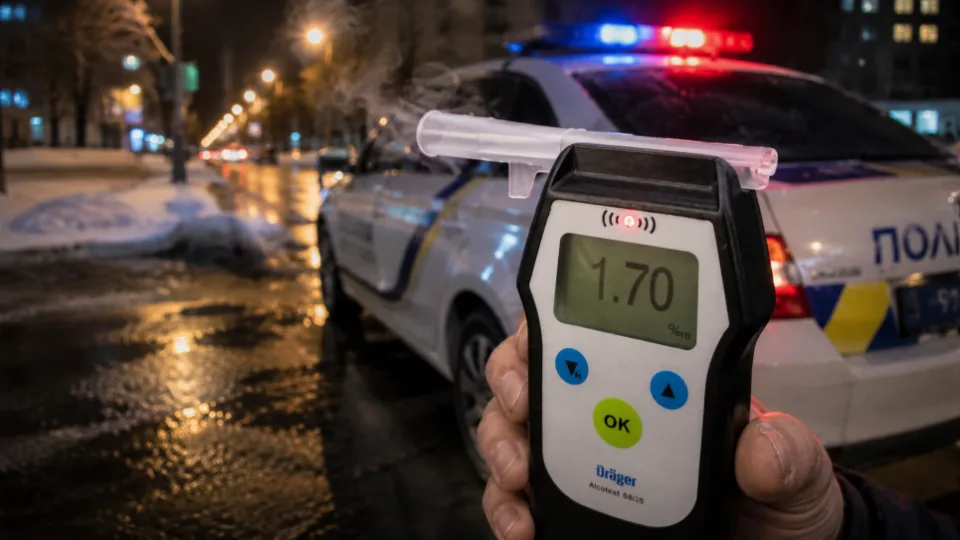










The Poltava Appellate Court canceled the ruling holding the driver administratively liable for driving under the influence of alcohol and closed the case. The court concluded that during the preparation of the materials, the police officers did not follow the established procedure for conducting the sobriety test, and the evidence in the case does not prove the person’s guilt beyond a reasonable doubt.
The basis for holding the driver liable were events in December 2025. Police stopped a Renault vehicle for not using the turn signal, after which they offered the driver to undergo a sobriety test using the special technical device Drager. The test result was 0.42 per mille, and a protocol was drawn up against the driver under Part 1 of Article 130 of the Code of Administrative Offenses. The district court found him guilty, imposed a fine of 17,000 UAH, deprived him of the right to drive for one year, and collected court fees.
Disagreeing with this decision, the defense attorney filed an appeal. He noted that the test results cannot be considered proper and sufficient evidence of guilt. In particular, the defense pointed out that the Drager printout indicated an air temperature of +11°C, although, according to official data from the hydrometeorological service, the actual temperature in that area that day was below zero. Additionally, the defense insisted that the police officers did not specify or state any particular signs of intoxication that justified the test.
What the appellate court established
After reviewing case materials 538/15/26 and the video recording from the scene, the Poltava Appellate Court concluded that the first-instance court considered the case one-sidedly and did not clarify all circumstances essential for the correct resolution of the dispute.
The appellate court noted that according to the Ministry of Internal Affairs and Ministry of Health instructions, a sobriety test is conducted if the police detect corresponding signs. However, the video shows that the police only expressed an assumption about the driver’s intoxication but did not inform him of specific signs of such a state. Meanwhile, the administrative offense protocol did not mention signs of intoxication at all, whereas the inspection report contained information about a strong smell of alcohol from the mouth and facial redness.
The court also analyzed the video and noted that during communication with the police, the driver behaved adequately, answered questions clearly, his speech was understandable, and his behavior corresponded to the situation. The recording does not show impaired coordination, hand tremors, or other signs characteristic of intoxication as per the instructions.
Furthermore, the appellate court found that after the Drager test, the police immediately informed the driver about drawing up the protocol but did not explain his right to undergo a repeated test at a healthcare facility if he disagreed with the on-site result, as required by Article 266 of the Code of Administrative Offenses and the instructions.
The court separately evaluated the defense’s arguments regarding the temperature readings recorded by the Drager device. Taking into account the certificate from the Poltava Regional Hydrometeorological Center, the appellate court noted that the air temperature shown on the device printout significantly differed from the actual regional temperature. The court believed that such a discrepancy might indicate a technical malfunction or violation of the device’s operating conditions, which could directly affect the measurement accuracy.
Legal assessment of the court
Referring to Article 62 of the Constitution of Ukraine, the appellate court emphasized that a person’s guilt must be proven by proper, admissible, and reliable evidence, and all doubts regarding the proof of guilt are interpreted in favor of the person held liable.
Considering the established procedural violations during the test, inconsistencies in the case materials, and other examined evidence, the court concluded that the driver’s guilt was not proven beyond a reasonable doubt by admissible and reliable evidence. Therefore, the appellate court satisfied the appeal, canceled the district court’s ruling, and closed the proceedings under paragraph 1 of part 1 of Article 247 of the Code of Administrative Offenses due to the absence of an administrative offense. The appellate court’s ruling took legal effect upon adoption and is final.
Subscribe to our Telegram channel t.me/sudua and to Google News SUD.UA, as well as to our VIBER and WhatsApp, pages on Facebook and Instagram to stay informed about the most important events.