Squeeze-out Procedure in Ukraine: From a Corporate Rehabilitation Tool to a Systemic Legal Problem













The Law of Ukraine "On Joint Stock Companies" introduced the procedure of compulsory share buyout (squeeze-out), according to which shareholders collectively owning more than 95% of the company's shares gained the right to buy out shares from minority shareholders whose combined stake does not exceed 5%. The purpose of this legislative innovation was to consolidate the corporate structure, eliminate prerequisites for corporate abuses, and improve the efficiency of company management. This approach is an established practice in European Union countries and aims to enhance the investment climate.
The law clearly defined the pricing procedure: the buyout price must correspond to the market value of the shares, determined by an independent licensed appraiser according to the Valuation Report. The company's supervisory board was granted the right to adjust this price only within 10% of the appraised value.
During 2019–2020, after the relevant legislative amendments came into force, majority shareholders of a significant number of large and medium enterprises initiated and completed squeeze-out procedures. The vast majority of minority shareholders received monetary compensation for their shares without filing any claims.
Change in Judicial Practice and Its Legal Consequences
Starting in 2020, the Supreme Court formed a series of legal positions in cases related to squeeze-out that significantly changed the approach to determining the amount of compensation.
By the Resolution of the Chamber for Corporate Disputes of the Cassation Commercial Court within the Supreme Court dated June 15, 2022, a legal position was formulated according to which the buyout price must be not only market-based but also "fair." The court defined the fairness criterion: the buyout price cannot be lower than the net asset value of the company. This formula is absent in the text of the Law of Ukraine "On Joint Stock Companies." Moreover, this legal position is applied retroactively—to procedures completed several years before the formation of this practice.
It is worth noting that the European Court of Human Rights in the case "Ukrkava v. Ukraine" recognized as a violation of the Convention the approach where the court substitutes the legislator by means of expansive interpretation in similar legal relations.
Conclusions of Judicial Expert Examinations
Based on court rulings in relevant cases, judicial economic expert examinations were conducted by leading state scientific research forensic economic institutes (Kyiv, Kharkiv, Dnipro, and others). The experts’ conclusions are consistent: firstly, there is no regulatory methodology for determining the "fair" value of shares in Ukrainian legislation; secondly, the market value of a minority stake of up to 5% in the presence of a consolidated 95% stake is objectively lower than the proportional share of net assets, since such a stake lacks any influence on company management.
Expansion of the Circle of Responsible Persons
An additional aspect of the new judicial practice, which developed in 2025, was the imposition of responsibility for compensation payments not only on shareholders and beneficiaries but also on issuers—that is, directly on companies that were not parties to the share purchase-sale transactions between shareholders.
Cumulative Impact on the Size of Claims
The combination of several factors led to a significant increase in the claimed amounts compared to the initial value of the respective share packages:
- application of the "net asset value" formula instead of market valuation;
- accrual of inflation index for the entire period—considering the suspension of the statute of limitations during the COVID-19 quarantine and martial law, the actual calculation period in some cases exceeded six years;
- increase in claim amounts due to procedural grounds (violations of procedure);
- imposition of responsibility on issuers who were not parties to the relevant transactions.
Altogether, these factors have led to cases where the claimed amounts exceed the initial buyout value of the share packages by several dozen times. For some industrial enterprises, the potential total claim amounts are comparable to or exceed the volume of their liquid assets.
Specific Cases and Enterprises
Among the enterprises currently involved in such disputes are, in particular:
— PJSC "Avdiivka Coke Plant" (cases No. 905/671/19, 905/830/21, 905/1926/18);
— PJSC "Azovstal Iron and Steel Works" (cases No. 910/8714/18, 905/993/21, 908/2252/22 / 905/692/22);
— enterprises of the DTEK group (cases No. 910/2483/18, 910/12591/18);
— PJSC "Ukrainian Graphite" (case No. 908/3492/19);
— PJSC "Carlsberg Ukraine" (case No. 908/2497/25) — claim amount UAH 712,426,315.27.
A significant part of these enterprises operate in frontline regions and are critically important for the functioning of the country's industrial infrastructure. A telling example is PJSC "Carlsberg Ukraine": in 2019, the company conducted a squeeze-out procedure during which a share with a nominal value of 1 hryvnia was valued for buyout at 14.72 hryvnias and paid to minority shareholders. At the same time, within the same category of disputes, this procedure is cited both as an example of the majority shareholder's good faith behavior and as the subject of a claim exceeding UAH 712 million.
Similar pressure has also affected enterprises such as Rud, Metinvest, and DTEK.
Transformation of the Nature of Disputes
Case analysis reveals a stable trend: most plaintiffs in squeeze-out disputes are not the original minority shareholders but persons who acquired the right to claim under assignment agreements after the buyout procedures were completed. Thus, a secondary market for such claims against real sector enterprises has formed in practice.
The predominantly property, rather than corporate, nature of these disputes is also evidenced by the fact that in response to proposals to return shares to their former owners, plaintiffs usually officially refuse, insisting exclusively on monetary compensation.
An additional procedural aspect is the exemption of some plaintiffs in such cases from paying court fees, which also affected the accessibility of this instrument and the volume of revenues to the state budget.
These circumstances directly affect Ukraine's investment attractiveness: in conditions of legal uncertainty regarding the consequences of procedures conducted under the legislation in force at the time, attracting foreign and domestic investments to the real economy sector becomes significantly more difficult, as confirmed by investment statistics in 2025.
Threat to the Financial Stability of Real Sector Enterprises
The sectoral structure of enterprises involved in squeeze-out disputes covers metallurgy, mining, coke-chemical, and energy industries—sectors that form a significant share of industrial production, foreign currency earnings, and tax revenues in Ukraine. Most of these enterprises are city-forming and thus bear social responsibility for the employment of tens of thousands of workers and the functioning of entire settlements.
The key economic risk is the mismatch between the claimed financial demands and the actual solvency of the defendant enterprises. According to calculations based on certain industrial enterprises, the potential total amount of satisfied claims in some cases is comparable to the annual volume of working capital or even exceeds the value of their liquid assets. This means that full enforcement of decisions is practically impossible without critically undermining operational activities.
The situation is especially acute for enterprises operating in frontline regions or suffering direct damage from hostilities. PJSC "Avdiivka Coke Plant" and PJSC "Azovstal Iron and Steel Works" are in active combat zones or effectively destroyed, yet enforcement continues on corporate disputes related to events of 2019–2020.
Multiplicative Effect on Related Industries
The metallurgical and mining industries are structurally integrated into a broad production chain: their activities directly support the loading of railway infrastructure (JSC "Ukrzaliznytsia"), the energy sector, logistics operators, raw material suppliers, and component manufacturers. Financial destabilization of anchor enterprises inevitably transmits both upstream and downstream along the production chain, reducing volumes of related production and services.
Moreover, these enterprises are contractors or subcontractors for state defense orders. Disruption of their operational stability during wartime poses a direct threat to the production support of the security and defense sector.
Impact on the Labor Market
Real sector enterprises involved in these disputes collectively employ hundreds of thousands of workers. Forced withdrawal of significant funds through enforcement of court decisions or the need to form reserves for potential claims directly reduces resources available for payroll, job retention, and social payments.
Mass layoffs at city-forming enterprises, especially in industrial regions and frontline cities where alternative employment is limited, will have significant socio-economic repercussions: increased unemployment, reduced consumer demand, and decreased local budget revenues from personal income tax and unified social contributions.
Investment Climate and Capital Attraction Prospects
Legal uncertainty regarding the consequences of corporate procedures conducted under the legislation in force at the time is one of the factors reducing Ukraine's investment attractiveness. For foreign investors, a key condition for market entry is predictability of the legal environment: the possibility of ex post review of completed corporate procedures using retroactive standards and imposing liability on persons who were not parties to the relevant transactions contradicts fundamental principles of legal certainty and investment protection.
Statistics of foreign direct investment in Ukraine in 2025 reflect this trend: despite the presence of international support and reconstruction mechanisms, private investment capital remains cautious, and one of the documented risks analyzed by potential investors is the unpredictability of judicial practice in corporate disputes.
Impact on the State Budget
Financial destabilization of large taxpayers directly affects budget revenues. Enterprises in metallurgy, mining, and energy sectors are significant payers of corporate profit tax, VAT, excise tax, rent payments for subsoil use, and unified social contributions.
A separate budgetary aspect is the practice of exempting plaintiffs in relevant cases from paying court fees. Given the scale of claims (in some cases hundreds of millions of hryvnias), the court fees payable at standard rates would constitute a substantial amount of revenue to the special fund of the state budget designated for financing the judicial system.
Systemic Risk for the Corporate Sector
The formation of judicial practice whereby completed corporate procedures can be reviewed after a significant time lapse using new standards and involving persons who acquired claims on the secondary market creates a systemic risk for the entire corporate sector—not only for enterprises that underwent the procedure in 2019–2020.
It is fundamentally important that the squeeze-out legislation has not changed regarding the basic pricing principles: the procedure is still applied today, and share buyouts continue to be carried out at market value determined by an independent appraiser (with the only procedural innovation being the requirement for review of the valuation report). Thus, every joint stock company conducting or planning to conduct a squeeze-out procedure under current legislation also falls within the scope of similar legal risk.
Analysis of new squeeze-out procedures carried out in 2023–2025 confirms this pattern: in all studied cases, the buyout price determined by an independent licensed appraiser according to legislative requirements is significantly lower than the calculated "net asset value" indicator applied by the Supreme Court as the criterion of a "fair" price. Below are data on seven enterprises that recently completed or started the squeeze-out procedure:
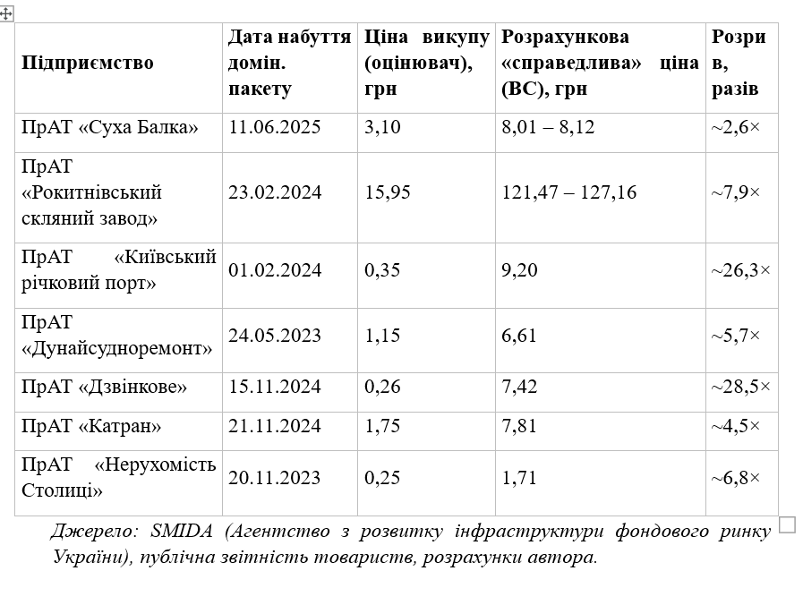
As the data show, the gap between the buyout price determined by an independent appraiser according to current legislation and the calculated "net asset value" indicator applied by the court as the criterion of a "fair" price in the studied cases ranges from 2.6 to 28.5 times. This means that each of these companies already carries a potential future risk of similar claims.
Thus, the issue of forming stable and predictable judicial practice in this category of cases acquires significance beyond individual corporate disputes and directly concerns the conditions for the functioning of the real economy sector, job preservation, and Ukraine's investment climate during wartime and post-war reconstruction.
Response of Government Institutions
The issue has been considered at the level of parliamentary oversight: the Temporary Investigative Commission of the Verkhovna Rada of Ukraine on investigating possible facts of corruption or corruption-related offenses in law enforcement agencies, courts, and judicial authorities, chaired by People's Deputy Serhiy Vlasenko, initiated the relevant investigation.
The Federation of Employers of Ukraine together with the Federation of Trade Unions of Ukraine appealed to the Office of the President of Ukraine regarding the need for systemic regulation of this issue. The matter is also under consideration by the Cabinet of Ministers of Ukraine and the Council for Entrepreneurship Support at the Office of the President of Ukraine.
Despite the fact that the Cabinet of Ministers of Ukraine, the Office of the President, and relevant parliamentary committees are already working on solutions to this problem, it is obvious that legislative or governmental changes alone cannot overcome the crisis of legal certainty. Final rules are primarily formed in judicial practice. In the absence of clear legislative criteria for determining the fair value of shares and balanced mechanisms for business protection under wartime economy conditions, the judicial system inevitably faces legal gaps and ambiguity in law enforcement.
Therefore, resolving this systemic problem requires not only legislative changes but also broad professional dialogue among the state, business, judiciary, scholars, and relevant associations. Developing unified legal approaches and methodology for determining the fair value of shares will contribute to forming predictable judicial practice and reducing legal uncertainty.
Subscribe to our Telegram channel t.me/sudua and to Google News SUD.UA, as well as to our VIBER and WhatsApp pages on Facebook and Instagram to stay informed about the most important events.