What circumstances does the court consider when deciding to conduct a hearing fully or partially in the absence of a lawyer — Supreme Court's answer


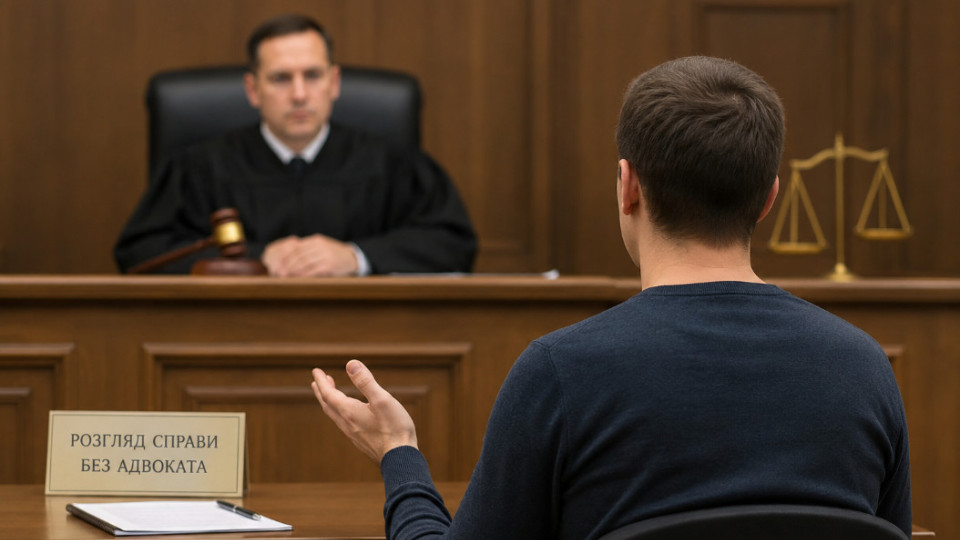










In the case of conducting a hearing without a lawyer, the court must compensate for their absence as much as possible by other procedural means. Such conclusions were reached by the united chamber of the Cassation Criminal Court within the Supreme Court as a result of reviewing case No. 285/1242/17.
In this criminal proceeding, the courts of previous instances found the accused guilty and sentenced him under Part 3 of Article 286 of the Criminal Code of Ukraine. In the cassation appeal, the defense side considered the appellate court's conclusions unfounded that the accused and his defenders abused the right to postpone the trial and thus sought to delay the terms of the appellate review.
Assessing these cassation claims, the united chamber of the Cassation Criminal Court of the Supreme Court pointed out that, besides the obligation under Article 6 of the Convention for the Protection of Human Rights and Fundamental Freedoms to ensure the accused's right to defense, Ukraine also has obligations under Article 2 of this Convention, which guarantees the right to life. In this case, the appellate court faced the problem of reconciling the obligation under Article 2 of the Convention to do everything necessary to hold the person accountable if their guilt is proven — on the one hand — and the accused's right to have qualified legal representation in the appellate court — on the other.
At the time of the appellate review, the convicted person was represented by four defenders, two of whom filed appellate complaints on behalf of the convicted. The appellate review of this criminal proceeding was postponed 8 times because the defenders, who were notified in advance about the hearing date, did not appear at the court sessions. Evaluating these circumstances, the united chamber concluded that the appellate court made every possible effort to ensure the case was heard on time and with respect for the accused's right to be represented by a defender.
The united chamber noted that the convicted person was well aware that the statute of limitations would soon expire. However, during the appellate review, he refused the assistance of three defenders, some of whom had defended him for a long time and were well acquainted with the circumstances of his case. The accused could not have failed to understand that dismissing lawyers familiar with his case two weeks before the statute of limitations expired would result in him either remaining without legal representation or receiving a lawyer who would be forced to study the case and prepare for the appellate review in a very short time. Refusal of a defender or their replacement requires very serious reasons, but the convicted person neither in the appellate court nor in the cassation court was able to explain the reasons for dismissing the lawyers. Such actions and decisions of the convicted gave the appellate court grounds to believe that the defense side was manipulating procedural rights to wait out the statute of limitations.
The resolution of the united chamber of the Cassation Criminal Court of the Supreme Court dated June 1, 2026, in case No. 285/1242/17 (proceeding No. 51-3988kmo25) can be found at this link.
Subscribe to our Telegram channel t.me/sudua and to Google News SUD.UA, as well as to our VIBER and WhatsApp, Facebook page Facebook and Instagram Instagram to stay informed about the most important events.