A Viber message cannot replace proper court summons — Supreme Court












The issue of proper notification of participants in the process is directly related to the realization of the right to a fair trial and access to justice. Errors in the procedure of summoning parties often become grounds for overturning court decisions even when the dispute on the merits has not yet been considered.
In the ruling of the Supreme Court, composed of the First Judicial Panel of the Cassation Civil Court in case No. 758/5240/24 dated June 10, 2026, the question was considered regarding the possibility of leaving the claim without consideration due to the plaintiff's repeated absence if the notification about the court hearing was made via the Viber application without a corresponding application from the party involved.
Case circumstances
The plaintiff applied to the court with claims to invalidate electronic auctions for the sale of a mortgaged apartment, cancel the certificate of ownership of the new acquirer, and terminate their ownership rights to the property.
The proceedings in the case were opened in May 2024.
The plaintiff and her representative did not appear at the court hearing scheduled for March 11, 2025. At the same time, the lawyer submitted a motion in advance to postpone the hearing due to participation in another court proceeding.
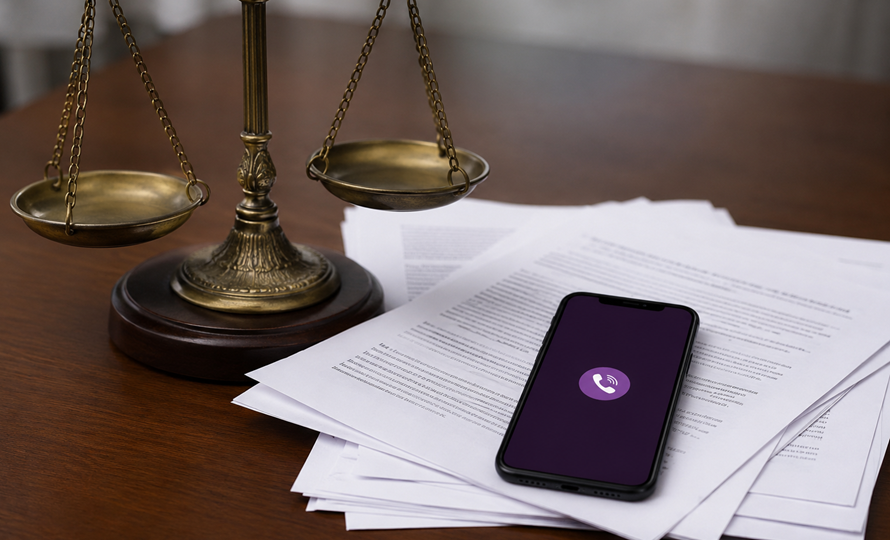
The court postponed the hearing to April 16, 2025, and notified about the new hearing date via the Viber application to the phone number provided by the plaintiff in the claim.
Subsequently, the court of first instance left the claim without consideration, considering that the plaintiff repeatedly failed to appear in court without valid reasons. The appellate court agreed with this conclusion, noting that the fact of delivery of the message via Viber confirms proper notification of the party.
The plaintiff's representative appealed these decisions to the Supreme Court, emphasizing that neither the plaintiff nor her lawyer submitted applications to receive court summons via Viber, and therefore such a method of notification does not comply with procedural law requirements.
Position of the Supreme Court
The Supreme Court indicated that one of the grounds for leaving a claim without consideration is the absence at the court hearing of a properly notified plaintiff twice in a row if no application was received from them for consideration of the case without their participation and there are obstacles to such consideration.
At the same time, the plaintiff must be properly notified in the prescribed manner about the date, time, and place of both the first and second court hearings at which they did not appear.
The court noted that the court may notify a party about the case consideration using mobile communication means by sending text (SMS) messages, but exclusively if there is a corresponding written application from such a party.
However, there is no evidence in the case of proper notification of the plaintiff or her representative about the case consideration, no evidence of sending the mentioned court summons-notifications by postal service or through the "Electronic Court" subsystem, and consequently, their receipt (delivery).
The Supreme Court drew attention to the fact that a delivery receipt of a message via Viber is not proper notification, since the court of first instance did not have the prerequisites provided by parts nine and thirteen of Article 128 of the Civil Procedure Code of Ukraine to apply such a method of notifying a party about the court hearing, as there are no corresponding applications from the plaintiff or her representative about summons by mobile communication means in the case materials.
Moreover, the Supreme Court emphasized that the court did not find evidence that the plaintiff's party abused their procedural rights. Both the plaintiff and her representative have registered places of residence, properly received summons about the court hearing date, and therefore, evidently, the reason for sending summons to the plaintiff's party not by the usual method but somehow via the Viber application on the phone is unreasonable and unclear.
The court concluded that these circumstances indicate that the plaintiff and her representative were not properly notified by the court of first instance about the case consideration.
Therefore, the conclusion of the court of first instance, which was agreed upon by the appellate court, that the plaintiff was properly notified about the date and time of the court hearing of the court of first instance and did not appear without valid reasons, is unfounded, and thus there were no grounds under paragraph 3 of part one of Article 257 of the Civil Procedure Code of Ukraine to leave the claim without consideration and to issue the contested court decision by the court of first instance.
The Supreme Court satisfied the cassation appeal, canceled the decisions of the courts of first and appellate instances, and sent the case for further consideration.
The court confirmed an important legal position according to which notification of a party via Viber or other mobile communication means can be used only if there is a corresponding written application from such a person.
Additionally, you can familiarize yourself with another position of the Supreme Court, according to which summons to court via SMS messages is possible only if there is an application from the party and the technical capability of the court — at this link.
Subscribe to our Telegram channel t.me/sudua and to Google News SUD.UA, as well as to our VIBER and WhatsApp, Facebook page and Instagram to stay informed about the most important events.