Parents of Children with Disabilities Lose Family Guarantees after Mobilization: Why the State Must Eliminate Legal Inequality


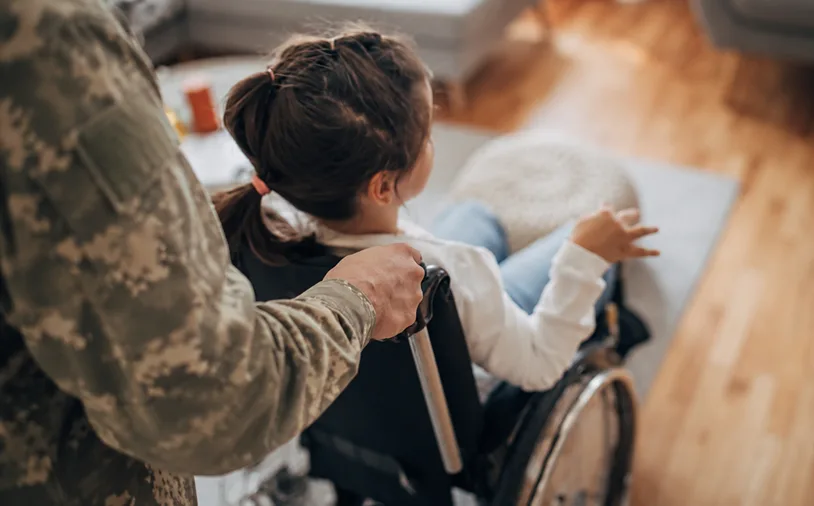










In Ukraine, it is proposed to amend Article 26 of the Law of Ukraine "On Military Duty and Military Service" regarding removing restrictions on the right of servicemen to be discharged from military service due to raising a child with a disability under 18 years old.
Bill No. 15057 aims to resolve a legal conflict between the Law of Ukraine "On Mobilization Preparation and Mobilization" and the Law of Ukraine "On Military Duty and Military Service." Currently, parents raising a child with a disability under 18 years have the right to deferment from mobilization without additional conditions. However, for servicemen already serving, the right to discharge on this basis is possible only if there are no other persons obligated to raise the child.
As Judicial-Legal Newspaper wrote, this approach contradicts the principle of equality of children in rights enshrined in the Constitution of Ukraine, as well as the state's international obligations. In particular, the UN Convention on the Rights of the Child requires that in all decisions concerning children, priority be given to ensuring their best interests, and guarantees children with disabilities special protection and support considering the needs of families providing care.
Why the changes are important
Bill No. 15057 raises the issue not of creating new privileges for servicemen but of preventing the narrowing of their rights simply due to serving in the military.
The state recognises that a child with a disability requires special protection, and their parents need the ability to provide proper care, treatment, and rehabilitation. However, current legislation creates a situation where after mobilization, one parent loses the ability to exercise the same family guarantees they had before service.
Fulfilling the constitutional duty to defend the state should not mean automatic restriction of other constitutional rights of the serviceman, including the right to participate in raising and caring for a child with a disability. On the contrary, those already performing defence tasks should not be in a less protected position compared to those not yet called to military service.
Adopting bill No. 15057 would eliminate this inequality and establish the principle that a serviceman's status cannot be grounds for reducing the scope of state guarantees for their child. The balance between defence needs and citizens' rights should be ensured not by restricting rights of a specific group but by finding legislative solutions that simultaneously consider state interests and the best interests of the child.
However, as of 17th July 2026, bill No. 15057 has effectively not progressed in parliament. The document was registered on 9th March 2026, but after registration, its consideration has not advanced. In particular, the bill's card contains no materials indicating further movement or preparation for consideration by the Verkhovna Rada.
Lawyers and medical professionals on the need to protect the rights of children with disabilities and the role of parents in care and rehabilitation
During a professional discussion of bill No. 15057 held on 17th July with the participation of lawyers, human rights defenders, representatives of public organisations, the medical community, and members of parliament, participants recalled provisions of the UN Convention on the Rights of Persons with Disabilities regarding ensuring the right of children with disabilities to family life and support for their families.
Participants noted that current legislation creates a situation where children with the same legal status receive different levels of state protection depending on whether one parent was mobilised. In their opinion, the bill does not create new rights but aims to harmonise norms regarding deferment from mobilisation and discharge of servicemen.
During the discussion, emphasis was placed on the principles of the rule of law, legal certainty, and the best interests of the child. Experts noted that the status of a child with a disability should have independent significance, and when deciding on discharge issues, it is important to consider not only the formal presence of the other parent but the actual ability to provide care, treatment, and rehabilitation for the child.
Lawyers emphasised that bill No. 15057 is not aimed at expanding the grounds for discharge of servicemen but at restoring the balance between the state's defence interests and the protection of the rights of children with disabilities. They pointed out that after legislative changes in 2024, a situation arose where the state effectively ceased to equally assess the needs of children with disabilities depending on their father's status. According to them, the current norm provides for discharge only in the absence of other persons who can raise the child, but in such cases, the right to discharge does not differ from situations involving raising a healthy child without one parent.
Lawyers also commented on the position of the Ministry of Defence of Ukraine regarding the possible impact of the bill on defence capability. They noted that the argument about a "significant outflow of servicemen" should be assessed considering the specific number of people affected by the changes. According to them, this is not about mass discharge of military personnel but a limited number of parents of children with disabilities who lost the ability to return to their families due to legislative changes.
In their opinion, even if the number of such servicemen is small relative to the Defence Forces, for each child with a disability, the possibility of both parents participating in care and upbringing is of significant importance.
During the discussion, lawyers also noted that the rule of law is not merely a formal provision in legislation but implies adherence to principles such as legal certainty, prohibition of arbitrariness, equality before the law, non-discrimination, and human rights protection.
Human rights defenders also noted that current legislation creates a problem of legal uncertainty because the same life circumstance — raising a child with a disability under 18 — has different legal consequences depending on the father's status. A father not yet serving in the military can receive a deferment, while a serviceman in a similar situation has significantly more limited discharge options. Children with the same legal status receive different levels of state protection depending on whether their father was mobilised. According to them, this approach contradicts the principles of equality and non-discrimination.
Representatives of rehabilitation centres and the medical community emphasised that rehabilitation of children with disabilities is a continuous process largely dependent on daily parental involvement. According to them, rehabilitation activities may require four to six hours of daily family participation, and for certain severe illnesses — up to eight hours per day. A significant part of this burden falls on the family, while the absence of one parent can negatively affect the stability of treatment, rehabilitation, and child development.
Some speeches were dedicated to children with cystic fibrosis, rare diseases, autism, severe developmental disorders, and other conditions requiring constant medical supervision, special nutrition, regular doctor visits, and continuous family involvement. Specialists also noted that overburdening one parent increases the risk of exhaustion, care breakdown, deterioration of the mother's mental health, and even institutionalisation of the child.
Members of parliament also joined the discussion of bill No. 15057 and provided recommendations for its revision before the second reading. In particular, they urged representatives of public organisations and human rights defenders to promptly submit their proposals and amendments that could be considered during further work on the document.
A representative of the Ministry for Veterans Affairs reported that the department supports the idea of equal grounds for deferment from mobilisation and discharge from military service but proposes to refine the bill. Specifically, the right is proposed to be linked not only to the status of a child with a disability but to their actual need for constant care. To this end, it is proposed to define a list of medical indications that would be grounds for deferment and discharge. According to the ministry's proposal, this list should be approved by the Cabinet of Ministers upon submission by the Ministry of Health or directly by the MoH.
In conclusion, it can be stated that there is a conflict between the state's declared guarantees of protection for children with disabilities and current legal regulation. Despite recognising the need for special care for such children, after mobilisation, one parent effectively loses the ability to use the family guarantees they had before service. Therefore, we await appropriate state steps aimed at eliminating this discrepancy and bringing legislation into line with constitutional guarantees and international standards for protecting children's rights.
Subscribe to our Telegram channel t.me/sudua, follow SUD.UA on Google News , and join us on VIBER, WhatsApp, Facebook and on Instagram to stay informed about the important events.