How to Become a Judge: Candidate Requirements, Competition Stages, and Required Documents













The profession of a judge not only requires a high level of responsibility and public trust but also opens opportunities to directly influence the establishment of justice and the rule of law in Ukraine. This was reminded by the High Qualification Commission of Judges of Ukraine.
The HQCJ emphasized that the path to obtaining this profession has many stages, so for most candidates, this process seems complicated and unclear. The Commission decided to clarify the main aspects.
How to Become a Judge in Ukraine
Judicial System
The judicial system of Ukraine is built on the principles of territoriality, specialization, and instance hierarchy.
The judicial system consists of:
- local courts;
- appellate courts;
- higher specialized courts;
- the Supreme Court.
All judges in Ukraine have a unified status regardless of their workplace.
Information about vacant judge positions is regularly updated on the official website of the High Qualification Commission of Judges of Ukraine.
Who Can Become a Judge
To apply for the position of judge, a candidate must meet a number of requirements defined by the law.
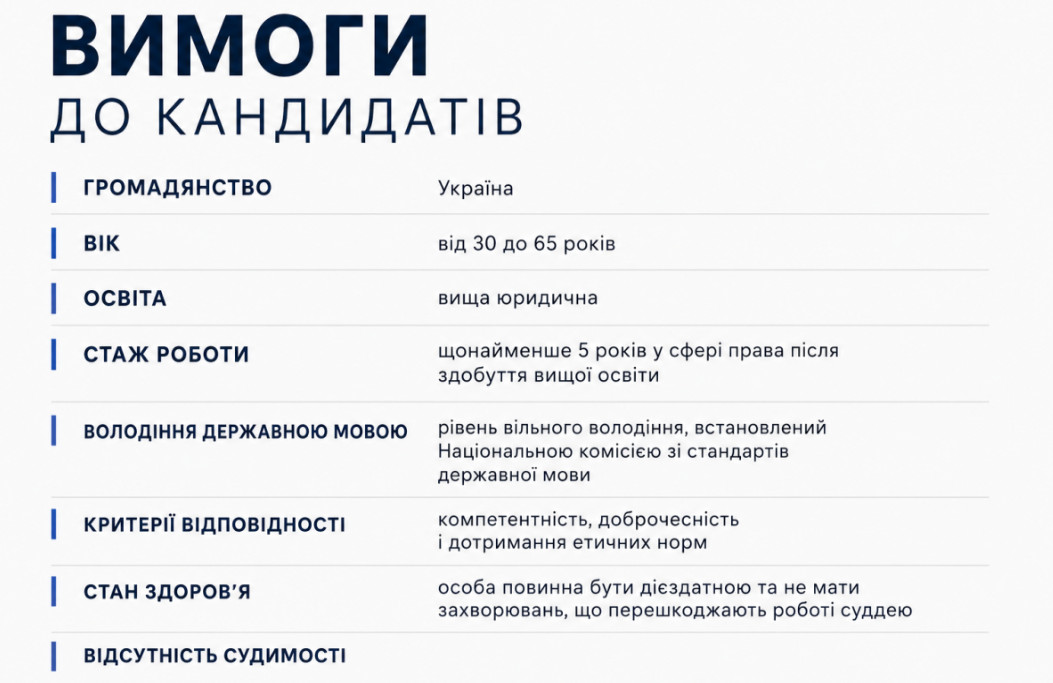
General Candidate Requirements
- Citizenship – Ukraine;
- Age – from 30 to 65 years;
- Education – higher legal education;
- Work experience – at least 5 years in the legal field after obtaining higher education;
- Proficiency in the state language – free command level established by the National Commission on State Language Standards;
- Compliance criteria – competence, integrity, and adherence to ethical standards;
- Health status – the person must be capable and not have diseases that prevent working as a judge;
- No criminal record.
Important: the candidate must meet these requirements on the day of submitting the application for participation in the selection (competition) for the judge position.
Who Conducts the Selection of Judges
The selection (competition) for the position of judge is the authority of the High Qualification Commission of Judges of Ukraine.
Depending on the court level, this procedure has its specifics:
- To occupy the position of a judge of a local court, a candidate must participate in a selection, after which they will be included in the reserve.
Candidates in the reserve can participate in competitions for vacant judge positions in specific courts.
- For judge positions in appellate, higher specialized courts, and the Supreme Court, a competition (special appointment procedure) is held, which differs from the selection and does not involve inclusion in the reserve.
How to Become a Judge of a Local Court: Selection and Competition Stages
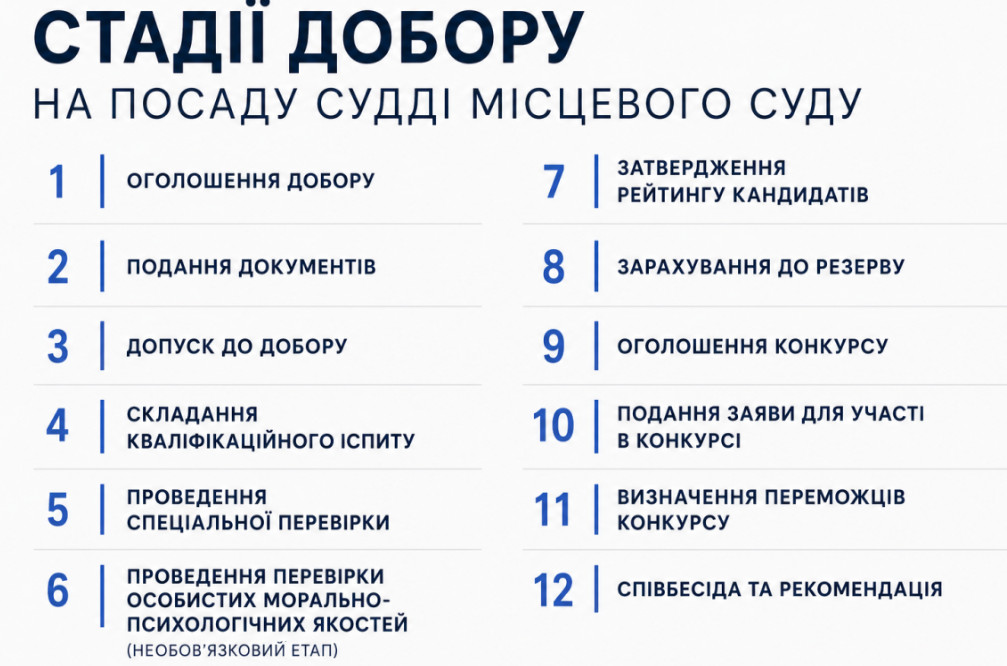
1. Announcement of Selection
The decision to announce the selection is made by the High Qualification Commission of Judges of Ukraine.
This decision specifies:
- the deadline for submitting applications and documents, which cannot be less than 30 days from the date of the decision publication;
- the estimated number of vacant judge positions for which the selection is announced.
The announcement of the selection is published on the official website of the Commission and the official web portal of the judiciary of Ukraine.
2. Submission of Documents
To participate in the selection, a candidate must submit the following documents:
1) a written application for participation in the selection;
2) a copy of the identity document confirming Ukrainian citizenship (Ukrainian citizen passport);
3) candidate questionnaire for the judge position;
4) motivation letter of the candidate for the judge position;
5) declaration of integrity and family ties of the candidate for the judge position;
6) a copy of the diploma of higher legal education with annexes;
7) copies of documents confirming professional experience in the legal field;
8) medical institution documents;
9) a copy of the declaration of a person authorized to perform state or local government functions;
12) a copy of the document confirming proficiency in the state language according to the level defined by the National Commission on State Language Standards;
13) other documents specified by the decision to announce the selection.
Documents for participation in the procedure are submitted through the electronic cabinet:
3. Admission to Selection
Candidates who have submitted a complete package of documents and meet the legal requirements on the day of application submission are admitted to participate in the selection.
4. Passing the Qualification Exam
The qualification exam is conducted by passing:
- testing on the history of Ukrainian statehood;
- testing knowledge level in the legal field with specializations of the respective court (one or several at the candidate’s choice);
- cognitive abilities testing (IQ test);
- performing a practical task in the specializations of the respective court (one or several at the candidate’s choice).
Active judges wishing to transfer to another local court may also take the qualification exam simultaneously with candidates.
The procedure for passing the qualification exam and the methodology for evaluating candidates can be found here.
5. Conducting a Special Check
For candidates who successfully passed the exam, a special check is conducted – a mandatory procedure to verify the authenticity of the information submitted by the candidate for the position, as well as their compliance with the law’s requirements regarding holding a position with increased corruption risk (National Agency on Corruption Prevention, Ministry of Internal Affairs, Security Service of Ukraine, etc.).
6. Conducting a Check of the Candidate’s Personal Moral and Psychological Qualities*
To establish candidates' compliance with the legal requirements for the judge position, the High Qualification Commission of Judges of Ukraine may decide to conduct tests to check the personal moral and psychological qualities of such candidates.
Testing is conducted if the HQCJ determines such a need and makes the corresponding decision.
* optional stage
7. Approval of the Candidate Ranking
Based on the qualification exam scores, the HQCJ determines, approves, and publishes on its official website the ranking of candidates for the judge position who have successfully passed the special check.
The ranking is formed separately for each court specialization: administrative, commercial, and general (civil and criminal).
8. Inclusion of Candidates in the Reserve
After approving the candidate ranking for the judge position, the HQCJ includes all candidates in the reserve for occupying vacant judge positions.
Being in the reserve is a factual confirmation of a person’s professional suitability and gives them the right to participate in future competitions for specific vacant positions in local courts of the respective specialization.
The candidate remains in the reserve for two years (with the possibility of extension by the HQCJ for another year) and can participate in competitions during this period.
9. Announcement of the Competition
The competition is announced by the HQCJ if there are vacant positions in courts of the respective specialization.
The decision to announce the competition specifies the names of courts with vacant judge positions, the number of such positions, competition conditions, date, time, and place of its conduct.
The announcement of the competition is published on the official website of the Commission and the official web portal of the judiciary of Ukraine.
10. Submission of Application for Participation in the Competition
A candidate in the reserve has the right to submit an application to participate in the competition for a vacant position in one or several courts (if provided by the specific competition conditions).
11. Determination of Competition Winners
Winners are determined based on their ranking position.
According to HQCJ practice, during the competition, the candidate with the higher ranking position chooses the position first. The next candidate in the ranking chooses from the judge positions that were not previously occupied.
12. Interview and Recommendation
After determining the competition results, the HQCJ conducts an interview with the winner to establish the candidate’s compliance with the criteria of integrity and professional ethics.
Based on the interview results, the HQCJ decides whether to recommend the candidate for appointment or refuse to make a recommendation.
How to Become a Judge of the Appellate, Higher Specialized, and Supreme Court: Competition Stages
To occupy the position of a judge of the appellate, higher specialized court, and Supreme Court, a person must meet the general and special requirements for a candidate for the judge position.
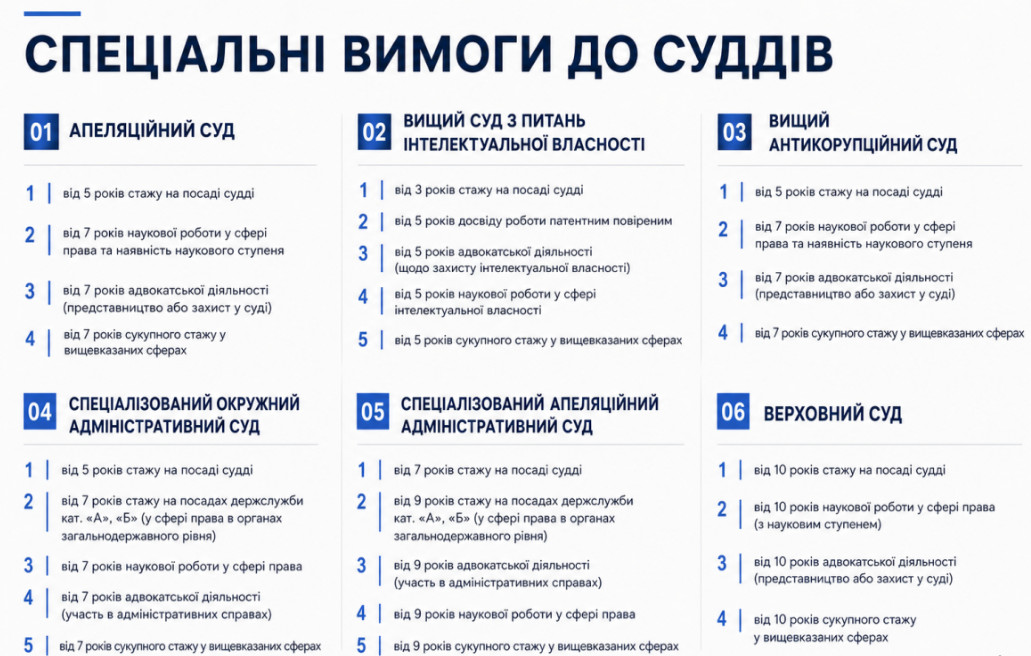
Special Requirements for a Candidate for the Judge Position:
- Appellate Court:
- at least 5 years of experience as a judge;
- at least 7 years of scientific work in the legal field and possession of a scientific degree;
- at least 7 years of advocacy (representation or defense in court);
- at least 7 years of combined experience in the above fields.
- Higher Court on Intellectual Property Issues:
- at least 3 years of experience as a judge;
- at least 5 years of experience as a patent attorney;
- at least 5 years of advocacy (regarding intellectual property protection);
- at least 5 years of scientific work in the field of intellectual property;
- at least 5 years of combined experience in the above fields.
- Higher Anti-Corruption Court:
- at least 5 years of experience as a judge;
- at least 7 years of scientific work in the legal field and possession of a scientific degree;
- at least 7 years of advocacy (representation or defense in court);
- at least 7 years of combined experience in the above fields.
- Specialized District Administrative Court:
- at least 5 years of experience as a judge;
- at least 7 years of experience in state service positions of category "A", "B" (in the legal field at the national level);
- at least 7 years of scientific work in the legal field;
- at least 7 years of advocacy (participation in administrative cases);
- at least 7 years of combined experience in the above fields.
- Specialized Appellate Administrative Court:
- at least 7 years of experience as a judge;
- at least 9 years of experience in state service positions of category "A", "B" (in the legal field at the national level);
- at least 9 years of advocacy (participation in administrative cases);
- at least 9 years of scientific work in the legal field;
- at least 9 years of combined experience in the above fields.
- Supreme Court:
- at least 10 years of experience as a judge;
- at least 10 years of scientific work in the legal field (with a scientific degree);
- at least 10 years of advocacy (representation or defense in court);
- at least 10 years of combined experience in the above fields.
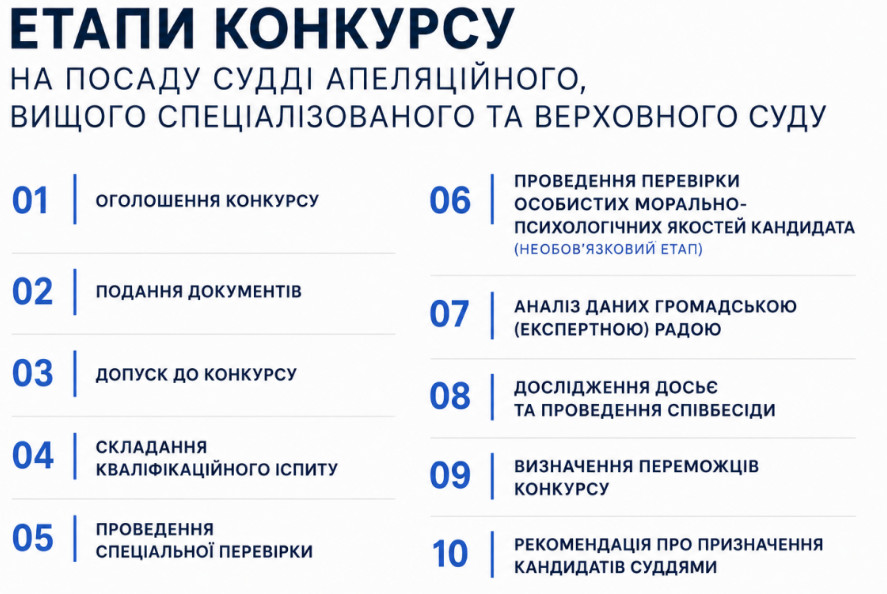
Stages of the Competition for the Position of Judge of the Appellate, Higher Specialized, and Supreme Court
1. Announcement of the Competition
The decision to announce the competition is made by the High Qualification Commission of Judges of Ukraine.
The decision specifies the names of courts with vacant judge positions, the number of such positions, competition conditions, date, time, and place of its conduct.
The announcement of the competition is published on the official website of the Commission and the official web portal of the judiciary of Ukraine.
2. Submission of Documents
To participate in the competition, a candidate must submit the following documents:
1) a written application for participation in the competition and for qualification assessment;
2) a copy of the identity document confirming Ukrainian citizenship (Ukrainian citizen passport);
3) candidate questionnaire for the judge position;
4) motivation letter of the candidate for the judge position;
5) declaration of integrity and family ties of the candidate for the judge position;
6) a copy of the diploma of higher legal education with annexes;
7) copies of documents confirming professional experience in the legal field;
8) medical institution documents;
9) a copy of the declaration of a person authorized to perform state or local government functions;
12) a copy of the document confirming proficiency in the state language according to the level defined by the National Commission on State Language Standards;
13) documents confirming compliance with one of the legal requirements for occupying the judge position of the respective court;
14) other documents specified by the decision to announce the competition.
A person who received a recommendation for appointment to the judge position based on the competition results cannot participate in other competitions for the judge position until the Higher Council of Justice reviews the respective recommendation.
3. Admission to the Competition
Candidates who have submitted all necessary documents and meet the legal requirements are admitted to participate in the competition.
4. Passing the Qualification Exam
The qualification exam is conducted by passing:
- testing on the history of Ukrainian statehood;
- testing knowledge level in the legal field with specializations of the respective court (one or several at the candidate’s choice);
- cognitive abilities testing (IQ test);
- performing a practical task in the specializations of the respective court (one or several at the candidate’s choice).
5. Conducting a Special Check
For candidates who successfully passed the exam, a special check is conducted – a mandatory procedure to verify the authenticity of the information submitted by the candidate for the position, as well as their compliance with the law’s requirements regarding holding a position with increased corruption risk (National Agency on Corruption Prevention, Ministry of Internal Affairs, Security Service of Ukraine, etc.).
6. Conducting a Check of the Candidate’s Personal Moral and Psychological Qualities*
To establish candidates' compliance with the legal requirements for the judge position, the High Qualification Commission of Judges of Ukraine may decide to conduct tests to check the personal moral and psychological qualities of such candidates.
Testing is conducted if the HQCJ determines such a need and makes the corresponding decision.
* optional stage
7. Analysis of Data by the Public (Expert) Council
To assist in establishing the compliance of a judge (candidate for the judge position) with the criteria of professional ethics and integrity for qualification assessment purposes, the following operate:
- Public Integrity Council (PIC)
The PIC assists the HQCJ in establishing the compliance of a judge (candidate for the judge position) with the criteria of professional ethics and integrity for qualification assessment purposes and provides an appropriate conclusion if grounds exist.
The PIC consists of twenty members, appointed by assemblies of representatives of public associations.
Members of the PIC may be representatives of human rights public associations, legal scholars, lawyers, journalists recognized as experts in their professional field, possessing high professional reputation and meeting the criteria of political neutrality and integrity.
The PIC is not involved in competition procedures where the Public Council of International Experts and the Expert Council operate.
- Public Council of International Experts (PCIE)
The PCIE is established to assist the HQCJ in establishing, for qualification assessment purposes, the compliance of candidates for judge positions of the Higher Anti-Corruption Court with integrity criteria (morality, honesty, incorruptibility), specifically regarding the legality of property sources, correspondence of the candidate’s or their family members' lifestyle to declared income, possession of knowledge and practical skills to consider cases under the jurisdiction of the Higher Anti-Corruption Court.
The decision on the candidate’s compliance with the specified criteria is made by the majority of the joint composition of the HQCJ and PCIE.
Members of the PCIE are appointed by the High Qualification Commission of Judges of Ukraine exclusively based on proposals from international organizations cooperating with Ukraine in corruption prevention and counteraction according to Ukraine’s international treaties.
If grounds are established, the issue of the candidate’s compliance with the legal criteria is resolved at a joint meeting of the HQCJ and PCIE.
- Expert Council (EC)
The EC is an auxiliary and advisory body of the HQCJ that collects, verifies, and analyzes information regarding candidates for judge positions of the Specialized District Administrative Court and the Specialized Appellate Administrative Court.
The EC issues conclusions on the compliance or non-compliance of a candidate for the judge position of the Specialized District Administrative Court or Specialized Appellate Administrative Court with the criteria of integrity and/or professional competence.
The EC consists of three persons proposed by the Council of Judges of Ukraine and three persons proposed by international and foreign organizations that, according to international or interstate agreements, have provided Ukraine with international technical assistance in judicial reform and/or corruption prevention and counteraction over the last five years.
If grounds are established, the issue of the candidate’s compliance with the legal criteria is resolved at a joint meeting of the HQCJ and EC.
8. File Review and Interview
File review and interview are separate stages of qualification assessment and are conducted for candidates who have successfully passed the exam and were admitted to this stage.
At this stage, the following are examined:
1) candidate’s previous work experience and analysis of submitted documents;
2) information regarding the candidate’s compliance with the professional ethics criterion;
3) materials of the special check and other information regarding the candidate’s compliance with the integrity criterion, including correspondence of expenses and property of the candidate and their family members to declared income, including copies of declarations submitted according to anti-corruption legislation;
4) conclusion of the public (expert) council on the candidate’s non-compliance with the criteria of professional ethics and integrity (if available);
5) declarations of integrity and family ties;
6) results of tests regarding compliance with qualification assessment criteria (if conducted);
7) results of other means of establishing compliance with qualification assessment criteria (if applied);
8) other information and data on the basis of which compliance with qualification assessment criteria may be established, as well as any other information about the judge recognized by the HQCJ decision as subject to inclusion in the judicial file.
Interviews with candidates are open and broadcast live on the Internet.
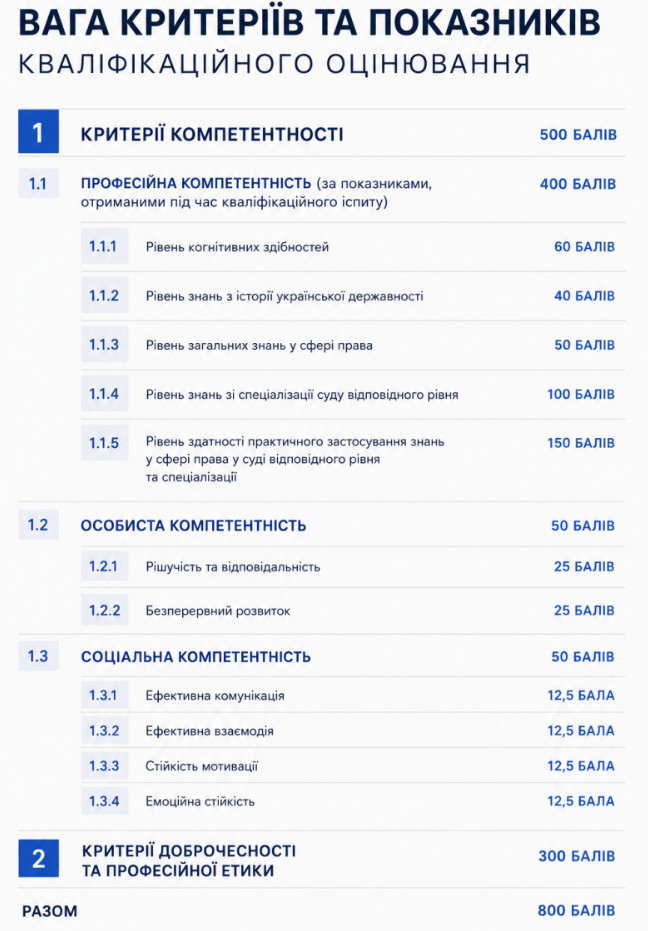
Based on the interview results, the HQCJ decides on confirming or not confirming the candidate’s ability to administer justice in the respective court and determines the candidate’s qualification assessment score, which simultaneously serves as the ranking score if the candidate’s ability to administer justice is confirmed.
9. Determination of Competition Winners
Competition winners are determined based on their ranking position according to the qualification assessment results.
10. Recommendation for Appointment of Candidates as Judges
The HQCJ submits a recommendation to the High Council of Justice for the appointment of the candidate who took the winning position in the ranking to the judge position.
Submission for Appointment
The High Council of Justice, based on the recommendation submitted by the High Qualification Commission of Judges of Ukraine, considers the issue of:
1) appointing the candidate to the judge position. If a positive decision is made, it submits a proposal to the President of Ukraine for appointing the judge to the position;
2) transferring a judge to another court.
The High Council of Justice refuses to submit a proposal to the President of Ukraine for appointing a judge to the position only on the following grounds:
1) existence of reasonable doubt regarding the candidate’s compliance with the criteria of integrity or professional ethics or other circumstances that may negatively affect public trust in the judiciary in connection with such appointment;
2) violation of the legally established procedure for appointment to the judge position.
Appointment to the Position
Appointment to the judge position is the final stage of the procedure for occupying a judicial position.
Appointment to the judge position is made by the President of Ukraine based on and within the submission of the High Council of Justice, without verifying compliance with the legal requirements for candidates for the judge position and the procedure for conducting selection or qualification assessment of candidates.
Subscribe to our Telegram channel t.me/sudua and to Google News SUD.UA, as well as to our VIBER and WhatsApp, Facebook page and Instagram to stay informed about the most important events.